Hellbender
Cryptobranchus alleganiensis
Quick answer
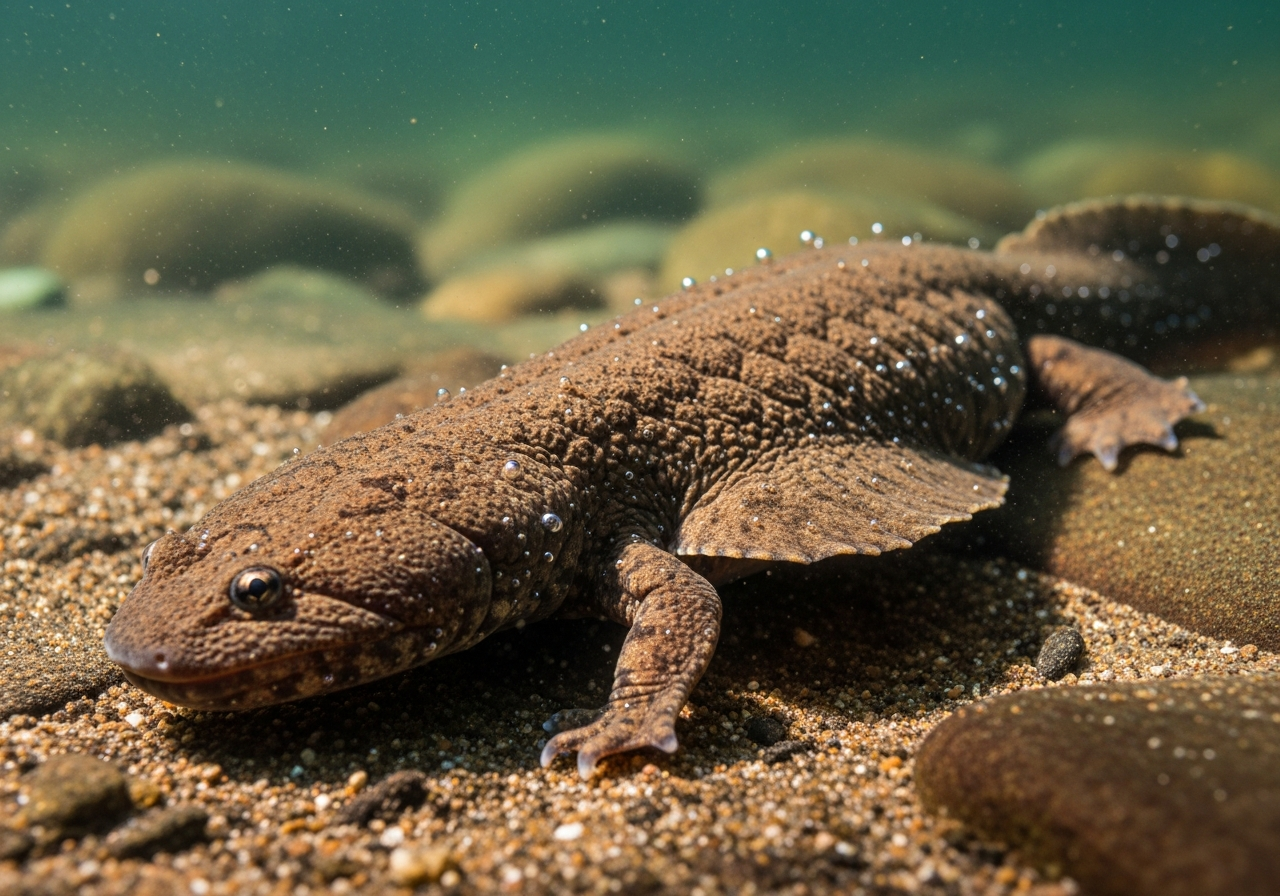
The hellbender is the largest salamander in North America, reaching up to 74 cm (29 in) long. It is fully aquatic, living its whole life in clean, fast-flowing streams where it breathes mainly through the wrinkled folds of its skin. Hellbenders are long-lived, often surviving 25 to 30 years.
Hellbender facts at a glance
| Scientific name | Cryptobranchus alleganiensis |
|---|---|
| Diet | Carnivore (crayfish, small fish) |
| Habitat | Clean, fast-flowing rocky streams and rivers |
| Lifespan | 25–30 years |
| Weight | Up to about 1.5 kg (3.3 lb) |
| Size | 30–74 cm (12–29 in) body length |
| Conservation status | Vulnerable (IUCN) |
| Kingdom | Animalia |
|---|---|
| Phylum | Chordata |
| Class | Amphibia |
| Order | Urodela |
| Family | Cryptobranchidae |
| Genus | Cryptobranchus |
Where it lives
Cool, clean, fast-flowing rivers of the eastern and central United States, especially the Appalachian region.
Behavior and breathing
Hellbenders are secretive, mostly nocturnal salamanders that hide by day under large flat rocks in the streambed. They are fully aquatic and absorb most of their oxygen directly through the heavily wrinkled folds of skin along their bodies, which increase surface area in cool, oxygen-rich water. They rarely leave the stream and rely on clean, flowing water to survive.
Diet and feeding
Hellbenders are carnivores whose diet is dominated by crayfish, along with small fish and aquatic insects. They hunt at night, using suction and a quick sideways snap of the jaws to capture prey. Healthy crayfish populations are essential to their survival.
Habitat and range
This giant salamander lives in cool, clear, fast-flowing rivers and streams of the eastern and central United States, particularly in the Appalachian region. It needs rocky stream bottoms with large flat stones for shelter and nesting. Because it breathes through its skin, it is extremely sensitive to silt and pollution.
Conservation
Hellbenders are listed as Vulnerable and have declined sharply across much of their range. The main threats are water pollution, siltation from erosion, dams, and disease, all of which degrade the clean streams they depend on. Captive breeding and stream restoration programs are working to recover populations.
Frequently asked questions about the Hellbender
How big do hellbenders get?
Hellbenders are the largest salamanders in North America, reaching up to about 74 cm (29 in) in length and weighing as much as 1.5 kg (3.3 lb).
How do hellbenders breathe?
Hellbenders breathe mainly through their skin. The loose, wrinkled folds along their body greatly increase surface area, letting them absorb oxygen directly from cool, fast-flowing water.
What do hellbenders eat?
Hellbenders are carnivores that feed mostly on crayfish, along with small fish and aquatic insects, hunting at night on the streambed.
Are hellbenders endangered?
Hellbenders are listed as Vulnerable by the IUCN and have declined across much of their range due to water pollution, siltation, dams, and disease.
Are hellbenders dangerous to people?
No. Despite their fearsome name and appearance, hellbenders are harmless to humans. They are not venomous and pose no threat; they are simply large, secretive stream salamanders.