Emperor Penguin
Aptenodytes forsteri
Quick answer
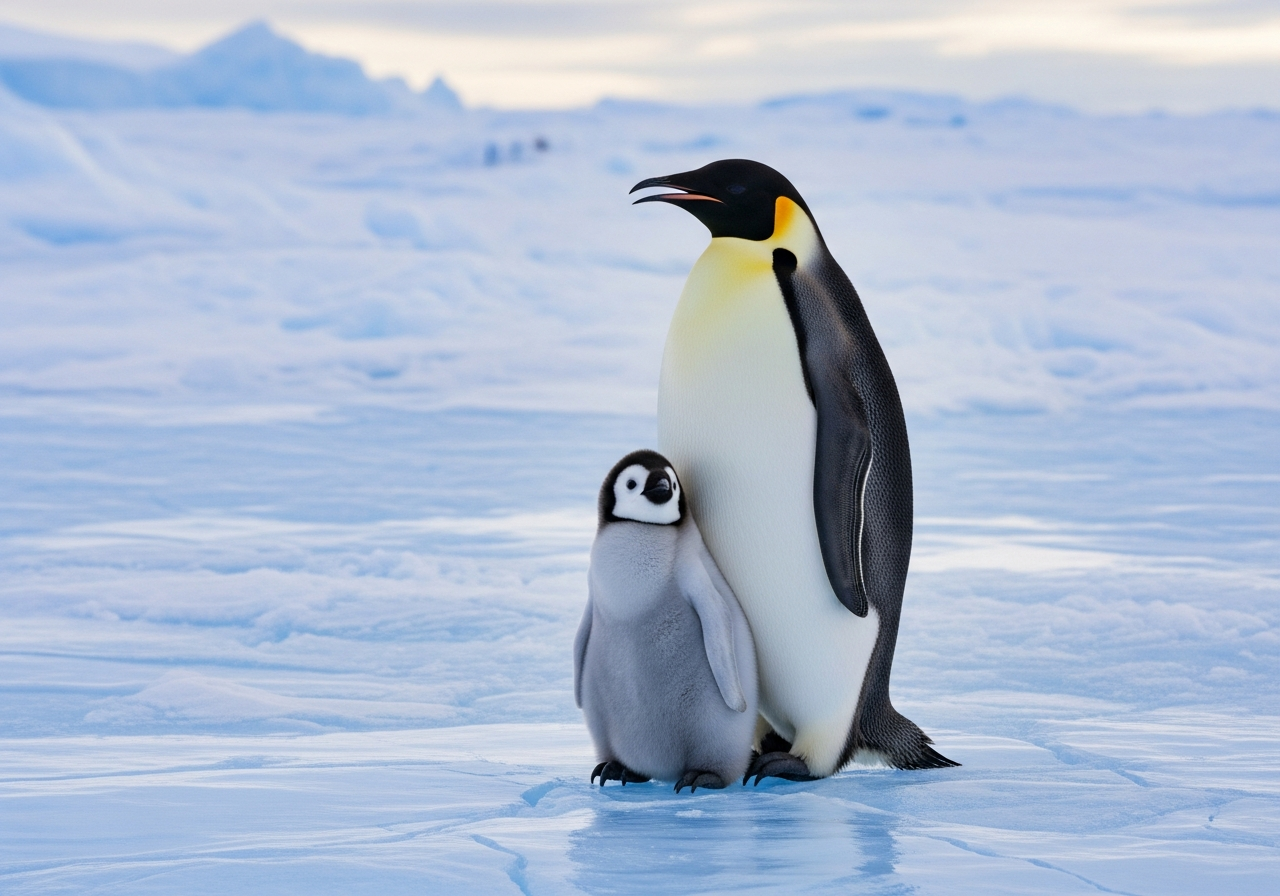
The emperor penguin is the tallest and heaviest penguin species, standing up to 1.2 m (4 ft). It is the only animal that breeds during the brutal Antarctic winter, where males incubate a single egg on their feet through months of darkness and temperatures below -40°C. Emperor penguins live around 20 years.
Emperor Penguin facts at a glance
| Scientific name | Aptenodytes forsteri |
|---|---|
| Diet | Carnivore (fish, krill, squid) |
| Habitat | Antarctic sea ice and surrounding ocean |
| Lifespan | ~20 years |
| Height | Up to 1.2 m (4 ft) |
| Dive depth | Up to 500 m (1,640 ft) |
| Conservation status | Near Threatened (IUCN) |
| Kingdom | Animalia |
|---|---|
| Phylum | Chordata |
| Class | Aves |
| Order | Sphenisciformes |
| Family | Spheniscidae |
| Genus | Aptenodytes |
Breeding in the cold
Emperor penguins are the only species that breeds during the Antarctic winter. After the female lays a single egg, she returns to the sea to feed while the male balances the egg on his feet under a flap of skin for about two months, fasting the entire time.
Surviving the freeze
To endure temperatures below -40°C and fierce winds, emperor penguins huddle together in dense groups, constantly rotating so each bird gets time in the warm center. This cooperative behavior is essential for survival and warmth.
Diving and feeding
Emperor penguins are exceptional divers, reaching depths of up to 500 m and staying underwater for more than 20 minutes while hunting fish, krill, and squid. Their solid bones and streamlined bodies make them powerful swimmers.
Conservation
Emperor penguins depend on stable sea ice to breed. Because climate change is reducing and destabilizing Antarctic ice, the species is increasingly threatened, and scientists warn that continued ice loss could sharply reduce their populations this century.
Frequently asked questions about the Emperor Penguin
How do emperor penguins survive the Antarctic winter?
Emperor penguins survive by huddling together in large groups and rotating positions so every bird shares time in the warm center. Their dense feathers and fat reserves also insulate them against extreme cold.
Do male or female penguins incubate the egg?
In emperor penguins, the male incubates the single egg. He balances it on his feet under a flap of skin for about two months while fasting, as the female feeds at sea.
What do emperor penguins eat?
Emperor penguins are carnivores that eat fish, krill, and squid. They dive deep into the ocean to hunt, sometimes reaching depths of 500 m.
How deep can emperor penguins dive?
Emperor penguins can dive up to 500 m (1,640 ft) deep and stay underwater for more than 20 minutes, making them the deepest-diving birds.
Are emperor penguins endangered?
Emperor penguins are listed as Near Threatened. Their reliance on stable sea ice makes them especially vulnerable to climate change and shrinking Antarctic ice.
How tall are emperor penguins?
Emperor penguins are the largest penguin species, standing up to about 1.2 m (4 ft) tall and weighing up to 45 kg (99 lb).