Humpback Whale
Megaptera novaeangliae
Quick answer
The humpback whale is a large baleen whale found in oceans worldwide, famous for its complex, haunting songs, spectacular breaching, and enormous wing-like flippers. Humpbacks can grow to 15 m (49 ft), migrate thousands of miles between feeding and breeding grounds, and live up to 80 years or more. Once hunted to the brink, they are now a conservation success story listed as Least Concern.
Humpback Whale facts at a glance
| Scientific name | Megaptera novaeangliae |
|---|---|
| Diet | Carnivore (krill and small fish) |
| Habitat | Oceans worldwide |
| Lifespan | Up to 80–90 years |
| Weight | 25,000–30,000 kg (28–33 tons) |
| Top speed | Up to 27 km/h (17 mph) |
| Conservation status | Least Concern (IUCN) |
| Kingdom | Animalia |
|---|---|
| Phylum | Chordata |
| Class | Mammalia |
| Order | Artiodactyla |
| Family | Balaenopteridae |
| Genus | Megaptera |
Where it lives
Every major ocean, migrating between polar feeding grounds and tropical breeding waters.
The whale that sings
Male humpbacks produce some of the longest and most complex songs in the animal kingdom, sequences of moans, cries, and whistles that can last 20 minutes and be repeated for hours. All the males in a population sing the same evolving song, which gradually changes from year to year, likely as part of breeding behavior.
Bubble-net feeding
Humpbacks are baleen whales that filter krill and small fish from the water. Groups use a remarkable cooperative technique called bubble-net feeding, blowing a spiraling curtain of bubbles to herd prey into a tight ball before lunging up through the middle with mouths wide open.
Migration and acrobatics
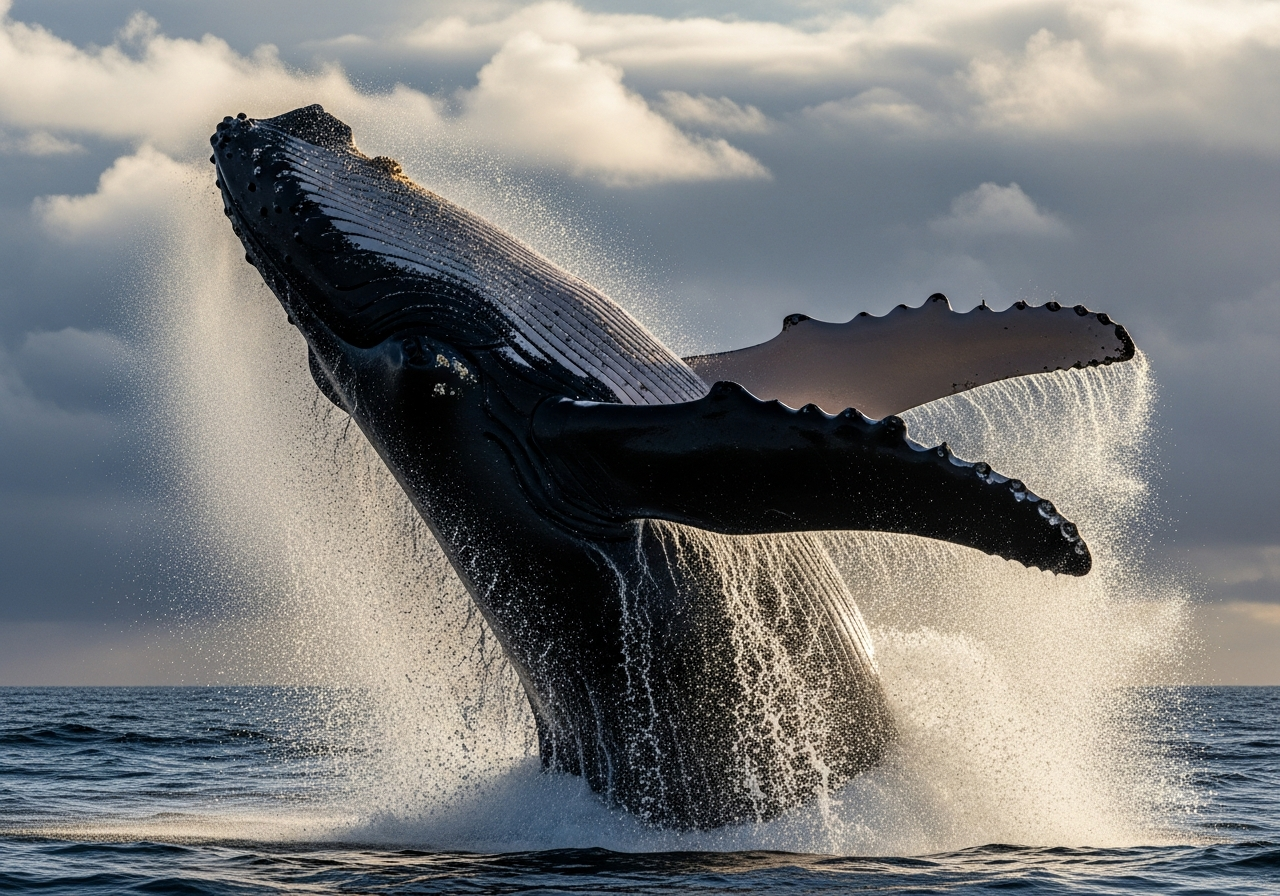
Humpbacks undertake some of the longest migrations of any mammal, traveling thousands of miles between cold, food-rich feeding grounds and warm breeding waters. They are famous for breaching, hurling their huge bodies out of the water, and for slapping the surface with their long flippers and tail.
Conservation
Commercial whaling drove humpbacks to the edge of extinction in the 20th century. Since an international hunting ban, most populations have rebounded strongly, and the species is now listed as Least Concern, a landmark conservation success. Ship strikes, entanglement, and noise pollution remain ongoing threats.
Frequently asked questions about the Humpback Whale
Why do humpback whales sing?
Mainly male humpbacks sing, most often on breeding grounds, so the songs are thought to play a role in attracting mates or competing with other males. All males in a population share the same slowly changing song.
What do humpback whales eat?
Humpbacks are baleen whales that feed on tiny krill and small schooling fish, filtering huge mouthfuls of water through their baleen plates, sometimes using cooperative bubble-net feeding.
How big do humpback whales get?
Humpback whales typically grow to about 14 to 15 m (46 to 49 ft) long and weigh around 30,000 kg (33 tons), with females slightly larger than males.
Why do humpback whales breach?
Humpbacks breach, leaping out of the water, for reasons that may include communication, dislodging parasites, or play. The huge splash can be seen and heard from far away.
Are humpback whales endangered?
No longer overall. After near-extinction from whaling, most humpback populations have recovered well and the species is now Least Concern, though ship strikes and entanglement remain threats.