Whale Shark
Rhincodon typus
Quick answer
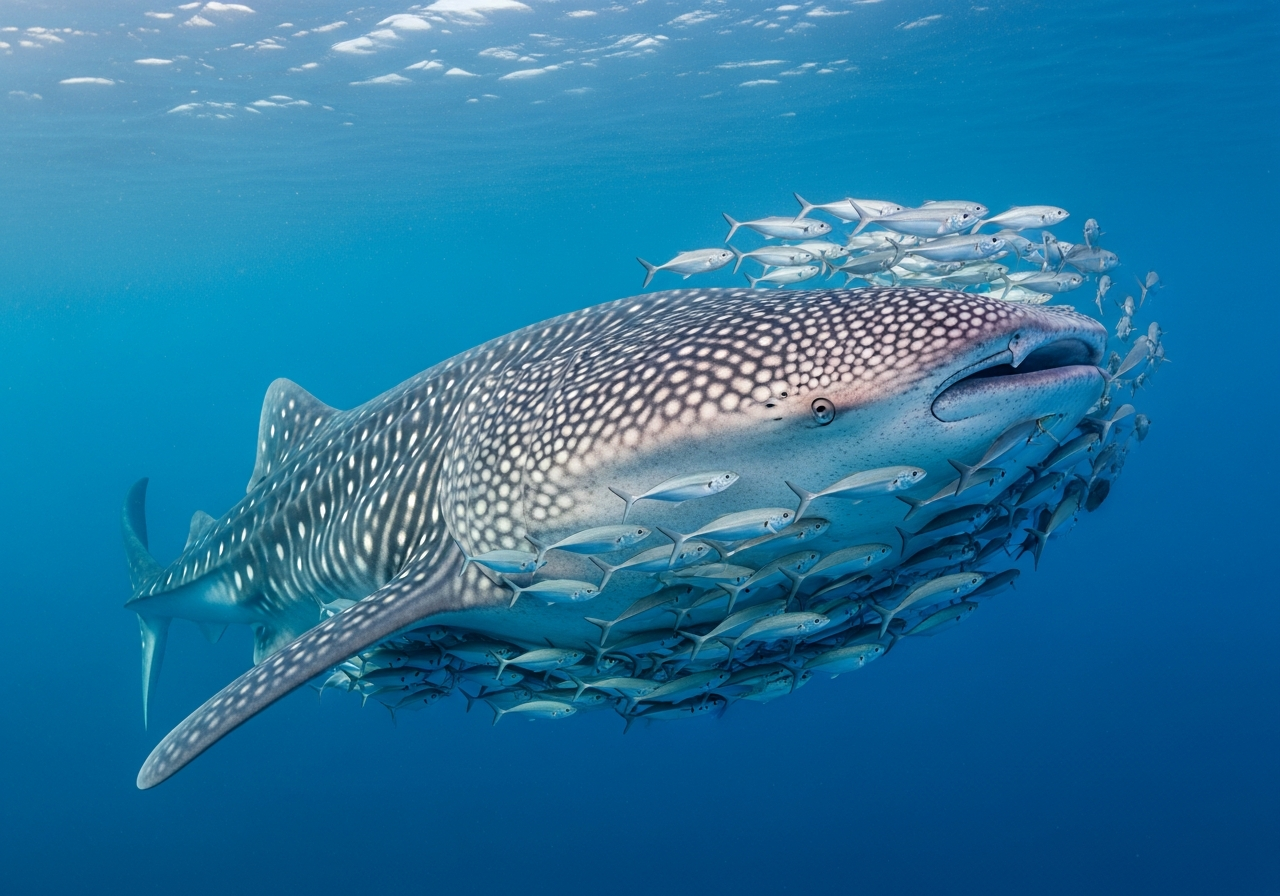
The whale shark is the largest fish on Earth, reaching up to about 18 meters (59 ft) long, yet it is a gentle filter feeder that poses no danger to people. It cruises warm oceans slowly with its enormous mouth open, straining tiny plankton and small fish from the water. Each whale shark has a unique pattern of white spots, like a fingerprint, that scientists use to identify individuals.
Whale Shark facts at a glance
| Scientific name | Rhincodon typus |
|---|---|
| Diet | Filter feeder (plankton, small fish) |
| Habitat | Warm open and coastal oceans |
| Lifespan | Estimated 70–100 years |
| Length | Up to about 18 m (59 ft) |
| Weight | Up to roughly 19,000 kg (42,000 lb) |
| Conservation status | Endangered (IUCN) |
| Kingdom | Animalia |
|---|---|
| Phylum | Chordata |
| Class | Chondrichthyes |
| Order | Orectolobiformes |
| Family | Rhincodontidae |
| Genus | Rhincodon |
Where it lives
Warm tropical and subtropical seas around the world, often at coastal feeding hotspots.
The biggest fish
The whale shark is the largest living fish and the largest non-mammal vertebrate, dwarfing every other shark. Despite its size, it is a slow, peaceful animal that swims at only a few kilometers per hour. Its broad, flat head ends in a mouth that can be over a meter wide.
Filter feeding
Whale sharks feed mostly on plankton, krill, fish eggs, and small fish. They feed by swimming forward with the mouth open or by hanging vertically and actively suction-feeding at dense food patches, filtering huge volumes of water through spongy pads in their gills. They have thousands of tiny teeth that play almost no role in feeding.
Habitat and migration
Whale sharks live in warm tropical and subtropical seas worldwide and undertake long migrations to follow seasonal plankton blooms. They gather in large numbers at a handful of feeding hotspots, which makes those sites important for both wildlife tourism and research. They can dive to great depths between visits to the surface.
Conservation
Whale sharks are listed as Endangered. They grow and reproduce slowly, so populations recover poorly, and they are threatened by fishing, ship strikes, and accidental capture. Their habit of feeding at the surface in predictable places makes them both easier to protect and more vulnerable to boat traffic.
Frequently asked questions about the Whale Shark
Is the whale shark a whale or a shark?
The whale shark is a true shark, not a whale. It is a fish that breathes through gills, and it gets its name from its whale-like size and filter-feeding habits.
Are whale sharks dangerous?
No. Whale sharks are gentle filter feeders that eat tiny plankton and small fish. They are harmless to humans and often let divers and snorkelers swim alongside them.
How big is the largest fish in the world?
The whale shark is the largest fish, reaching up to about 18 m (59 ft) long and weighing as much as 19,000 kg (42,000 lb), far larger than any other shark.
What do whale sharks eat?
Whale sharks are filter feeders that eat plankton, krill, fish eggs, and small fish. They strain food from huge volumes of seawater using spongy filter pads in their gills.
How long do whale sharks live?
Whale sharks are thought to live a very long time, with estimates ranging from about 70 to 100 years, though their slow growth makes exact ages hard to measure.