Ball Python
Python regius
Quick answer
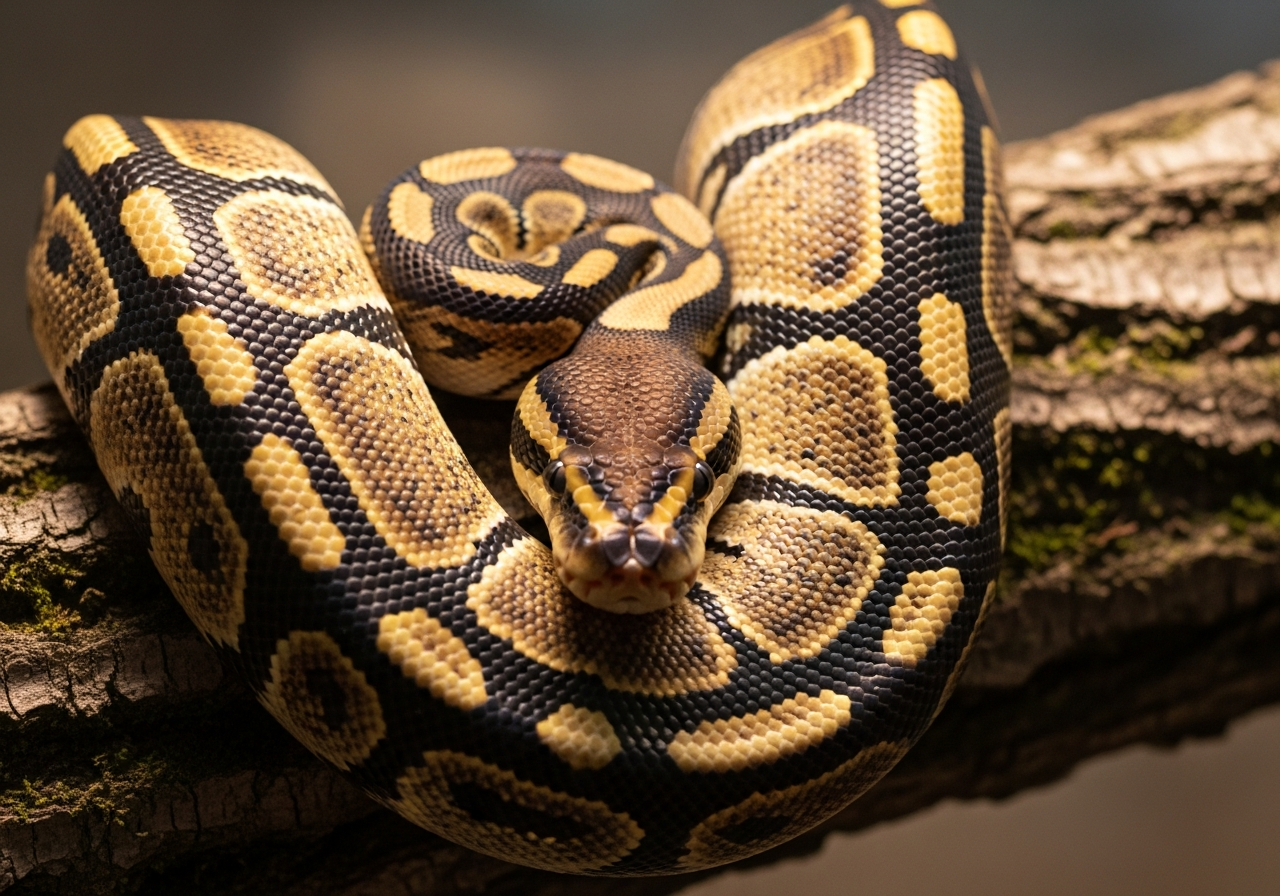
The ball python is a small, non-venomous constrictor from the grasslands and forests of West and Central Africa, named for its habit of curling into a tight ball when stressed. Docile and slow-moving, it is one of the most popular pet snakes in the world and comes in hundreds of color and pattern 'morphs'. Ball pythons are long-lived, often reaching 20 to 30 years in captivity.
Ball Python facts at a glance
| Scientific name | Python regius |
|---|---|
| Diet | Carnivore |
| Habitat | Grassland and open forest of West/Central Africa |
| Lifespan | 20–30 years in captivity |
| Length | 1–1.5 m (3–5 ft) |
| Top speed | Slow-moving |
| Conservation status | Near Threatened (IUCN) |
| Kingdom | Animalia |
|---|---|
| Phylum | Chordata |
| Class | Reptilia |
| Order | Squamata |
| Family | Pythonidae |
| Genus | Python |
Why the name?
When frightened, a ball python tucks its head into the center of its coils and rolls into a tight ball, protecting its most vulnerable part. This shy, defensive behavior, rather than biting, gives the snake its name and is a big reason it is considered easy and safe to keep.
A harmless constrictor
Ball pythons are non-venomous. They kill prey such as rodents by constriction, coiling around it and tightening until it can no longer breathe. To humans they are harmless and docile, and their calm temperament has made them one of the most kept snakes in the world.
Heat-sensing pits
Like other pythons, ball pythons have heat-sensing pits along the lips that detect the body warmth of nearby prey. Combined with a keen sense of smell, gathered by flicking the tongue, this lets them hunt small mammals effectively even in darkness.
Morphs and conservation
Selective breeding has produced hundreds of color and pattern variations called morphs, fueling a huge pet industry. In the wild, ball pythons are listed as Near Threatened, with collection for the pet and skin trades and habitat loss putting pressure on wild populations in West Africa.
Frequently asked questions about the Ball Python
Why is it called a ball python?
The ball python is named for its habit of curling into a tight ball, with its head tucked safely in the middle of its coils, when it feels stressed or threatened.
Are ball pythons venomous or dangerous?
No. Ball pythons are non-venomous constrictors and are harmless to humans. They are known for their docile, shy nature, which is why they are such popular pets.
What do ball pythons eat?
Ball pythons are carnivores that eat small mammals, mainly rodents such as mice and rats, killing them by constriction rather than venom.
How long do ball pythons live?
Ball pythons are long-lived snakes, commonly reaching 20 to 30 years in captivity, so they are a long-term commitment for an owner.
How big do ball pythons get?
Ball pythons are relatively small pythons, usually growing to about 1 to 1.5 m (3 to 5 ft), with females typically larger than males.