Chameleon
Chamaeleonidae
Quick answer
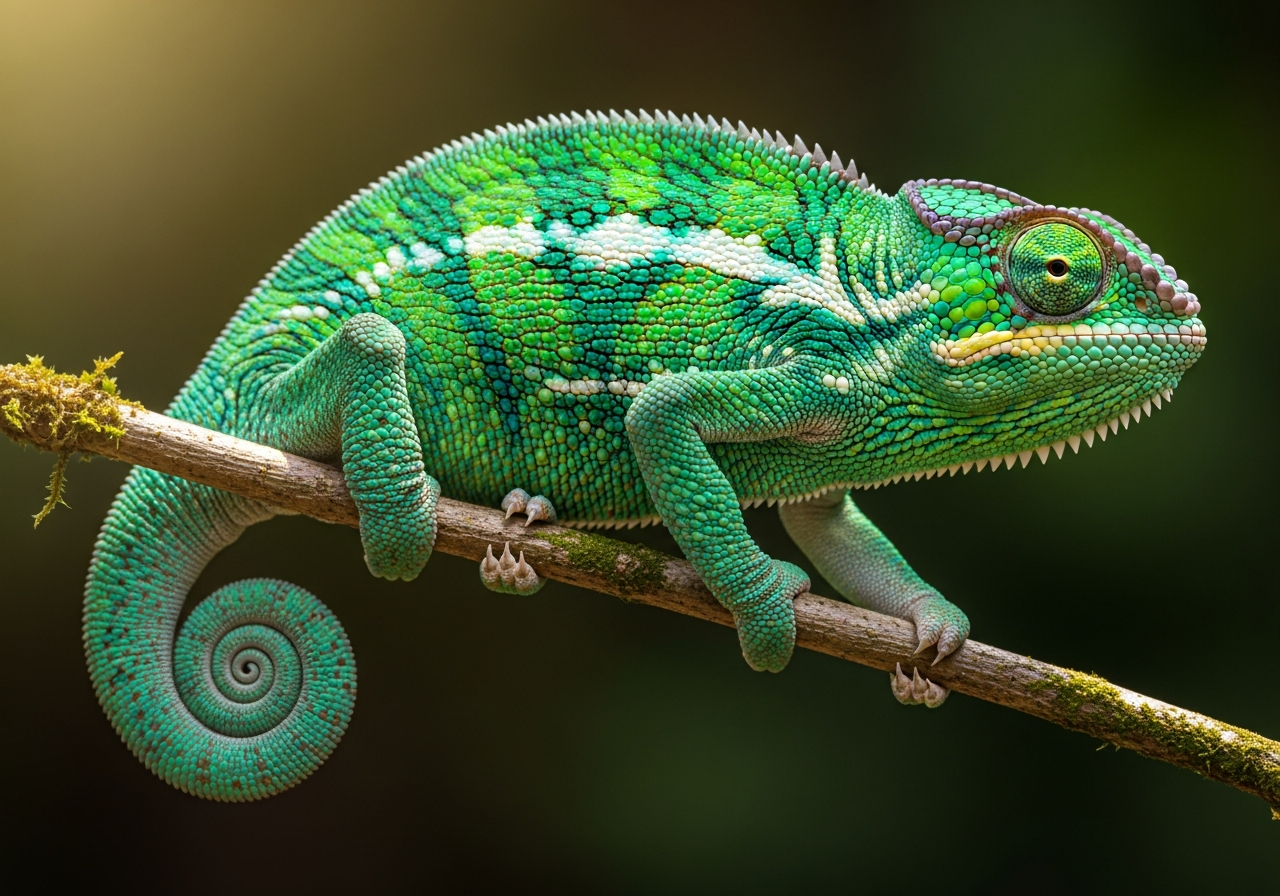
Chameleons are a family of tree-dwelling lizards, most famous for changing color and for eyes that swivel independently to give nearly 360-degree vision. Found mainly in Africa and Madagascar, they catch insects with a sticky, projectile tongue that can extend longer than their own body. There are over 200 species, and color change is used as much for communication and temperature as for camouflage.
Chameleon facts at a glance
| Scientific name | Chamaeleonidae (family) |
|---|---|
| Diet | Insectivore (mostly) |
| Habitat | Forest, savanna, and scrub |
| Lifespan | 3–10 years depending on species |
| Length | Up to 60 cm (24 in) in large species |
| Top speed | Slow and deliberate |
| Conservation status | Least Concern (varies by species) |
| Kingdom | Animalia |
|---|---|
| Phylum | Chordata |
| Class | Reptilia |
| Order | Squamata |
| Family | Chamaeleonidae |
How they change color
Chameleons change color not mainly by pigment but by adjusting microscopic crystals in their skin that reflect different wavelengths of light. They shift color to communicate mood, attract mates, intimidate rivals, and regulate temperature, darkening to absorb heat. Camouflage is only part of the story.
Independent eyes
A chameleon's turret-like eyes move independently of each other, letting it scan in two directions at once for nearly 360-degree vision. When it spots prey, both eyes lock forward together to judge distance with precision before the tongue strikes.
The explosive tongue
A chameleon hunts by firing out a sticky-tipped tongue that can be longer than its entire body, striking prey in a fraction of a second with remarkable accuracy. Special gripping feet and a prehensile tail that curls around branches make it a slow but sure-footed climber.
Diversity and conservation
There are more than 200 chameleon species, around half of them found only on the island of Madagascar, from giants over half a meter long to tiny species smaller than a fingernail. While many are listed as Least Concern, deforestation and the pet trade threaten a number of the more specialized species.
Frequently asked questions about the Chameleon
How do chameleons change color?
Chameleons change color mainly by adjusting tiny light-reflecting crystals in their skin rather than by pigment alone. They do this to signal mood, communicate, attract mates, and control their temperature, not just to camouflage.
Why can chameleons look in two directions at once?
A chameleon's eyes move independently, each in its own cone-shaped turret, giving nearly 360-degree vision so it can watch for prey and predators at the same time before focusing both eyes on a target.
How long is a chameleon's tongue?
A chameleon's tongue can extend to longer than its own body length and shoots out in a fraction of a second to snatch insects with its sticky tip.
What do chameleons eat?
Most chameleons are insectivores, eating insects such as crickets, locusts, and flies. Larger species may also take small birds or other lizards.
Where do chameleons live?
Chameleons live mainly in mainland Africa and on Madagascar, with some species in southern Europe, the Middle East, and parts of Asia, in habitats from rainforest to desert scrub.