Quick answer
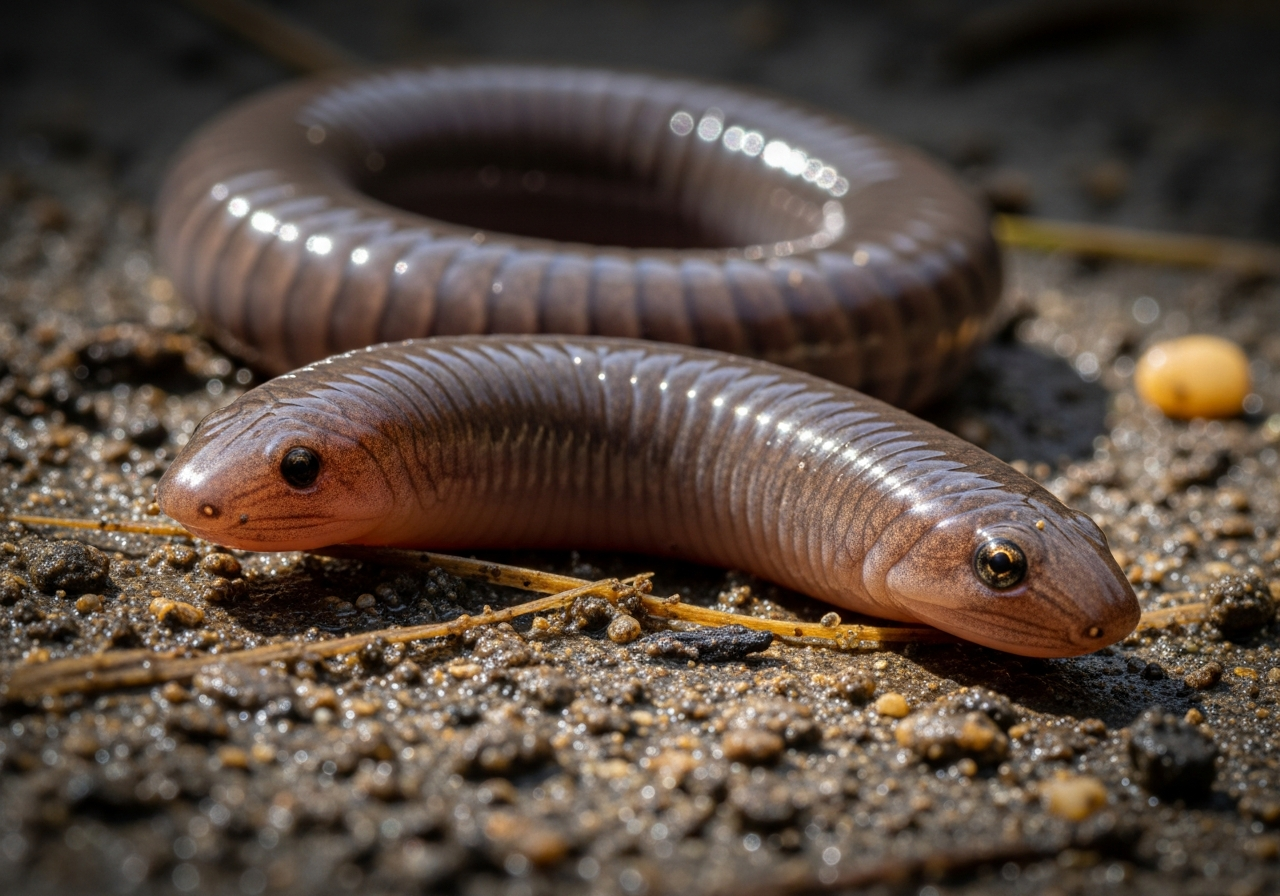
Caecilians are a group of limbless, worm-like amphibians that live mostly hidden in damp soil and leaf litter across the tropics of Africa, Asia, and the Americas. They range from a few centimeters to over 1.5 m (5 ft) long, have tiny or skin-covered eyes, and rely on a pair of sensory tentacles to find prey underground. Long-lived for amphibians, some caecilians survive well over a decade.
Top questions about the Caecilian
Caecilian facts at a glance
- Weight 100 g
- Length 40 cm
- Top speed 2 km/h
- Lifespan 12 years
| Scientific name | Gymnophiona |
|---|---|
| Diet | Carnivore (worms, insects, small invertebrates) |
| Habitat | Damp soil and leaf litter in the tropics |
| Lifespan | Often more than a decade |
| Length | From a few cm up to 1.5 m (5 ft) |
| Conservation status | Varies by species |
| Kingdom | Animalia |
|---|---|
| Phylum | Chordata |
| Class | Amphibia |
| Order | Gymnophiona |
Where it lives
The caecilian (Gymnophiona) is native to Damp soil and leaf litter across the wet tropics of Africa, Asia, and Central and South America. — recorded across Africa, Asia, South America in this guide’s range summary.
For occurrence records, see GBIF species search and sources below.
How big is a caecilian?
An adult caecilian measures 40 cm long — about 23% of the height of an average adult person (1.73 m) — and weighs around 100 g, a small fraction of an average adult’s body weight (70 kg).
Length vs an average adult’s height (to scale)
What is a baby caecilian called?
Baby name
A baby Caecilian is called a larva.
Explore more animal collective nouns and baby animal names .
Behavior and senses
Caecilians are secretive amphibians that spend most of their lives burrowing through moist soil and leaf litter, and a few species are fully aquatic. With no limbs, they move like worms or snakes, pushing through the ground with a strong, muscular body. Their eyes are tiny and often covered by skin or bone, so they navigate using a unique pair of retractable tentacles between the eyes and nostrils that detect chemicals and prey.
Diet and feeding
Caecilians are carnivores that eat earthworms, termites, insect larvae, and other small invertebrates found underground. They seize prey with strong jaws lined with backward-curving teeth and may spin to subdue it. Their underground lifestyle keeps them close to a steady supply of soil-dwelling animals.
Habitat and range
As a group, caecilians live across the wet tropics of Africa, Asia, and Central and South America, with none in most temperate regions. They favor warm, damp environments such as rainforest soil, riverbanks, and leaf litter. Because they live hidden underground or in water, they are rarely seen and remain among the least-known amphibians.
Reproduction and conservation
Caecilians have remarkable reproduction: some lay eggs while others give birth to live young, and in several species the young feed on a special layer of their mother's skin. As a diverse group their conservation status varies by species, with many too poorly known to assess, while some face threats from habitat loss. Their secretive habits mean scientists are still discovering new kinds.
Dig deeper into the Caecilian
- How Long Do Caecilians Live?
Caecilian lifespan is typically Often more than a decade. What shortens or extends life, life stages, and status (Least Concern).
- What Do Caecilians Eat?
What caecilians eat: Carnivore (worms, insects, small invertebrates), foraging style, and seasonal shifts in Damp soil and leaf litter in the tropics.
- Where Do Caecilians Live?
Where caecilians live: Damp soil and leaf litter in the tropics, native range cues, and human overlap. Status Least Concern.
Explore the Caecilian
Related Amphibians
Range & geography
Did you know? Caecilian facts
- Caecilians are a group of limbless, worm-like amphibians that live mostly hidden in damp soil and leaf litter across the tropics of Africa, Asia, and the Americas.
- A caecilian is a limbless, worm-like amphibian that lives mostly underground in damp tropical soil. Despite looking like worms or snakes, caecilians are amphibians, related to frogs and salamanders.
- Neither. Caecilians are amphibians that have evolved a long, limbless body for burrowing, which makes them resemble large earthworms or snakes, but they are not closely related to either.
- Caecilians are carnivores that eat earthworms, termites, insect larvae, and other small invertebrates they encounter in the soil, gripping prey with strong, toothed jaws.
- Only poorly. Their eyes are tiny and often covered by skin or bone, so instead of relying on sight they use a special pair of tentacles to sense chemicals and locate prey in the dark.
- Conservation: Varies by species.
Diet & feeding
Caecilian feeds primarily as a carnivore (worms, insects, small invertebrates). Caecilians are secretive amphibians that spend most of their lives burrowing through moist soil and leaf litter, and a few species are fully aquatic. With no limbs, they move like worms or snakes, pushing through the ground with a strong, m
Adaptations
- Caecilians are secretive amphibians that spend most of their lives burrowing through moist soil and leaf litter, and a few species are fully aquatic. With no limbs, they move like worms or snakes, pushing through the ground with a strong, muscular body. Their eyes are tiny and often covered by skin or bone, so they navigate using a unique pair of retractable tentacles between the eyes and nostrils that detect chemicals and prey.
- Caecilians are carnivores that eat earthworms, termites, insect larvae, and other small invertebrates found underground. They seize prey with strong jaws lined with backward-curving teeth and may spin to subdue it. Their underground lifestyle keeps them close to a steady supply of soil-dwelling animals.
Behaviour & ecology
- Caecilians are secretive amphibians that spend most of their lives burrowing through moist soil and leaf litter, and a few species are fully aquatic. With no limbs, they move like worms or snakes, pushing through the ground with a strong, muscular body. Their eyes are tiny and often covered by skin or bone, so they navigate using a unique pair of retractable tentacles between the eyes and nostrils that detect chemicals and prey.
- Caecilians are carnivores that eat earthworms, termites, insect larvae, and other small invertebrates found underground. They seize prey with strong jaws lined with backward-curving teeth and may spin to subdue it. Their underground lifestyle keeps them close to a steady supply of soil-dwelling animals.
- As a group, caecilians live across the wet tropics of Africa, Asia, and Central and South America, with none in most temperate regions. They favor warm, damp environments such as rainforest soil, riverbanks, and leaf litter. Because they live hidden underground or in water, they are rarely seen and remain among the least-known amphibians.
Communication
- Caecilian uses scent, posture, and vocal signals to mark territory and coordinate social behaviour.
- Communication intensity often peaks during breeding seasons and territorial disputes.
Habitat & range
Damp soil and leaf litter in the tropics
Ecological role
Caecilian acts as a predator that helps regulate prey populations and maintain balance in damp soil and leaf litter in the tropics.
Conservation status of the Caecilian
The caecilian (Gymnophiona) is listed as Least Concern on the IUCN Red List. Least Concern (LC) is the IUCN's lowest-risk category, assigned to widespread, abundant species that have been evaluated and found not to be threatened. It does not mean a species faces no pressures — only that it is not currently at risk of extinction.
The caecilian (Gymnophiona) is assessed on the IUCN Red List. Look up on the IUCN Red List .
Frequently asked questions about the Caecilian
What is a caecilian?
A caecilian is a limbless, worm-like amphibian that lives mostly underground in damp tropical soil. Despite looking like worms or snakes, caecilians are amphibians, related to frogs and salamanders.
Are caecilians worms or snakes?
Neither. Caecilians are amphibians that have evolved a long, limbless body for burrowing, which makes them resemble large earthworms or snakes, but they are not closely related to either.
What do caecilians eat?
Caecilians are carnivores that eat earthworms, termites, insect larvae, and other small invertebrates they encounter in the soil, gripping prey with strong, toothed jaws.
Can caecilians see?
Only poorly. Their eyes are tiny and often covered by skin or bone, so instead of relying on sight they use a special pair of tentacles to sense chemicals and locate prey in the dark.
Where do caecilians live?
They live in the wet tropics of Africa, Asia, and Central and South America, in damp soil, leaf litter, and riverbanks, where they stay hidden most of the time.
Do caecilians care for their young?
Yes, in some species. The young of certain caecilians feed on a nutrient-rich outer layer of their mother's skin, an unusual form of parental care among amphibians.
What is a baby caecilian called?
A baby Caecilian is called a larva.
Sources & references
This guide is compiled and reviewed against established zoological and conservation references. Key sources for the Caecilian:
-
IUCN Red List of Threatened Species
Conservation status (Least Concern) reflects the IUCN Red List category for Gymnophiona.
-
iNaturalist — observations & photos
Search citizen-science observations and community IDs for Gymnophiona. Useful for range checks and recent sightings — not a substitute for formal Red List status.
-
GBIF — occurrence data
Global Biodiversity Information Facility species search for Gymnophiona. Explore published occurrence records used in range research.
- IUCN Red List — Gymnophiona.
Conservation status (Least Concern) and population trends.
- Wikipedia — Caecilian.
General taxonomy and overview (cross-check primary sources).
-
Global Animal Guide editorial standards
How we research, source, review, and update every guide for accuracy.