Quick answer
Cicadas are large sap-feeding insects of the family Cicadidae, famous for the loud song of the males and for spending most of their lives underground. Adults are 2 to 5 cm (0.8 to 2 in) long, fly on clear membranous wings, and feed on plant sap. Nymphs live underground for years, while adults survive only a few weeks. They are found in forests and grasslands worldwide.
Top questions about the Cicada
Cicada facts at a glance
- Weight 2 g
- Length 4 cm
- Top speed 5 km/h
- Lifespan 1 years
| Scientific name | Family Cicadidae |
|---|---|
| Diet | Herbivore (plant sap) |
| Habitat | Forests and grasslands worldwide |
| Lifespan | Nymphs years underground; adults a few weeks |
| Length | 2–5 cm (0.8–2 in) depending on species |
| Sound | Among the loudest of all insects |
| Conservation status | Varies by species |
| Kingdom | Animalia |
|---|---|
| Phylum | Arthropoda |
| Class | Insecta |
| Order | Hemiptera |
| Family | Cicadidae |
Where it lives
The cicada (Cicadidae) is native to Forests and grasslands worldwide; known for the loud summer song of the males. — recorded across Africa, Asia, Europe, North America, South America, Oceania in this guide’s range summary.
For occurrence records, see GBIF species search and sources below.
How big is a cicada?
An adult cicada measures 4 cm long — about 2% of the height of an average adult person (1.73 m) — and weighs around 2 g, a small fraction of an average adult’s body weight (70 kg).
Length vs an average adult’s height (to scale)
What is a group of cicadas called?
Group name (collective noun)
A group of Cicadas is called a cloud. It is also known as a plague or a swarm.
Baby name
A baby Cicada is called a nymph.
Explore more animal collective nouns and baby animal names .
Appearance and identification
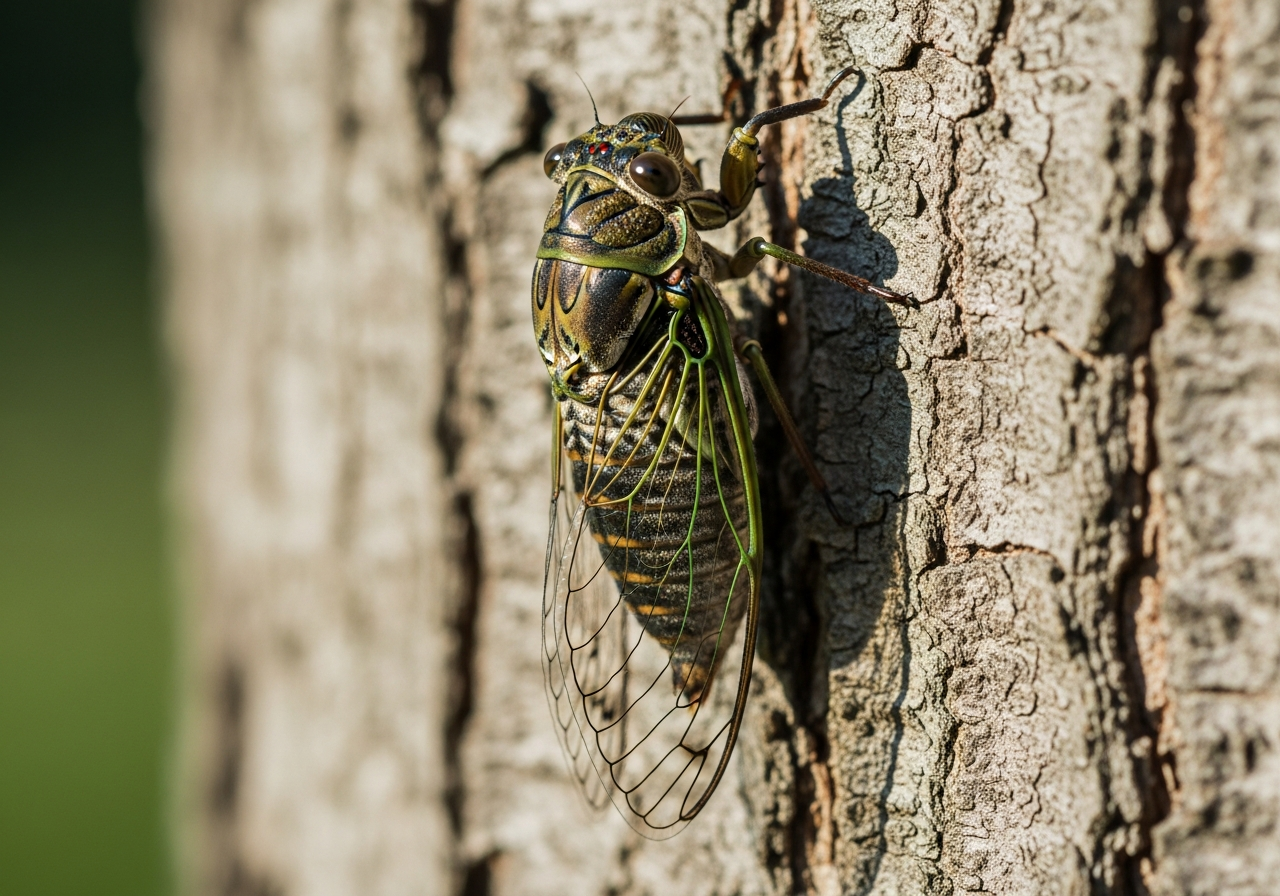
Cicadas are stout, broad-headed insects measuring 2 to 5 cm (0.8 to 2 in) long depending on the species, with prominent bulging eyes set wide apart. They have two pairs of clear, well-veined membranous wings that are held roof-like over the body at rest. Many species are green, brown, or black, sometimes with striking red or gold eyes. Adults are strong fliers but clumsy, and are often heard long before they are seen.
The famous song
Male cicadas produce one of the loudest sounds of any insect using paired ribbed membranes called tymbals on the sides of the abdomen. Muscles buckle these membranes rapidly in and out, and the largely hollow abdomen amplifies the clicks into a continuous, penetrating call. The song is used mainly to attract females, and different species have distinct calls so that mates find the right partner. In large choruses the combined sound can be intense enough to be uncomfortable at close range.
Life cycle underground
Cicadas spend the great majority of their lives as nymphs living underground, where they feed on sap from plant roots. Depending on the species this stage lasts from a couple of years to many years, and some North American periodical cicadas emerge together after 13 or 17 years. When ready, the nymphs dig to the surface, climb a plant or tree, and moult into winged adults, leaving behind the familiar empty shell. The adult stage that follows lasts only a few weeks.
Diet and feeding
Both nymphs and adults are herbivores that feed on plant sap rather than solid food. Using needle-like mouthparts, nymphs draw sap from roots underground, while adults feed on the fluids of twigs and branches. Because the sap is watery and low in nutrients, cicadas process large volumes and are not considered serious pests of crops in most cases. Their feeding and egg-laying can, however, cause minor damage to young twigs.
Predators and defence
Cicadas are eaten by birds, small mammals, reptiles, and predatory insects, and they have few active defences beyond flight and camouflage. Periodical species rely on a strategy of overwhelming numbers, emerging all at once so that predators cannot possibly eat them all before they breed. A specialised wasp known as the cicada killer hunts them to provision its nest. When handled, adults may emit a sharp distress squawk and take off quickly.
Dig deeper into the Cicada
- Cicada: Key Facts
Cicadas (Cicadidae) are insects found across Africa, Asia, Europe, North America, South America, Oceania.
- What Do Cicadas Eat?
What cicadas eat: Herbivore (plant sap), foraging style, and seasonal shifts in Forests and grasslands worldwide.
- Where Do Cicadas Live?
Where cicadas live: Forests and grasslands worldwide, native range cues, and human overlap. Status Least Concern.
Explore the Cicada
Related Insects
Did you know? Cicada facts
- Cicadas are large insects best known for the loud buzzing song of the males, which is among the loudest sounds made by any insect.
- Male cicadas vibrate ribbed membranes called tymbals on their abdomen, and the mostly hollow abdomen amplifies the sound. The song attracts females and can exceed 100 decibels in some species.
- Cicadas spend most of their lives as nymphs underground, from a couple of years to many years, while the winged adults live only a few weeks. Periodical species famously emerge after 13 or 17 years.
- Cicadas feed on plant sap throughout their lives. Nymphs drink sap from plant roots underground, while adults feed on sap from stems and twigs.
- Cicadas are harmless to people and do not bite or sting. They cause little damage to healthy plants, though heavy egg-laying can harm the twigs of young trees.
- Conservation: Varies by species.
Diet & feeding
Cicada feeds primarily as a herbivore (plant sap). Cicadas spend most of their lives as nymphs living underground, where they feed on sap from plant roots. This stage can last from a couple of years to many years depending on the species. When ready, the nymphs dig their way to the surface, climb a tree or stem, and mo
Adaptations
- Male cicadas produce their loud song using special membranes called tymbals on the sides of the abdomen, which they vibrate rapidly. The largely hollow abdomen acts as a resonating chamber, amplifying the sound, which in some species exceeds 100 decibels. The song is used to attract females, and choruses of many males can fill a summer landscape with noise.
- Cicadas spend most of their lives as nymphs living underground, where they feed on sap from plant roots. This stage can last from a couple of years to many years depending on the species. When ready, the nymphs dig their way to the surface, climb a tree or stem, and molt into winged adults, leaving behind their empty shells.
Behaviour & ecology
- Male cicadas produce their loud song using special membranes called tymbals on the sides of the abdomen, which they vibrate rapidly. The largely hollow abdomen acts as a resonating chamber, amplifying the sound, which in some species exceeds 100 decibels. The song is used to attract females, and choruses of many males can fill a summer landscape with noise.
- Cicadas spend most of their lives as nymphs living underground, where they feed on sap from plant roots. This stage can last from a couple of years to many years depending on the species. When ready, the nymphs dig their way to the surface, climb a tree or stem, and molt into winged adults, leaving behind their empty shells.
- Some North American cicadas are periodical, emerging together in enormous numbers after either 13 or 17 years underground. These synchronized emergences flood the area with so many cicadas that predators cannot eat them all, a survival strategy known as predator satiation. Annual cicadas, by contrast, appear every summer in smaller numbers.
Communication
- Cicada uses scent, posture, and vocal signals to mark territory and coordinate social behaviour.
- Communication intensity often peaks during breeding seasons and territorial disputes.
Habitat & range
Forests and grasslands worldwide
Ecological role
Cicada shapes vegetation through grazing or browsing and serves as prey for larger predators where ranges overlap.
Conservation status of the Cicada
The cicada (Cicadidae) is listed as Least Concern on the IUCN Red List. Least Concern (LC) is the IUCN's lowest-risk category, assigned to widespread, abundant species that have been evaluated and found not to be threatened. It does not mean a species faces no pressures — only that it is not currently at risk of extinction.
The cicada (Cicadidae) is assessed on the IUCN Red List. Look up on the IUCN Red List .
Frequently asked questions about the Cicada
Why are cicadas so loud?
Male cicadas make sound with ribbed membranes called tymbals on the abdomen, which they buckle rapidly while the hollow abdomen amplifies the noise. The call attracts females, and large choruses rank among the loudest sounds made by any insect.
How long do cicadas live?
Cicadas spend most of their lives as nymphs underground, which can last from a few years up to 13 or 17 years in periodical species. The winged adults that emerge live only a few weeks.
What do cicadas eat?
Cicadas are herbivores that feed on plant sap. Nymphs draw sap from roots underground, while adults feed on the fluids of twigs and branches using needle-like mouthparts.
Do cicadas bite or sting?
Cicadas do not bite or sting and are harmless to people. Their mouthparts are built for piercing plants to feed on sap, not for defence.
Why do periodical cicadas emerge every 13 or 17 years?
Emerging together after 13 or 17 years floods the area with so many cicadas that predators cannot eat them all, ensuring many survive to breed. The long, prime-numbered cycles are also thought to make it harder for predators to sync with them.
Are cicadas the same as locusts?
No. Cicadas are a separate group of sap-feeding insects and do not swarm to destroy crops. Locusts are a type of grasshopper, and the two are often confused only because of the noise and large numbers of emerging cicadas.
What is a group of cicadas called?
A group of Cicadas is called a cloud. It is also known as a plague or a swarm.
What is a baby cicada called?
A baby Cicada is called a nymph.
Sources & references
This guide is compiled and reviewed against established zoological and conservation references. Key sources for the Cicada:
-
IUCN Red List of Threatened Species
Conservation status (Least Concern) reflects the IUCN Red List category for Cicadidae.
-
iNaturalist — observations & photos
Search citizen-science observations and community IDs for Cicadidae. Useful for range checks and recent sightings — not a substitute for formal Red List status.
-
GBIF — occurrence data
Global Biodiversity Information Facility species search for Cicadidae. Explore published occurrence records used in range research.
- IUCN Red List — Cicadidae.
Conservation status (Least Concern) and population trends.
- Wikipedia — Cicada.
General taxonomy and overview (cross-check primary sources).
-
Global Animal Guide editorial standards
How we research, source, review, and update every guide for accuracy.