Quick answer
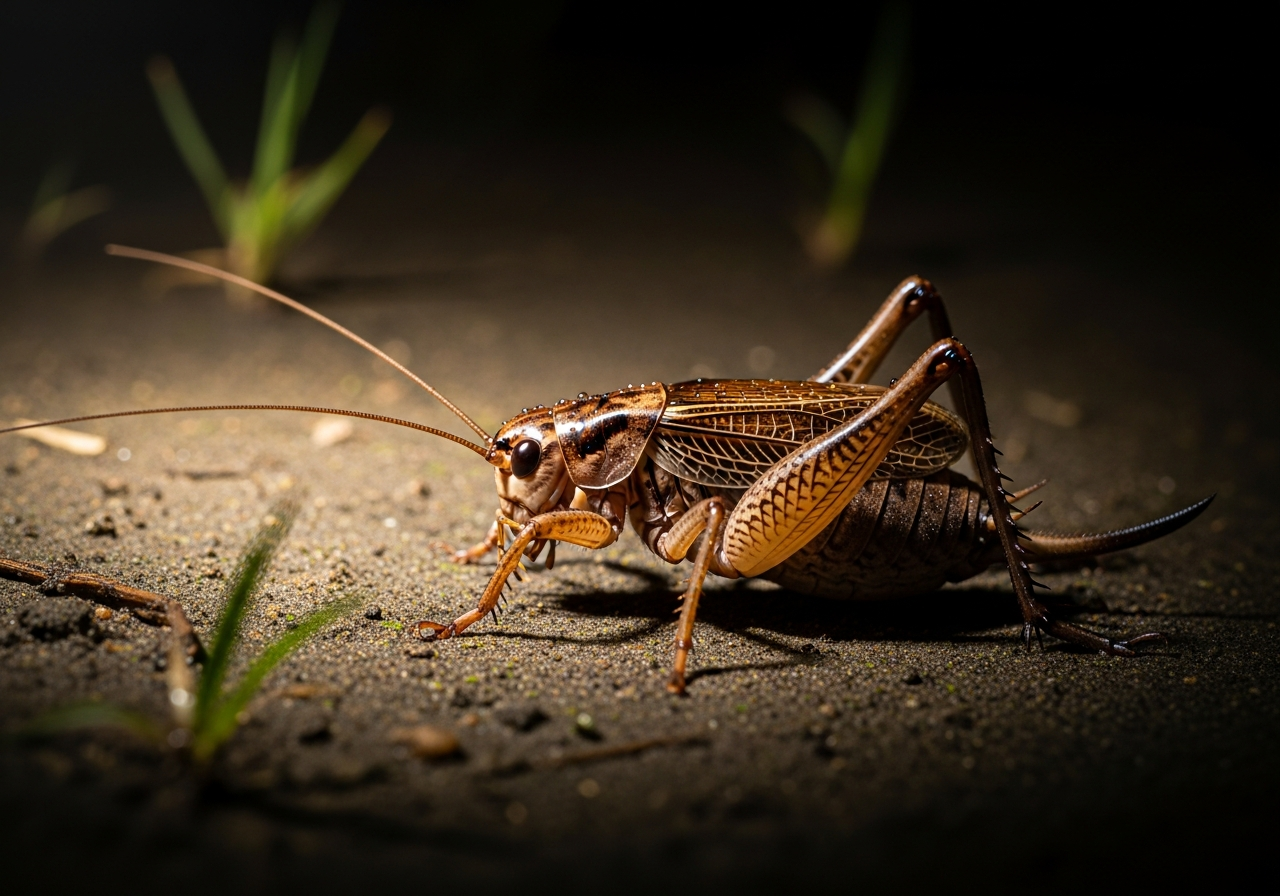
Crickets are jumping insects closely related to grasshoppers, best known for the chirping sound males make to attract mates. They are mostly active at night and feed on plants, fungi, and small insects. Crickets are also widely raised as food for pets and, increasingly, for people. Most live for about a year or less.
Top questions about the Cricket
Cricket facts at a glance
- Weight 1 g
- Length 3 cm
- Top speed 5 km/h
- Lifespan 1 years
| Scientific name | Family Gryllidae |
|---|---|
| Diet | Omnivore (plants, fungi, small insects) |
| Habitat | Grasslands, forests, gardens, buildings |
| Lifespan | About 1 year or less |
| Size | About 1–5 cm depending on species |
| Sound | Males chirp by rubbing their wings |
| Conservation status | Least Concern (IUCN) |
| Kingdom | Animalia |
|---|---|
| Phylum | Arthropoda |
| Class | Insecta |
| Order | Orthoptera |
| Family | Gryllidae |
Where it lives
The cricket (Gryllidae) is native to Grasslands, forests, and gardens across warmer regions of the world, on every continent except Antarctica. — recorded across Africa, Asia, Europe, North America, South America, Oceania in this guide’s range summary.
For occurrence records, see GBIF species search and sources below.
How big is a cricket?
An adult cricket measures 3 cm long — about 1% of the height of an average adult person (1.73 m) — and weighs around 1 g, a small fraction of an average adult’s body weight (70 kg).
Length vs an average adult’s height (to scale)
What is a group of crickets called?
Group name (collective noun)
A group of Crickets is called a swarm.
Baby name
A baby Cricket is called a nymph.
Explore more animal collective nouns and baby animal names .
The familiar chirp
The chirping associated with crickets is made mostly by males, who rub a sharp edge on one wing against a rough surface on the other, a process called stridulation. The calls attract females and warn off rival males. Because chirping rate rises with temperature, the calls can even give a rough sense of how warm it is.
Diet and behavior
Crickets are omnivores that eat plant matter, fungi, and small insects, scavenging a wide range of foods. They are mostly active at night, hiding by day under stones, logs, or vegetation. Like their grasshopper relatives, crickets have strong hind legs and can jump to escape danger.
Crickets and people
Crickets are raised in large numbers as a reliable food source for pet reptiles, amphibians, and birds, and they are increasingly farmed as a protein source for human food in some regions. In several cultures their chirping is seen as a pleasant sound or even a sign of good luck.
Life cycle and habitat
Crickets develop through incomplete metamorphosis, hatching as nymphs that resemble small wingless adults and molting as they grow. They live in grasslands, forests, gardens, and sometimes inside buildings, and are found across much of the world in warmer climates.
Dig deeper into the Cricket
- Cricket: Key Facts
Crickets are jumping insects closely related to grasshoppers, best known for the chirping sound males make to attract mates.
- What Do Crickets Eat?
What crickets eat: Omnivore (plants, fungi, small insects), foraging style, and seasonal shifts in Grasslands, forests, gardens, buildings.
- Where Do Crickets Live?
Where crickets live: Grasslands, forests, gardens, buildings, native range cues, and human overlap. Status Least Concern.
Explore the Cricket
Related Insects
Did you know? Cricket facts
- Crickets are jumping insects closely related to grasshoppers, best known for the chirping sound males make to attract mates.
- Male crickets chirp to attract females and to ward off other males. They make the sound by rubbing their wings together, a process called stridulation.
- Crickets are omnivores that eat plant material, fungi, and small insects. They are scavengers that will feed on a wide variety of organic matter.
- Most crickets live for about a year or less. They hatch as nymphs, grow through several molts, and the adults usually die off after the breeding season.
- Yes. Crickets are edible and are farmed as a protein source for people in some parts of the world. They are also widely raised as food for pet reptiles, amphibians, and birds.
- Conservation: Least Concern (IUCN).
Diet & feeding
Cricket feeds primarily as a omnivore (plants, fungi, small insects). Crickets are omnivores that eat plant matter, fungi, and small insects, scavenging a wide range of foods. They are mostly active at night, hiding by day under stones, logs, or vegetation. Like their grasshopper relatives, crickets have strong hind le
Adaptations
- The chirping associated with crickets is made mostly by males, who rub a sharp edge on one wing against a rough surface on the other, a process called stridulation. The calls attract females and warn off rival males. Because chirping rate rises with temperature, the calls can even give a rough sense of how warm it is.
- Crickets are omnivores that eat plant matter, fungi, and small insects, scavenging a wide range of foods. They are mostly active at night, hiding by day under stones, logs, or vegetation. Like their grasshopper relatives, crickets have strong hind legs and can jump to escape danger.
Behaviour & ecology
- The chirping associated with crickets is made mostly by males, who rub a sharp edge on one wing against a rough surface on the other, a process called stridulation. The calls attract females and warn off rival males. Because chirping rate rises with temperature, the calls can even give a rough sense of how warm it is.
- Crickets are omnivores that eat plant matter, fungi, and small insects, scavenging a wide range of foods. They are mostly active at night, hiding by day under stones, logs, or vegetation. Like their grasshopper relatives, crickets have strong hind legs and can jump to escape danger.
- Crickets are raised in large numbers as a reliable food source for pet reptiles, amphibians, and birds, and they are increasingly farmed as a protein source for human food in some regions. In several cultures their chirping is seen as a pleasant sound or even a sign of good luck.
Communication
- Cricket uses scent, posture, and vocal signals to mark territory and coordinate social behaviour.
- Communication intensity often peaks during breeding seasons and territorial disputes.
Habitat & range
Grasslands, forests, gardens, buildings
Ecological role
Cricket participates in pollination, decomposition, or prey-base support for birds and other insectivores.
Conservation status of the Cricket
The cricket (Gryllidae) is listed as Least Concern on the IUCN Red List. Least Concern (LC) is the IUCN's lowest-risk category, assigned to widespread, abundant species that have been evaluated and found not to be threatened. It does not mean a species faces no pressures — only that it is not currently at risk of extinction.
The cricket (Gryllidae) is assessed on the IUCN Red List. Look up on the IUCN Red List .
Frequently asked questions about the Cricket
Why do crickets chirp?
Male crickets chirp to attract females and to ward off other males. They make the sound by rubbing their wings together, a process called stridulation.
What do crickets eat?
Crickets are omnivores that eat plant material, fungi, and small insects. They are scavengers that will feed on a wide variety of organic matter.
How long do crickets live?
Most crickets live for about a year or less. They hatch as nymphs, grow through several molts, and the adults usually die off after the breeding season.
Can you eat crickets?
Yes. Crickets are edible and are farmed as a protein source for people in some parts of the world. They are also widely raised as food for pet reptiles, amphibians, and birds.
Do crickets bite?
Large crickets can give a small nip if handled, but they are harmless to people. They have no venom and rely on jumping to escape rather than biting in defense.
What is the difference between a cricket and a grasshopper?
Crickets and grasshoppers are related jumping insects, but crickets usually have longer antennae, are active mainly at night, and chirp by rubbing their wings, while grasshoppers are active by day and rub a leg against a wing.
What is a group of crickets called?
A group of Crickets is called a swarm.
What is a baby cricket called?
A baby Cricket is called a nymph.
Sources & references
This guide is compiled and reviewed against established zoological and conservation references. Key sources for the Cricket:
-
IUCN Red List of Threatened Species
Conservation status (Least Concern) reflects the IUCN Red List category for Gryllidae.
-
iNaturalist — observations & photos
Search citizen-science observations and community IDs for Gryllidae. Useful for range checks and recent sightings — not a substitute for formal Red List status.
-
GBIF — occurrence data
Global Biodiversity Information Facility species search for Gryllidae. Explore published occurrence records used in range research.
- IUCN Red List — Gryllidae.
Conservation status (Least Concern) and population trends.
- Wikipedia — Cricket.
General taxonomy and overview (cross-check primary sources).
-
Global Animal Guide editorial standards
How we research, source, review, and update every guide for accuracy.