Quick answer
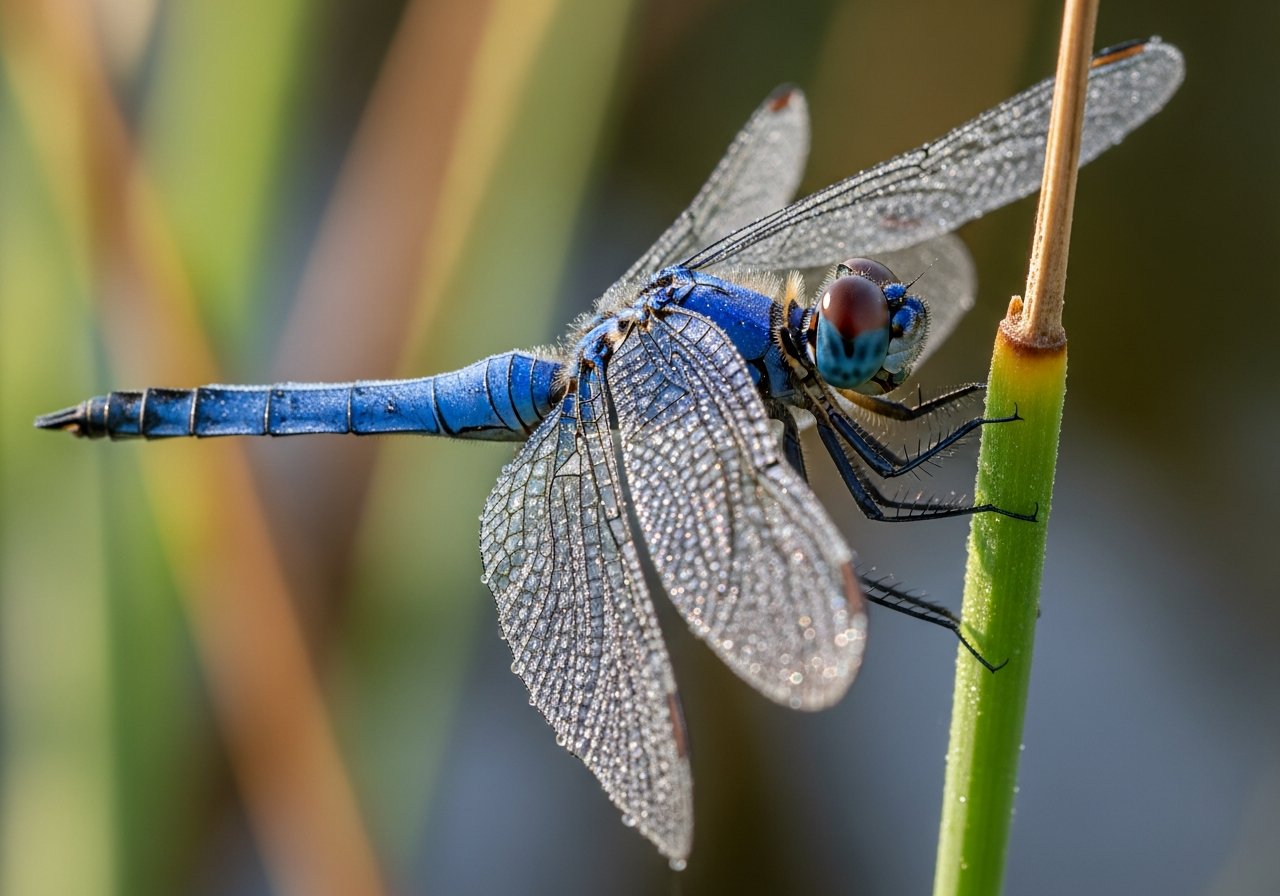
Dragonflies are fast, agile flying insects with long bodies, huge eyes, and two pairs of transparent wings. They are skilled aerial predators that catch other insects in mid-air, and they spend most of their lives as aquatic larvae before becoming adults. Adult dragonflies usually live only a few weeks to a few months.
Top questions about the Dragonfly
Dragonfly facts at a glance
- Weight 1 g
- Length 7 cm
- Top speed 50 km/h
- Lifespan 0.5 years
| Scientific name | Suborder Anisoptera |
|---|---|
| Diet | Carnivore (flying insects) |
| Habitat | Ponds, lakes, rivers, wetlands |
| Lifespan | Adults a few weeks to months; larvae up to years |
| Size | Wingspan 2–13 cm depending on species |
| Top speed | Up to ~50 km/h (30 mph) |
| Conservation status | Least Concern (IUCN) |
| Kingdom | Animalia |
|---|---|
| Phylum | Arthropoda |
| Class | Insecta |
| Order | Odonata |
| Family | Libellulidae |
Where it lives
The dragonfly (Anisoptera) is native to Near fresh water on every continent except Antarctica, from tropical wetlands to temperate ponds and rivers. — recorded across Africa, Asia, Europe, North America, South America, Oceania in this guide’s range summary.
For occurrence records, see GBIF species search and sources below.
How big is a dragonfly?
An adult dragonfly measures 7 cm long — about 4% of the height of an average adult person (1.73 m) — and weighs around 1 g, a small fraction of an average adult’s body weight (70 kg).
Length vs an average adult’s height (to scale)
What is a group of dragonflies called?
Group name (collective noun)
A group of Dragonflies is called a swarm. It is also known as a cluster or a flight.
Baby name
A baby Dragonfly is called a nymph. It may also be called a naiad.
Explore more animal collective nouns and baby animal names .
Masters of flight
Dragonflies are among the most agile fliers in the insect world. They can move each of their four wings independently, allowing them to hover, fly backward, and change direction instantly. This control makes them highly effective at catching other insects in mid-air, with a very high hunting success rate.
Remarkable vision
A dragonfly's huge compound eyes can each contain tens of thousands of lenses and wrap around much of its head, giving it nearly all-around vision. This excellent sight helps it spot and track fast-moving prey while flying, and judge the path needed to intercept it.
Life in water and air
Most of a dragonfly's life is spent underwater as a larva, sometimes for a year or more, where it hunts aquatic insects, tadpoles, and even small fish. When ready, the larva climbs out of the water, its skin splits, and the winged adult emerges. The adult stage lasts only weeks to a few months.
Habitat and importance
Dragonflies live near fresh water such as ponds, lakes, rivers, and wetlands, where they breed. Because their larvae are sensitive to pollution, the presence of dragonflies is often a sign of healthy water. They also help control populations of mosquitoes and other small insects.
Dig deeper into the Dragonfly
- How Fast Is A Dragonfly?
Dragonfly top speed is up to about ~50 km/h (30 mph). Sprint vs endurance and what limits pace.
- What Do Dragonflys Eat?
What dragonflys eat: Carnivore (flying insects), foraging style, and seasonal shifts in Ponds, lakes, rivers, wetlands.
- Where Do Dragonflys Live?
Where dragonflys live: Ponds, lakes, rivers, wetlands, native range cues, and human overlap. Status Least Concern.
Explore the Dragonfly
Related Insects
Did you know? Dragonfly facts
- Dragonflies are fast, agile flying insects with long bodies, huge eyes, and two pairs of transparent wings.
- Dragonflies are strong fliers and can reach speeds of around 50 km/h (30 mph) in short bursts. Their independent wing control also lets them hover and even fly backward.
- Adult dragonflies are carnivores that catch flying insects such as mosquitoes, flies, and gnats in mid-air. Their aquatic larvae eat other water insects, tadpoles, and small fish.
- Adult dragonflies usually live only a few weeks to a few months. They spend much longer as underwater larvae, sometimes more than a year, before becoming winged adults.
- Dragonflies do not sting, and they are harmless to people. A large one might pinch if handled, but they have no venom and pose no danger.
- Conservation: Least Concern (IUCN).
Diet & feeding
Dragonfly feeds primarily as a carnivore (flying insects). A dragonfly's huge compound eyes can each contain tens of thousands of lenses and wrap around much of its head, giving it nearly all-around vision. This excellent sight helps it spot and track fast-moving prey while flying, and judge the path needed to intercep
Adaptations
- Dragonflies are among the most agile fliers in the insect world. They can move each of their four wings independently, allowing them to hover, fly backward, and change direction instantly. This control makes them highly effective at catching other insects in mid-air, with a very high hunting success rate.
- A dragonfly's huge compound eyes can each contain tens of thousands of lenses and wrap around much of its head, giving it nearly all-around vision. This excellent sight helps it spot and track fast-moving prey while flying, and judge the path needed to intercept it.
Behaviour & ecology
- Dragonflies are among the most agile fliers in the insect world. They can move each of their four wings independently, allowing them to hover, fly backward, and change direction instantly. This control makes them highly effective at catching other insects in mid-air, with a very high hunting success rate.
- A dragonfly's huge compound eyes can each contain tens of thousands of lenses and wrap around much of its head, giving it nearly all-around vision. This excellent sight helps it spot and track fast-moving prey while flying, and judge the path needed to intercept it.
- Most of a dragonfly's life is spent underwater as a larva, sometimes for a year or more, where it hunts aquatic insects, tadpoles, and even small fish. When ready, the larva climbs out of the water, its skin splits, and the winged adult emerges. The adult stage lasts only weeks to a few months.
Communication
- Dragonfly uses scent, posture, and vocal signals to mark territory and coordinate social behaviour.
- Communication intensity often peaks during breeding seasons and territorial disputes.
Habitat & range
Ponds, lakes, rivers, wetlands
Ecological role
Dragonfly acts as a predator that helps regulate prey populations and maintain balance in ponds, lakes, rivers, wetlands.
Conservation status of the Dragonfly
The dragonfly (Anisoptera) is listed as Least Concern on the IUCN Red List. Least Concern (LC) is the IUCN's lowest-risk category, assigned to widespread, abundant species that have been evaluated and found not to be threatened. It does not mean a species faces no pressures — only that it is not currently at risk of extinction.
The dragonfly (Anisoptera) is assessed on the IUCN Red List. Look up on the IUCN Red List .
Frequently asked questions about the Dragonfly
How fast can a dragonfly fly?
Dragonflies are strong fliers and can reach speeds of around 50 km/h (30 mph) in short bursts. Their independent wing control also lets them hover and even fly backward.
What do dragonflies eat?
Adult dragonflies are carnivores that catch flying insects such as mosquitoes, flies, and gnats in mid-air. Their aquatic larvae eat other water insects, tadpoles, and small fish.
How long do dragonflies live?
Adult dragonflies usually live only a few weeks to a few months. They spend much longer as underwater larvae, sometimes more than a year, before becoming winged adults.
Do dragonflies bite or sting?
Dragonflies do not sting, and they are harmless to people. A large one might pinch if handled, but they have no venom and pose no danger.
Are dragonflies good for the environment?
Yes. Dragonflies help control mosquitoes and other small insects, and because their larvae need clean water, their presence is a good sign of healthy freshwater habitats.
Why do dragonflies have such big eyes?
A dragonfly's large compound eyes give it nearly all-around vision, which helps it spot and track fast prey in flight. Each eye can have tens of thousands of tiny lenses.
What is a group of dragonflies called?
A group of Dragonflies is called a swarm. It is also known as a cluster or a flight.
What is a baby dragonfly called?
A baby Dragonfly is called a nymph. It may also be called a naiad.
Sources & references
This guide is compiled and reviewed against established zoological and conservation references. Key sources for the Dragonfly:
-
IUCN Red List of Threatened Species
Conservation status (Least Concern) reflects the IUCN Red List category for Anisoptera.
-
iNaturalist — observations & photos
Search citizen-science observations and community IDs for Anisoptera. Useful for range checks and recent sightings — not a substitute for formal Red List status.
-
GBIF — occurrence data
Global Biodiversity Information Facility species search for Anisoptera. Explore published occurrence records used in range research.
- IUCN Red List — Anisoptera.
Conservation status (Least Concern) and population trends.
- Wikipedia — Dragonfly.
General taxonomy and overview (cross-check primary sources).
-
Global Animal Guide editorial standards
How we research, source, review, and update every guide for accuracy.