Quick answer
The giant house spider (Eratigena atrica) is one of Britain's largest spiders, a fast-moving but harmless funnel-weaver often seen indoors in autumn. Females reach a body length of up to about 7.5 cm across the legs, with a leg span reaching around 12 cm, and adults live for around three years. It builds sheet-like webs in sheds, garages and quiet corners and preys on flies and other invertebrates. It is common and of Least Concern.
Top questions about the Giant House Spider
Giant House Spider facts at a glance
- Weight 1 g
- Length 9 cm
- Top speed 2 km/h
- Lifespan 3 years
| Scientific name | Eratigena atrica (and closely related species) |
|---|---|
| Diet | Carnivore (flies, moths, and other invertebrates) |
| Habitat | Houses, sheds, garages, log piles, gardens |
| Leg span | Up to about 12 cm (females up to 7.5 cm body length) |
| Active season | Adults wander indoors mainly September–October |
| Venom | Harmless to humans |
| Conservation status | Least Concern |
| Kingdom | Animalia |
|---|---|
| Phylum | Arthropoda |
| Class | Arachnida |
| Order | Araneae |
| Family | Agelenidae |
| Genus | Eratigena |
Where it lives
The giant house spider (Eratigena atrica) is native to Throughout Europe, closely associated with human buildings; common in the UK where it is one of the largest house spiders. — recorded across Europe in this guide’s range summary.
For occurrence records, see GBIF species search and sources below.
How big is a giant house spider?
An adult giant house spider measures 9 cm long — about 5% of the height of an average adult person (1.73 m) — and weighs around 1 g, a small fraction of an average adult’s body weight (70 kg).
Length vs an average adult’s height (to scale)
What is a group of giant house spiders called?
Group name (collective noun)
A group of Giant House Spiders is called a cluster.
Baby name
A baby Giant House Spider is called a spiderling.
Explore more animal collective nouns and baby animal names .
Appearance and size
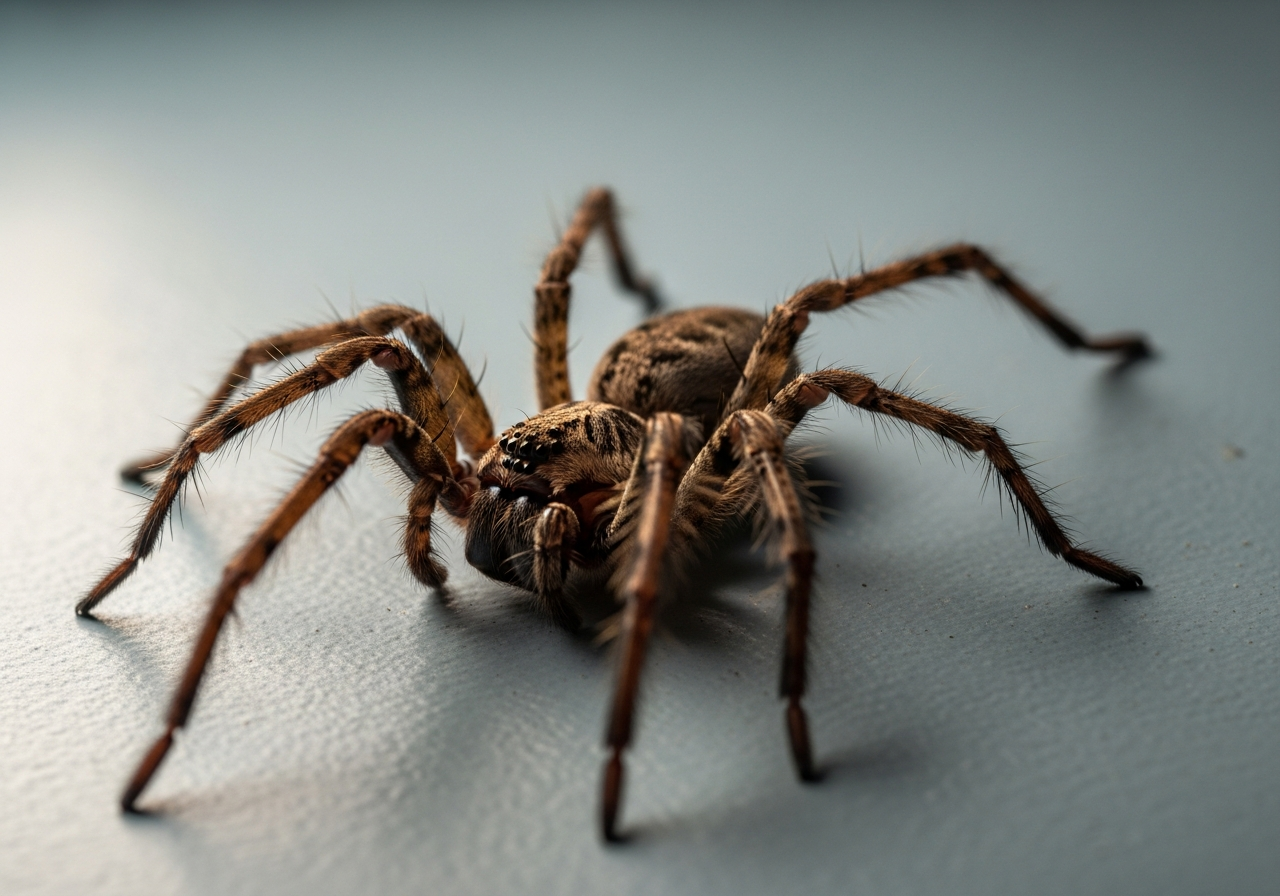
The giant house spider is a large, brown, long-legged spider with a leg span that can reach around 12 cm, making it one of the biggest spiders regularly encountered in Britain and northern Europe. Its body is mottled brown with darker markings, and the legs are covered in fine hairs. Females are bulkier than males, with body lengths of up to about 7.5 cm across the legs, while males have longer, spindlier legs relative to their bodies. Their size and speed make them look alarming, but the impression is misleading.
Webs and how it catches prey
Rather than spinning a sticky orb web, this spider weaves a flat sheet of silk that ends in a funnel-shaped retreat, where it waits out of sight. When a fly, moth or other invertebrate blunders onto the sheet, the vibrations alert the spider, which rushes out from its tunnel to seize the prey before retreating to feed. The web is not sticky; it relies on the spider's speed to reach victims before they escape. These funnels are often tucked behind furniture, in the corners of sheds, or among log piles and garden debris.
Why you see them in autumn
The spiders most people notice indoors are mature males, which leave their webs in early autumn to wander in search of females. This is why giant house spiders seem to appear suddenly in September and October, scuttling across floors or trapped in baths where they have fallen and cannot climb the smooth sides. They are not invading in greater numbers; they are simply more visible during the mating season. Once a male finds a female's web, he may stay with her for some time before mating.
Are they dangerous?
Despite their size and the fright they can cause, giant house spiders are harmless to people. Their venom is used to subdue small invertebrate prey and has no significant effect on humans, and they are reluctant to bite, preferring to flee. On the rare occasion a bite does occur, it is comparable to a minor sting at most. They are, in fact, useful housemates that help keep down numbers of flies and other insects.
Habitat and life cycle
Giant house spiders live in and around human buildings, including houses, sheds, garages and outbuildings, as well as in natural sites such as log piles, cavities and gardens. Females stay close to their webs for life, laying eggs in silken sacs and living for up to around three years, longer than many spiders. Males have shorter lives and usually die within weeks of maturing and mating. The species is common and widespread and is classed as Least Concern.
Dig deeper into the Giant House Spider
- Giant House Spider: Key Facts
Giant House Spiders (Eratigena atrica) are invertebrates found across Europe. Britain's large but harmless funnel-weaving house spider.
- How Long Do Giant House Spiders Live?
Giant House Spider lifespan is typically about 3 years. What shortens or extends life, life stages, and status (Least Concern).
- What Do Giant House Spiders Eat?
What giant house spiders eat: Carnivore (flies, moths, and other invertebrates), foraging style, and seasonal shifts in Houses, sheds, garages, log piles, gardens.
- Where Do Giant House Spiders Live?
Where giant house spiders live: Houses, sheds, garages, log piles, gardens, native range cues, and human overlap. Status Least Concern.
Explore the Giant House Spider
Related Invertebrates
Range & geography
Did you know? Giant House Spider facts
- The giant house spider (Eratigena atrica) is one of the largest spiders in the UK, with a leg span up to about 12 cm in the biggest females.
- No. Giant house spiders are harmless to people. They are not aggressive, their venom has no medical significance for humans, and bites are extremely rare even when the spider is handled. They are beneficial, catching flies and other insects.
- Male giant house spiders wander in late summer and autumn searching for females to mate with. Houses are warm, sheltered, and often contain resident females. The spiders are not seeking warmth — they are looking for mates. The same number of spiders may be present year-round, but males only become visible during their autumn wandering phase.
- Giant house spiders are large (leg spans up to about 12 cm), brown with pale markings on the abdomen, and move very fast in short bursts. They build flat funnel-shaped webs in corners and undisturbed spaces. The similar lace web spider has more distinctly yellowish-brown patterning.
- The giant house spider is among the largest spiders in the UK by leg span, alongside the cardinal spider (Tegenaria parietina). The raft spider (Dolomedes fimbriatus) is also large but lives only near water in wetland habitats.
- Conservation: Least Concern.
Diet & feeding
Giant House Spider feeds primarily as a carnivore (flies, moths, and other invertebrates). No. Giant house spiders are completely harmless to people. While they can technically bite if severely provoked and held, their venom has no medically significant effect on humans — any bite would cause no more than brief, mild i
Adaptations
- No. Giant house spiders are completely harmless to people. While they can technically bite if severely provoked and held, their venom has no medically significant effect on humans — any bite would cause no more than brief, mild irritation. They are not aggressive and will flee given any opportunity. Their intimidating size and sudden speed are the main reason they startle people, but they pose no threat and are in fact useful house guests that eat flies, moths, and other insects.
- Adult male giant house spiders wander in search of females from late August through October, which is when they are most often encountered crossing floors and walls indoors. Females tend to remain near their funnel webs in undisturbed corners, sheds, and garages, waiting for prey. After mating, females may survive for several years; males typically die after the mating season. This seasonal movement of large, fast spiders is the source of the UK's annual 'spider season.'
Behaviour & ecology
- No. Giant house spiders are completely harmless to people. While they can technically bite if severely provoked and held, their venom has no medically significant effect on humans — any bite would cause no more than brief, mild irritation. They are not aggressive and will flee given any opportunity. Their intimidating size and sudden speed are the main reason they startle people, but they pose no threat and are in fact useful house guests that eat flies, moths, and other insects.
- Adult male giant house spiders wander in search of females from late August through October, which is when they are most often encountered crossing floors and walls indoors. Females tend to remain near their funnel webs in undisturbed corners, sheds, and garages, waiting for prey. After mating, females may survive for several years; males typically die after the mating season. This seasonal movement of large, fast spiders is the source of the UK's annual 'spider season.'
- Giant house spiders spin flat, sheet-like webs with a narrow funnel or tube at one end where the spider waits. When an insect walks onto the sheet and stumbles, the spider rushes out, bites the prey, and drags it into the funnel. Their webs are often visible in corners of rooms, sheds, and between logs. Despite the name 'funnel-web spider' sometimes used informally in the UK, Eratigena is entirely harmless and utterly unlike the dangerous Australian funnel-web spiders.
Communication
- Giant House Spider uses scent, posture, and vocal signals to mark territory and coordinate social behaviour.
- Communication intensity often peaks during breeding seasons and territorial disputes.
Habitat & range
Houses, sheds, garages, log piles, gardens
Ecological role
Giant House Spider acts as a predator that helps regulate prey populations and maintain balance in houses, sheds, garages, log piles, gardens.
Conservation status of the Giant House Spider
The giant house spider (Eratigena atrica) is listed as Least Concern on the IUCN Red List. Least Concern (LC) is the IUCN's lowest-risk category, assigned to widespread, abundant species that have been evaluated and found not to be threatened. It does not mean a species faces no pressures — only that it is not currently at risk of extinction.
The giant house spider (Eratigena atrica) is assessed on the IUCN Red List. Look up on the IUCN Red List .
Frequently asked questions about the Giant House Spider
Are giant house spiders dangerous?
No. Giant house spiders are harmless to people, with venom that only affects their small invertebrate prey. They are reluctant to bite and prefer to run away, and any rare bite is no worse than a minor sting.
Why do giant house spiders come indoors in autumn?
The spiders seen indoors in September and October are mostly mature males wandering in search of a mate. They are not invading in greater numbers but are simply more visible as they roam. Many end up trapped in baths, unable to climb the smooth sides.
How big do giant house spiders get?
They are among Britain's largest spiders, with a leg span reaching around 12 cm. Females have a bulky body up to about 7.5 cm across the legs, while males have longer, thinner legs. Their size makes them look more threatening than they are.
What do giant house spiders eat?
They are carnivores that prey on flies, moths and other invertebrates. They build a flat sheet web with a funnel retreat and rush out to seize prey that lands on it. This makes them helpful in controlling household insects.
How long do giant house spiders live?
Females can live for around three years, which is long for a spider. Males live much shorter lives, usually dying within a few weeks of maturing and finding a mate in autumn.
Do giant house spiders make webs?
Yes. They weave a flat sheet of silk ending in a funnel-shaped tunnel where they hide. The web is not sticky, so the spider relies on speed to dash out and catch prey before it escapes.
What is a group of giant house spiders called?
A group of Giant House Spiders is called a cluster.
What is a baby giant house spider called?
A baby Giant House Spider is called a spiderling.
Sources & references
This guide is compiled and reviewed against established zoological and conservation references. Key sources for the Giant House Spider:
-
IUCN Red List of Threatened Species
Conservation status (Least Concern) reflects the IUCN Red List category for Eratigena atrica.
-
iNaturalist — observations & photos
Search citizen-science observations and community IDs for Eratigena atrica. Useful for range checks and recent sightings — not a substitute for formal Red List status.
-
GBIF — occurrence data
Global Biodiversity Information Facility species search for Eratigena atrica. Explore published occurrence records used in range research.
- IUCN Red List — Eratigena atrica.
Conservation status (Least Concern) and population trends.
- Animal Diversity Web — Eratigena atrica. University of Michigan Museum of Zoology.
Life history, morphology, and range.
- Wikipedia — Giant House Spider.
General taxonomy and overview (cross-check primary sources).
-
Global Animal Guide editorial standards
How we research, source, review, and update every guide for accuracy.