Quick answer
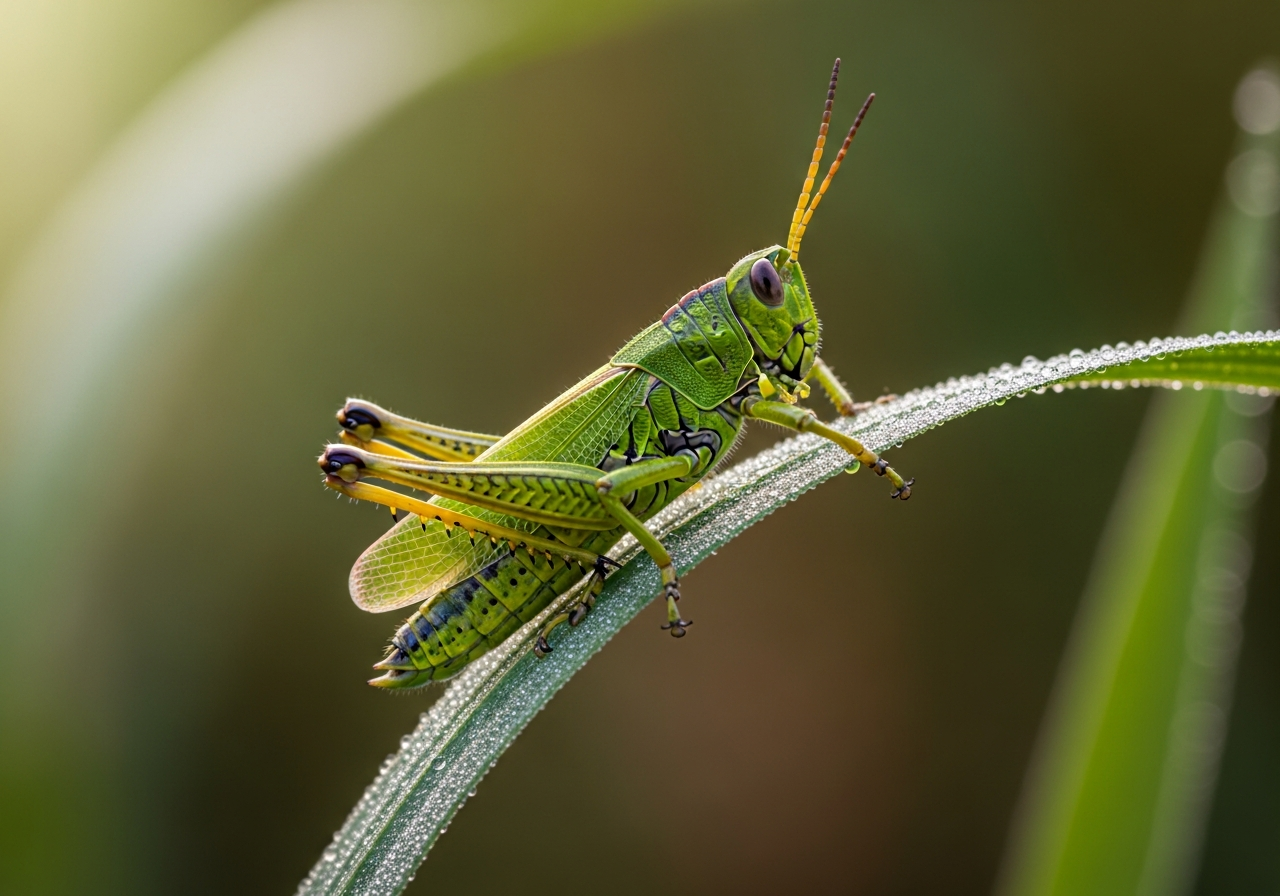
Grasshoppers are plant-eating insects famous for their powerful hind legs, which let them leap many times their own body length. They live in grasslands and fields, where they feed on leaves and stems, and many produce a chirping sound by rubbing body parts together. Most grasshoppers live for about a year or less.
Top questions about the Grasshopper
Grasshopper facts at a glance
- Weight 0 g
- Length 4 cm
- Top speed 13 km/h
- Lifespan 1 years
| Scientific name | Suborder Caelifera |
|---|---|
| Diet | Herbivore (leaves, grasses, stems) |
| Habitat | Grasslands, meadows, fields, scrub |
| Lifespan | About 1 year or less |
| Size | 2–8 cm (1–3 in) depending on species |
| Jump | Up to ~20 times body length |
| Conservation status | Least Concern (IUCN) |
| Kingdom | Animalia |
|---|---|
| Phylum | Arthropoda |
| Class | Insecta |
| Order | Orthoptera |
| Family | Acrididae |
Where it lives
The grasshopper (Caelifera) is native to Grasslands, meadows, and fields across all continents except Antarctica. — recorded across Africa, Asia, Europe, North America, South America, Oceania in this guide’s range summary.
For occurrence records, see GBIF species search and sources below.
How big is a grasshopper?
An adult grasshopper measures 4 cm long — about 2% of the height of an average adult person (1.73 m) — and weighs around 0 g, a small fraction of an average adult’s body weight (70 kg).
Length vs an average adult’s height (to scale)
What is a group of grasshoppers called?
Group name (collective noun)
A group of Grasshoppers is called a cloud. It is also known as a swarm.
Baby name
A baby Grasshopper is called a nymph.
Explore more animal collective nouns and baby animal names .
Powerful jumpers
Grasshoppers have large, muscular hind legs that store energy like a spring, letting them launch into leaps many times their own body length. Jumping helps them escape predators quickly, and many species can also fly to cover longer distances. The legs are the grasshopper's most distinctive feature.
Diet and feeding
Grasshoppers are herbivores that feed on grasses, leaves, and other plants using strong chewing mouthparts. Most cause little harm, but when conditions allow certain species to gather in huge numbers as swarming locusts, they can strip crops and become serious agricultural pests.
Sound and senses
Many grasshoppers produce a chirping or buzzing sound, often by rubbing a hind leg against a wing, a behavior called stridulation. These calls are used mainly to attract mates. Grasshoppers hear through simple ear-like organs located on the body rather than the head.
Life cycle and habitat
Grasshoppers develop through incomplete metamorphosis, hatching as small wingless nymphs that grow through several molts into winged adults. They are found in grasslands, meadows, and fields on most continents, and are an important food source for birds, reptiles, and other animals.
Dig deeper into the Grasshopper
- Grasshopper: Key Facts
Grasshoppers are plant-eating insects famous for their powerful hind legs, which let them leap many times their own body length.
- What Do Grasshoppers Eat?
What grasshoppers eat: Herbivore (leaves, grasses, stems), foraging style, and seasonal shifts in Grasslands, meadows, fields, scrub.
- Where Do Grasshoppers Live?
Where grasshoppers live: Grasslands, meadows, fields, scrub, native range cues, and human overlap. Status Least Concern.
Explore the Grasshopper
Related Insects
Did you know? Grasshopper facts
- Grasshoppers are plant-eating insects famous for their powerful hind legs, which let them leap many times their own body length.
- Grasshoppers can leap around 20 times their own body length thanks to their powerful spring-like hind legs. For a human, that would be like jumping the length of several buses.
- Grasshoppers are herbivores that feed on grasses, leaves, and stems. Most eat small amounts, but swarming species known as locusts can damage crops over wide areas.
- Many grasshoppers chirp by rubbing a hind leg against a wing, a process called stridulation. These sounds are mainly used by males to attract mates.
- Locusts are certain grasshopper species that can change behavior and form massive migrating swarms when crowded. Otherwise they are closely related plant-eating insects.
- Conservation: Least Concern (IUCN).
Diet & feeding
Grasshopper feeds primarily as a herbivore (leaves, grasses, stems). Grasshoppers have large, muscular hind legs that store energy like a spring, letting them launch into leaps many times their own body length. Jumping helps them escape predators quickly, and many species can also fly to cover longer distances. The leg
Adaptations
- Grasshoppers have large, muscular hind legs that store energy like a spring, letting them launch into leaps many times their own body length. Jumping helps them escape predators quickly, and many species can also fly to cover longer distances. The legs are the grasshopper's most distinctive feature.
- Grasshoppers are herbivores that feed on grasses, leaves, and other plants using strong chewing mouthparts. Most cause little harm, but when conditions allow certain species to gather in huge numbers as swarming locusts, they can strip crops and become serious agricultural pests.
Behaviour & ecology
- Grasshoppers have large, muscular hind legs that store energy like a spring, letting them launch into leaps many times their own body length. Jumping helps them escape predators quickly, and many species can also fly to cover longer distances. The legs are the grasshopper's most distinctive feature.
- Grasshoppers are herbivores that feed on grasses, leaves, and other plants using strong chewing mouthparts. Most cause little harm, but when conditions allow certain species to gather in huge numbers as swarming locusts, they can strip crops and become serious agricultural pests.
- Many grasshoppers produce a chirping or buzzing sound, often by rubbing a hind leg against a wing, a behavior called stridulation. These calls are used mainly to attract mates. Grasshoppers hear through simple ear-like organs located on the body rather than the head.
Communication
- Grasshopper uses scent, posture, and vocal signals to mark territory and coordinate social behaviour.
- Communication intensity often peaks during breeding seasons and territorial disputes.
Habitat & range
Grasslands, meadows, fields, scrub
Ecological role
Grasshopper shapes vegetation through grazing or browsing and serves as prey for larger predators where ranges overlap.
Conservation status of the Grasshopper
The grasshopper (Caelifera) is listed as Least Concern on the IUCN Red List. Least Concern (LC) is the IUCN's lowest-risk category, assigned to widespread, abundant species that have been evaluated and found not to be threatened. It does not mean a species faces no pressures — only that it is not currently at risk of extinction.
The grasshopper (Caelifera) is assessed on the IUCN Red List. Look up on the IUCN Red List .
Frequently asked questions about the Grasshopper
How far can a grasshopper jump?
Grasshoppers can leap around 20 times their own body length thanks to their powerful spring-like hind legs. For a human, that would be like jumping the length of several buses.
What do grasshoppers eat?
Grasshoppers are herbivores that feed on grasses, leaves, and stems. Most eat small amounts, but swarming species known as locusts can damage crops over wide areas.
How do grasshoppers make sound?
Many grasshoppers chirp by rubbing a hind leg against a wing, a process called stridulation. These sounds are mainly used by males to attract mates.
What is the difference between a grasshopper and a locust?
Locusts are certain grasshopper species that can change behavior and form massive migrating swarms when crowded. Otherwise they are closely related plant-eating insects.
How long do grasshoppers live?
Most grasshoppers live for about a year or less. They typically hatch in spring, mature over the summer, and die as colder weather sets in.
Do grasshoppers bite?
Grasshoppers can give a small nip if handled, but they are harmless to people. They have no venom and rely on jumping to escape rather than biting in defense.
What is a group of grasshoppers called?
A group of Grasshoppers is called a cloud. It is also known as a swarm.
What is a baby grasshopper called?
A baby Grasshopper is called a nymph.
Sources & references
This guide is compiled and reviewed against established zoological and conservation references. Key sources for the Grasshopper:
-
IUCN Red List of Threatened Species
Conservation status (Least Concern) reflects the IUCN Red List category for Caelifera.
-
iNaturalist — observations & photos
Search citizen-science observations and community IDs for Caelifera. Useful for range checks and recent sightings — not a substitute for formal Red List status.
-
GBIF — occurrence data
Global Biodiversity Information Facility species search for Caelifera. Explore published occurrence records used in range research.
- IUCN Red List — Caelifera.
Conservation status (Least Concern) and population trends.
- Wikipedia — Grasshopper.
General taxonomy and overview (cross-check primary sources).
-
Global Animal Guide editorial standards
How we research, source, review, and update every guide for accuracy.