Green Anaconda
Eunectes murinus
Quick answer
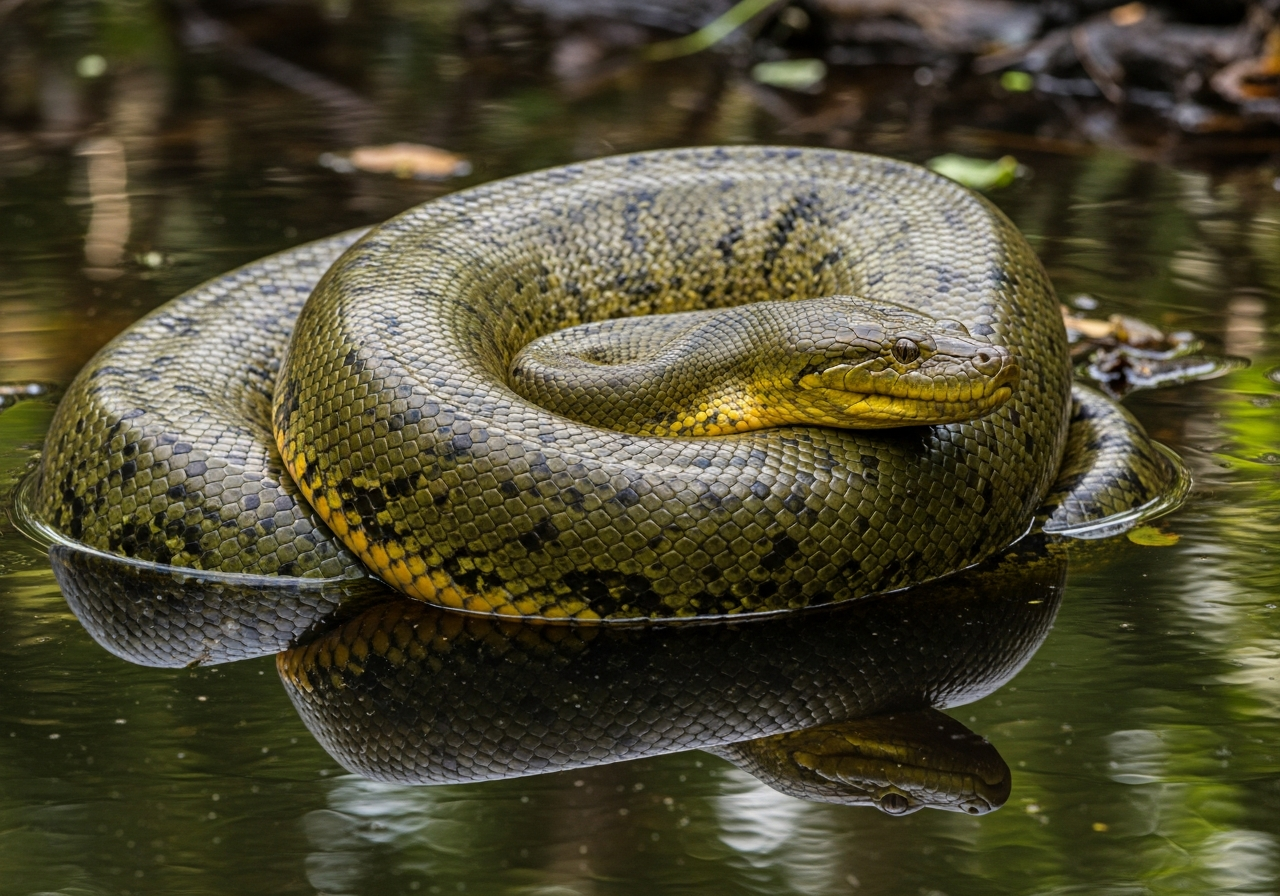
The green anaconda is the heaviest snake on Earth and one of the longest, reaching up to 5 m (16 ft) and weighing over 70 kg (150 lb), with large females far bigger than males. It is a non-venomous constrictor native to the swamps and slow rivers of tropical South America, where it ambushes prey in the water. Green anacondas eat fish, birds, capybaras, and caimans, and typically live around 10 years in the wild.
Green Anaconda facts at a glance
| Scientific name | Eunectes murinus |
|---|---|
| Diet | Carnivore |
| Habitat | Swamps, marshes, and slow tropical rivers |
| Lifespan | About 10 years in the wild |
| Length | Up to 5 m (16 ft), sometimes longer |
| Weight | Up to 70 kg (150 lb) or more |
| Conservation status | Least Concern (IUCN) |
| Kingdom | Animalia |
|---|---|
| Phylum | Chordata |
| Class | Reptilia |
| Order | Squamata |
| Family | Boidae |
| Genus | Eunectes |
Where it lives
Swamps, marshes, and slow rivers of the Amazon and Orinoco basins in tropical South America.
Behavior and life in the water
Green anacondas are semi-aquatic and spend much of their lives in shallow, slow-moving water where their bulk is supported and their movements are silent. Their eyes and nostrils sit high on the head, letting them watch and breathe while almost fully submerged. They are solitary and largely nocturnal, ambushing animals that come to drink rather than actively chasing prey.
Diet and constriction
As non-venomous constrictors, anacondas seize prey with backward-curving teeth and then coil around it, tightening with each breath until the animal can no longer breathe. They eat fish, birds, turtles, capybaras, deer, and caimans, and large individuals can take surprisingly big prey. After a large meal they may not need to feed again for weeks.
Habitat and range
The green anaconda lives across tropical South America east of the Andes, especially in the Amazon and Orinoco river basins. It favors swamps, marshes, flooded grasslands, and the margins of slow rivers. During the dry season some retreat into mud and become inactive until the rains return.
Reproduction
Female anacondas are much larger than males, an extreme example of size difference in snakes. During the breeding season several males may wrap around a single female in a writhing breeding ball that can last for weeks. The female gives birth to live young rather than laying eggs, producing dozens of independent babies at once.
Frequently asked questions about the Green Anaconda
What is the biggest snake in the world?
By weight, the green anaconda is the largest snake in the world, with heavy females exceeding 70 kg (150 lb). The reticulated python can grow longer, but the anaconda is far more massive.
Are green anacondas venomous?
No. Green anacondas are non-venomous constrictors. They kill prey by coiling around it and squeezing until it can no longer breathe, not by injecting venom.
What do green anacondas eat?
They are carnivores that eat fish, birds, turtles, capybaras, deer, and even caimans. They ambush prey near water and constrict it before swallowing it whole.
Do anacondas eat people?
Attacks on humans are extremely rare and well-documented cases of anacondas killing people are essentially absent. Most anacondas avoid humans and flee when disturbed.
How long do green anacondas live?
Green anacondas live around 10 years in the wild, though they can reach roughly 20 to 30 years in captivity with steady food and protection from predators.
Where do green anacondas live?
They live in tropical South America, mainly in the swamps, marshes, and slow rivers of the Amazon and Orinoco basins east of the Andes.