Atlantic Horseshoe Crab
Limulus polyphemus
Quick answer
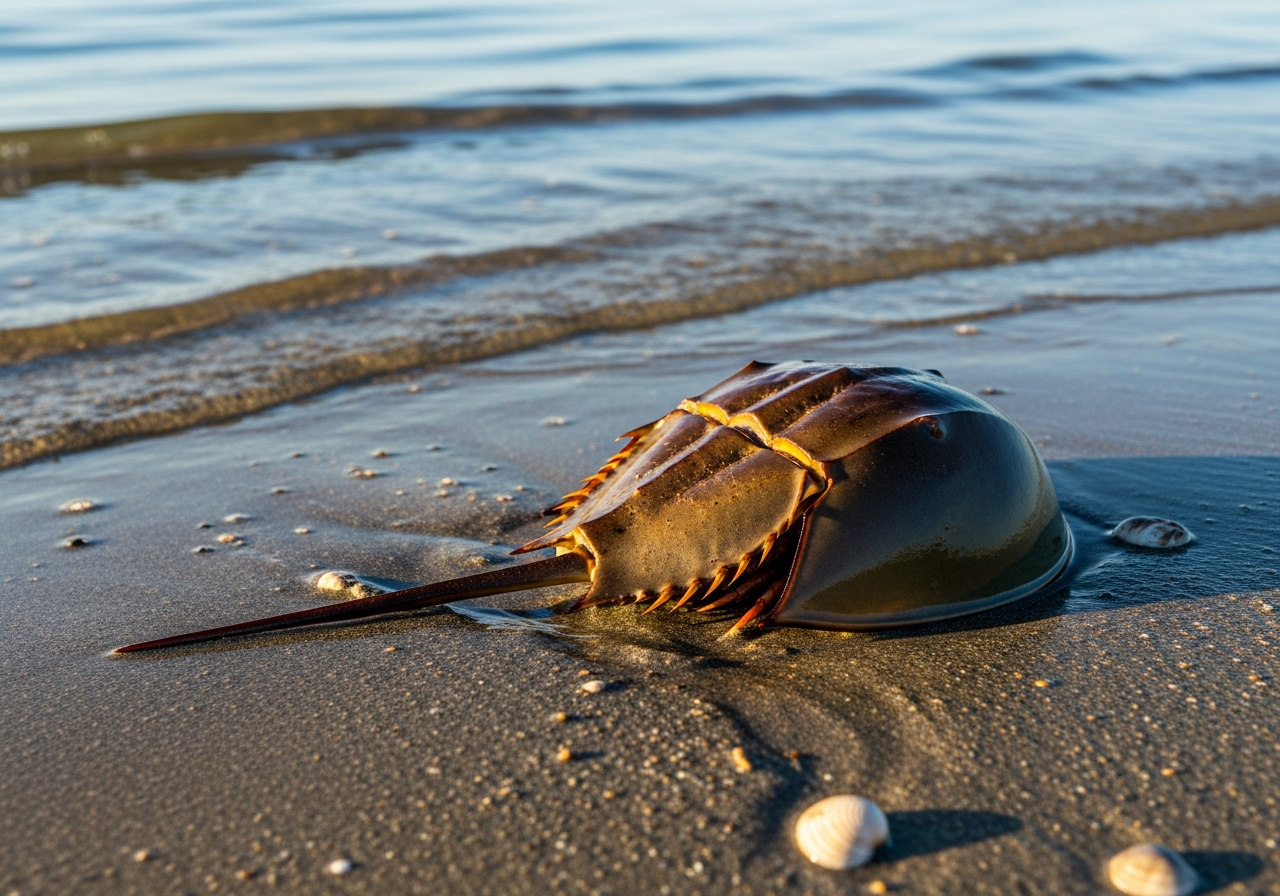
The Atlantic horseshoe crab is an ancient marine arthropod that has existed for hundreds of millions of years, making it a true living fossil. Despite its name it is not a crab but is more closely related to spiders and scorpions, with a horseshoe-shaped shell, many legs, and a long spike-like tail. Its copper-based blue blood is vital to medicine, and these animals can live more than 20 years.
Atlantic Horseshoe Crab facts at a glance
| Scientific name | Limulus polyphemus |
|---|---|
| Diet | Omnivore (worms, mollusks, algae, carrion) |
| Habitat | Shallow coastal waters and sandy beaches |
| Lifespan | Often 20+ years |
| Size | Up to about 60 cm (24 in) including tail |
| Top speed | Slow; crawls and plows through sand |
| Conservation status | Vulnerable (IUCN) |
| Kingdom | Animalia |
|---|---|
| Phylum | Arthropoda |
| Class | Merostomata |
| Order | Xiphosura |
| Family | Limulidae |
| Genus | Limulus |
Where it lives
Shallow coastal waters and beaches of the western Atlantic, along the eastern United States and the Gulf of Mexico.
An ancient survivor
Horseshoe crabs are among the oldest animal lineages still living, with fossil relatives dating back hundreds of millions of years, long before the dinosaurs. Their basic body plan has changed remarkably little over that time. Despite the name, they are not true crabs but chelicerates, the same broad group that includes spiders and scorpions.
Body and senses
A horseshoe crab has a smooth, domed shell, several pairs of legs hidden underneath, and a long, pointed tail called a telson that it uses to flip itself upright rather than as a weapon. It has up to ten eyes spread across its body, including large compound eyes used to find mates. The tail and shell are harmless to people despite their fierce appearance.
Diet and spawning
Horseshoe crabs are omnivores that plow through sand and mud searching for worms, mollusks, algae, and carrion, crushing food with the bases of their legs. Each spring, huge numbers gather on beaches to spawn, with females laying thousands of eggs in the sand. These eggs are a critical food source for migrating shorebirds along the Atlantic coast.
Blue blood and conservation
Horseshoe crab blood is blue because it uses copper-based hemocyanin instead of iron-based hemoglobin to carry oxygen. The blood contains a clotting agent used worldwide to test medicines and vaccines for dangerous bacterial contamination, making these animals important to human health. Overharvesting for bait and biomedical use, along with habitat loss, has led to the species being listed as Vulnerable.
Frequently asked questions about the Atlantic Horseshoe Crab
Is a horseshoe crab really a crab?
No. Despite the name, horseshoe crabs are not true crabs. They are chelicerates more closely related to spiders and scorpions than to crabs or lobsters.
Why is horseshoe crab blood blue?
Their blood carries oxygen using copper-based hemocyanin instead of the iron-based hemoglobin in our red blood, which gives it a blue color. The blood also contains a clotting agent used to test medicines for contamination.
Are horseshoe crabs dangerous?
No. Horseshoe crabs are harmless to people. Their long, pointed tail looks intimidating but is only used to flip the animal over if it lands on its back, not as a weapon.
What do horseshoe crabs eat?
Horseshoe crabs are omnivores that eat worms, mollusks, algae, and carrion. They plow through sand and mud and crush their food using the bristly bases of their legs.
How long do horseshoe crabs live?
Atlantic horseshoe crabs can live more than 20 years. They grow slowly, molting many times before reaching maturity at around 10 years old.
Are horseshoe crabs endangered?
The Atlantic horseshoe crab is listed as Vulnerable. Overharvesting for bait and biomedical use, plus loss of spawning beaches, has reduced its numbers and affected the shorebirds that rely on its eggs.