Quick answer
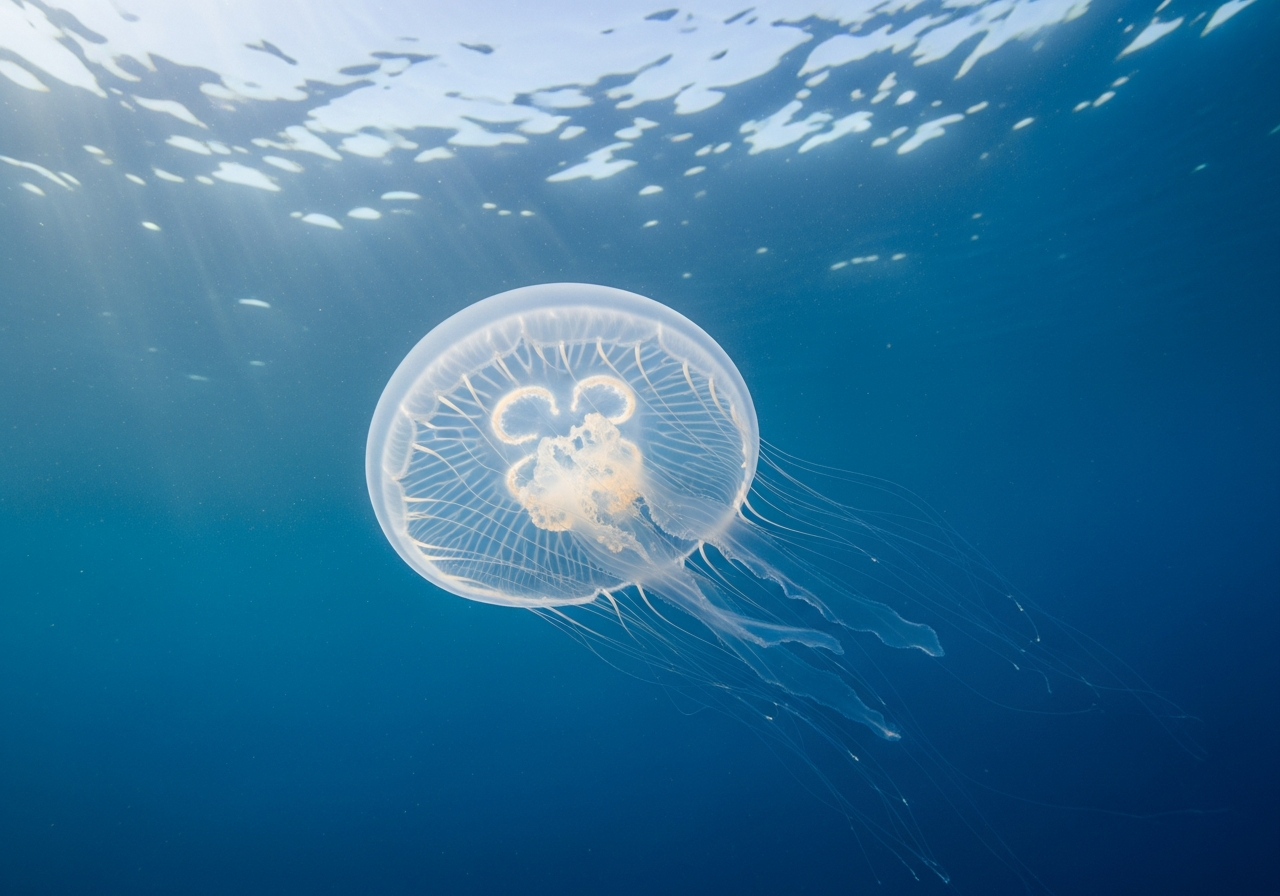
Jellyfish are gelatinous marine animals that have drifted through the oceans for over 500 million years, longer than the dinosaurs. They have no brain, heart, or bones, are about 95% water, and capture prey using stinging tentacles. Sizes range from a few millimeters to the lion's mane jellyfish with tentacles over 30 m (100 ft) long, and the box jellyfish is among the most venomous animals on Earth.
Top questions about the Jellyfish
Also available in Español (Medusa)
Jellyfish facts at a glance
- Weight 2 kg
- Length 40 cm
- Top speed 8 km/h
- Lifespan 1 years
| Scientific name | Medusozoa (subphylum) |
|---|---|
| Diet | Carnivore (plankton and small fish) |
| Habitat | Oceans worldwide, surface to deep sea |
| Lifespan | A few months to a few years |
| Composition | About 95% water |
| Top speed | Slow drifters; weak swimmers |
| Conservation status | Varies by species (most not assessed) |
| Kingdom | Animalia |
|---|---|
| Phylum | Cnidaria |
| Class | Scyphozoa |
Where it lives
The jellyfish (Medusozoa) is native to Every ocean on Earth, from warm surface waters to the freezing deep. — recorded across Oceans in this guide’s range summary.
For occurrence records, see GBIF species search and sources below.
How big is a jellyfish?
An adult jellyfish measures 40 cm long — about 23% of the height of an average adult person (1.73 m) — and weighs around 2.0 kg, about 3% of an average adult’s body weight (70 kg).
Length vs an average adult’s height (to scale)
What is a group of jellyfish called?
Group name (collective noun)
A group of Jellyfish is called a smack. It is also known as a bloom or a swarm.
Baby name
A baby Jellyfish is called an ephyra. It may also be called a polyp.
Explore more animal collective nouns and baby animal names .
Life without a brain
Jellyfish have no brain, heart, blood, or bones. They sense the world through a simple net of nerves and react to light, touch, and chemicals in the water. Made of around 95% water, their bell pulses gently to move, though they mostly drift with the currents.
Stinging tentacles
A jellyfish's trailing tentacles are armed with thousands of microscopic stinging capsules called nematocysts that fire venom-tipped threads on contact, paralyzing plankton and small fish. Some species are harmless to people, while the box jellyfish carries venom potent enough to be life-threatening.
Ancient survivors
Jellyfish are among the oldest animals on the planet, drifting through the seas for more than 500 million years, long before dinosaurs or even trees existed. They survive in every ocean, from warm surface waters to the freezing deep, which is part of why they have endured through mass extinctions.
Blooms and the 'immortal' jelly
Under the right conditions jellyfish can multiply into vast swarms called blooms, sometimes linked to warming seas and overfishing of their predators. One species, Turritopsis dohrnii, can revert to an earlier life stage when stressed, earning it the nickname the 'immortal jellyfish'.
Dig deeper into the Jellyfish
- Are Jellyfish Dangerous?
Are jellyfish dangerous? Realistic risk, when incidents rise, and safety basics.
- Jellyfish: Key Facts
Jellyfish are gelatinous marine animals that have drifted through the oceans for over 500 million years, longer than the dinosaurs.
- What Do Jellyfish Eat?
What jellyfish eat: Carnivore (plankton and small fish), foraging style, and seasonal shifts in Oceans worldwide, surface to deep sea.
- Where Do Jellyfish Live?
Where jellyfish live: Oceans worldwide, surface to deep sea, native range cues, and human overlap. Status Least Concern.
Explore the Jellyfish
Related Invertebrates
Collections
Range & geography
Did you know? Jellyfish facts
- Jellyfish are gelatinous marine animals that have drifted through the oceans for over 500 million years, longer than the dinosaurs.
- No. Jellyfish have no brain, heart, or bones. They use a simple network of nerves to sense light, touch, and chemicals and to coordinate the pulsing of their bell.
- Jellyfish sting using tiny capsules called nematocysts on their tentacles, which fire venom-tipped threads when touched, paralyzing prey. Some stings are harmless to humans while others, like the box jellyfish, can be deadly.
- Jellyfish are carnivores that feed mostly on plankton, tiny crustaceans, fish eggs, and small fish, capturing them with their stinging tentacles.
- Jellyfish have existed for more than 500 million years, making them far older than dinosaurs and among the most ancient animals still alive today.
- Conservation: Varies by species (most not assessed).
Diet & feeding
Jellyfish feeds primarily as a carnivore (plankton and small fish). A jellyfish's trailing tentacles are armed with thousands of microscopic stinging capsules called nematocysts that fire venom-tipped threads on contact, paralyzing plankton and small fish. Some species are harmless to people, while the box jellyfish ca
Adaptations
- Jellyfish have no brain, heart, blood, or bones. They sense the world through a simple net of nerves and react to light, touch, and chemicals in the water. Made of around 95% water, their bell pulses gently to move, though they mostly drift with the currents.
- A jellyfish's trailing tentacles are armed with thousands of microscopic stinging capsules called nematocysts that fire venom-tipped threads on contact, paralyzing plankton and small fish. Some species are harmless to people, while the box jellyfish carries venom potent enough to be life-threatening.
Behaviour & ecology
- Jellyfish have no brain, heart, blood, or bones. They sense the world through a simple net of nerves and react to light, touch, and chemicals in the water. Made of around 95% water, their bell pulses gently to move, though they mostly drift with the currents.
- A jellyfish's trailing tentacles are armed with thousands of microscopic stinging capsules called nematocysts that fire venom-tipped threads on contact, paralyzing plankton and small fish. Some species are harmless to people, while the box jellyfish carries venom potent enough to be life-threatening.
- Jellyfish are among the oldest animals on the planet, drifting through the seas for more than 500 million years, long before dinosaurs or even trees existed. They survive in every ocean, from warm surface waters to the freezing deep, which is part of why they have endured through mass extinctions.
Communication
- Jellyfish uses scent, posture, and vocal signals to mark territory and coordinate social behaviour.
- Communication intensity often peaks during breeding seasons and territorial disputes.
Habitat & range
Oceans worldwide, surface to deep sea
Ecological role
Jellyfish acts as a predator that helps regulate prey populations and maintain balance in oceans worldwide, surface to deep sea.
Conservation status of the Jellyfish
The jellyfish (Medusozoa) is listed as Least Concern on the IUCN Red List. Least Concern (LC) is the IUCN's lowest-risk category, assigned to widespread, abundant species that have been evaluated and found not to be threatened. It does not mean a species faces no pressures — only that it is not currently at risk of extinction.
The jellyfish (Medusozoa) is assessed on the IUCN Red List. Look up on the IUCN Red List .
Frequently asked questions about the Jellyfish
Do jellyfish have brains?
No. Jellyfish have no brain, heart, or bones. They use a simple network of nerves to sense light, touch, and chemicals and to coordinate the pulsing of their bell.
How do jellyfish sting?
Jellyfish sting using tiny capsules called nematocysts on their tentacles, which fire venom-tipped threads when touched, paralyzing prey. Some stings are harmless to humans while others, like the box jellyfish, can be deadly.
What do jellyfish eat?
Jellyfish are carnivores that feed mostly on plankton, tiny crustaceans, fish eggs, and small fish, capturing them with their stinging tentacles.
How long have jellyfish existed?
Jellyfish have existed for more than 500 million years, making them far older than dinosaurs and among the most ancient animals still alive today.
Is there really an immortal jellyfish?
Yes, sort of. The species Turritopsis dohrnii can revert from its adult form back to an earlier polyp stage when stressed or injured, potentially restarting its life cycle, which is why it is nicknamed the immortal jellyfish.
What is a group of jellyfish called?
A group of Jellyfish is called a smack. It is also known as a bloom or a swarm.
What is a baby jellyfish called?
A baby Jellyfish is called an ephyra. It may also be called a polyp.
Sources & references
This guide is compiled and reviewed against established zoological and conservation references. Key sources for the Jellyfish:
-
IUCN Red List of Threatened Species
Conservation status (Least Concern) reflects the IUCN Red List category for Medusozoa.
-
iNaturalist — observations & photos
Search citizen-science observations and community IDs for Medusozoa. Useful for range checks and recent sightings — not a substitute for formal Red List status.
-
GBIF — occurrence data
Global Biodiversity Information Facility species search for Medusozoa. Explore published occurrence records used in range research.
- IUCN Red List — Medusozoa.
Conservation status (Least Concern) and population trends.
- Wikipedia — Jellyfish.
General taxonomy and overview (cross-check primary sources).
-
Global Animal Guide editorial standards
How we research, source, review, and update every guide for accuracy.