Image sourcing: see credits & licences
Quick answer
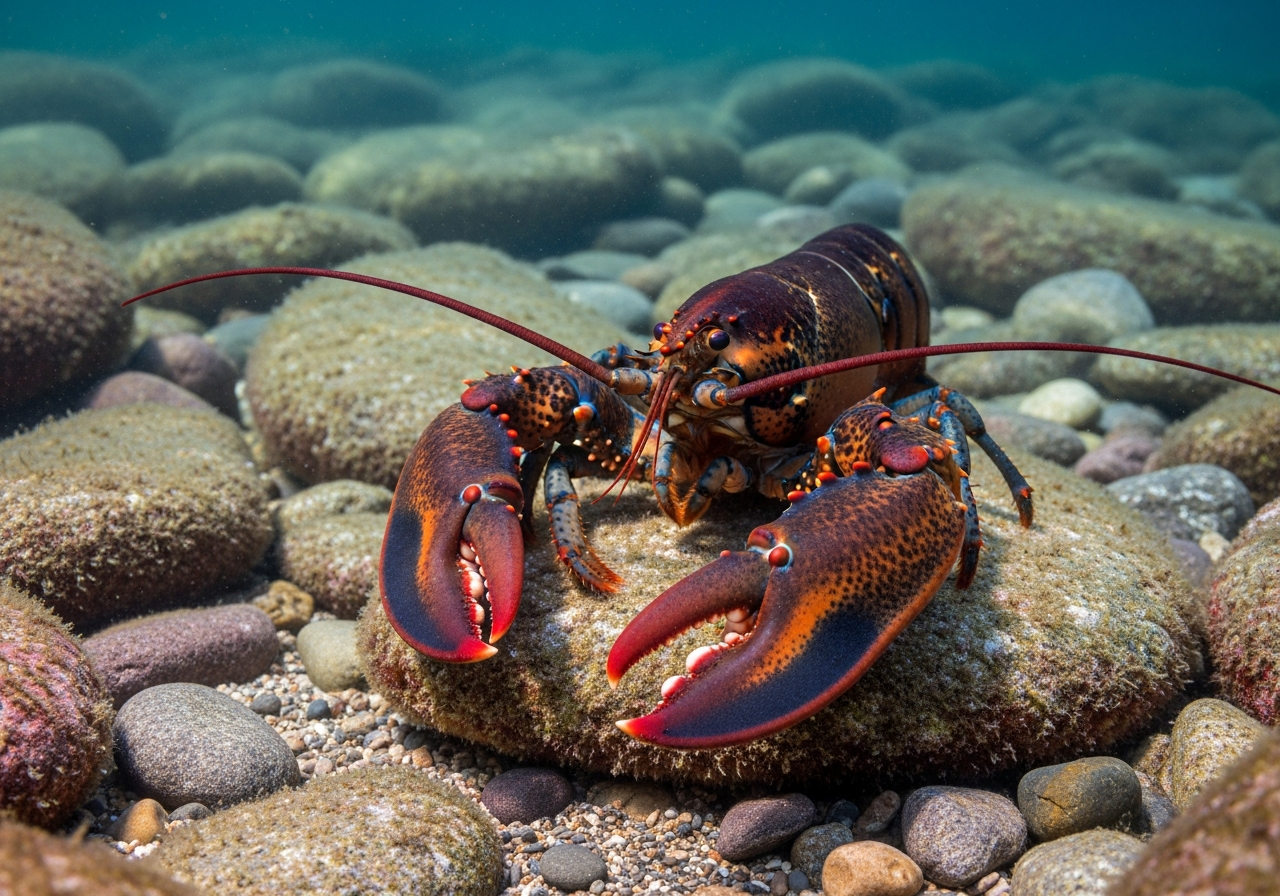
The American lobster is a large marine crustacean with two powerful front claws, an armored shell, and ten legs. It lives on the cold, rocky seabeds of the northwest Atlantic and can grow heavier than 9 kg (20 lb). Lobsters molt their shells to grow throughout life and can live more than 50 years, making them among the longest-lived invertebrates.
Top questions about the American Lobster
American Lobster facts at a glance
- Weight 2 kg
- Length 50 cm
- Top speed 18 km/h
- Lifespan 50 years
| Scientific name | Homarus americanus |
|---|---|
| Diet | Omnivore (fish, mollusks, worms, algae) |
| Habitat | Cold rocky seabeds of the northwest Atlantic |
| Lifespan | Often 45–50+ years |
| Weight | 0.5–9 kg (1–20 lb) |
| Top speed | Up to 18 km/h (11 mph) in a tail-flip escape |
| Conservation status | Least Concern (IUCN) |
| Kingdom | Animalia |
|---|---|
| Phylum | Arthropoda |
| Class | Malacostraca |
| Order | Decapoda |
| Family | Nephropidae |
| Genus | Homarus |
Where it lives
The american lobster (Homarus americanus) is native to Cold rocky seabeds of the northwest Atlantic, from Atlantic Canada to the northeastern United States. — recorded across Oceans, North America in this guide’s range summary.
For occurrence records, see GBIF species search and sources below.
How big is a american lobster?
An adult american lobster measures 50 cm long — about 29% of the height of an average adult person (1.73 m) — and weighs around 2.0 kg, about 3% of an average adult’s body weight (70 kg).
Length vs an average adult’s height (to scale)
What is a baby american lobster called?
Baby name
A baby American Lobster is called a larva.
Explore more animal collective nouns and baby animal names .
Armor and claws
A lobster's body is protected by a hard external skeleton, or exoskeleton, and tipped with two unequal front claws. The larger, blunt crusher claw breaks open shells, while the smaller, sharper pincer claw grips and tears food. To escape danger, a lobster snaps its powerful tail to shoot backward through the water.
Molting and growth
Because its shell cannot stretch, a lobster must molt, shedding its entire exoskeleton to grow a larger one. Young lobsters molt often, while adults may molt only once a year or less. Just after molting the new shell is soft, leaving the lobster vulnerable until it hardens.
Diet and behavior
Lobsters are mostly nocturnal bottom feeders that eat fish, mollusks, worms, sea urchins, and algae, and will scavenge when needed. They shelter in rocky crevices by day and forage at night, using long antennae and sensitive leg hairs to find food in dark water. They can sense their surroundings well despite having a very simple nervous system.
Long life and fishing
American lobsters grow slowly and can live well over 50 years, continuing to grow throughout their lives. They support one of the most valuable fisheries in the North Atlantic, managed with rules on minimum and maximum sizes and protection of egg-bearing females. Healthy populations make them a Least Concern species overall.
Dig deeper into the American Lobster
- How Long Do American Lobsters Live?
American Lobster lifespan is typically Often 45–50+ years. What shortens or extends life, life stages, and status (Least Concern).
- What Do American Lobsters Eat?
What american lobsters eat: Omnivore (fish, mollusks, worms, algae), foraging style, and seasonal shifts in Cold rocky seabeds of the northwest Atlantic.
- Where Do American Lobsters Live?
Where american lobsters live: Cold rocky seabeds of the northwest Atlantic, native range cues, and human overlap. Status Least Concern.
Explore the American Lobster
Related Invertebrates
Range & geography
Did you know? American Lobster facts
- The American lobster is a large marine crustacean with two powerful front claws, an armored shell, and ten legs.
- American lobsters are long-lived and can survive more than 50 years in the wild. They keep growing throughout their lives by repeatedly molting their shells.
- A live lobster's shell contains a red pigment bound to a protein, which masks the red color. Heat breaks that bond during cooking, releasing the red pigment and turning the shell bright red.
- Lobsters are omnivores that eat fish, mollusks, worms, sea urchins, and algae. They are mostly nocturnal and will also scavenge dead animals on the seabed.
- Lobsters have a large crusher claw for breaking open shells and a smaller, sharper pincer claw for gripping and tearing food. Which side becomes the crusher develops as the lobster grows.
- Conservation: Least Concern (IUCN).
Diet & feeding
American Lobster feeds primarily as a omnivore (fish, mollusks, worms, algae). Lobsters are mostly nocturnal bottom feeders that eat fish, mollusks, worms, sea urchins, and algae, and will scavenge when needed. They shelter in rocky crevices by day and forage at night, using long antennae and sensitive leg hairs to fin
Adaptations
- A lobster's body is protected by a hard external skeleton, or exoskeleton, and tipped with two unequal front claws. The larger, blunt crusher claw breaks open shells, while the smaller, sharper pincer claw grips and tears food. To escape danger, a lobster snaps its powerful tail to shoot backward through the water.
- Because its shell cannot stretch, a lobster must molt, shedding its entire exoskeleton to grow a larger one. Young lobsters molt often, while adults may molt only once a year or less. Just after molting the new shell is soft, leaving the lobster vulnerable until it hardens.
Behaviour & ecology
- A lobster's body is protected by a hard external skeleton, or exoskeleton, and tipped with two unequal front claws. The larger, blunt crusher claw breaks open shells, while the smaller, sharper pincer claw grips and tears food. To escape danger, a lobster snaps its powerful tail to shoot backward through the water.
- Because its shell cannot stretch, a lobster must molt, shedding its entire exoskeleton to grow a larger one. Young lobsters molt often, while adults may molt only once a year or less. Just after molting the new shell is soft, leaving the lobster vulnerable until it hardens.
- Lobsters are mostly nocturnal bottom feeders that eat fish, mollusks, worms, sea urchins, and algae, and will scavenge when needed. They shelter in rocky crevices by day and forage at night, using long antennae and sensitive leg hairs to find food in dark water. They can sense their surroundings well despite having a very simple nervous system.
Communication
- American Lobster uses scent, posture, and vocal signals to mark territory and coordinate social behaviour.
- Communication intensity often peaks during breeding seasons and territorial disputes.
Habitat & range
Cold rocky seabeds of the northwest Atlantic
Ecological role
American Lobster plays a recognised ecological role in cold rocky seabeds of the northwest atlantic.
Conservation status of the American Lobster
The american lobster (Homarus americanus) is listed as Least Concern on the IUCN Red List. Least Concern (LC) is the IUCN's lowest-risk category, assigned to widespread, abundant species that have been evaluated and found not to be threatened. It does not mean a species faces no pressures — only that it is not currently at risk of extinction.
The american lobster (Homarus americanus) is assessed on the IUCN Red List. Look up on the IUCN Red List .
Frequently asked questions about the American Lobster
How long do lobsters live?
American lobsters are long-lived and can survive more than 50 years in the wild. They keep growing throughout their lives by repeatedly molting their shells.
Why do lobsters turn red when cooked?
A live lobster's shell contains a red pigment bound to a protein, which masks the red color. Heat breaks that bond during cooking, releasing the red pigment and turning the shell bright red.
What do lobsters eat?
Lobsters are omnivores that eat fish, mollusks, worms, sea urchins, and algae. They are mostly nocturnal and will also scavenge dead animals on the seabed.
Why do lobsters have two different claws?
Lobsters have a large crusher claw for breaking open shells and a smaller, sharper pincer claw for gripping and tearing food. Which side becomes the crusher develops as the lobster grows.
How do lobsters grow if they have a hard shell?
Lobsters grow by molting, shedding their hard exoskeleton and forming a new, larger one. The fresh shell is soft at first and hardens over time, leaving the lobster vulnerable in between.
What is a baby american lobster called?
A baby American Lobster is called a larva.
Sources & references
This guide is compiled and reviewed against established zoological and conservation references. Key sources for the American Lobster:
-
IUCN Red List of Threatened Species
Conservation status (Least Concern) reflects the IUCN Red List category for Homarus americanus.
-
iNaturalist — observations & photos
Search citizen-science observations and community IDs for Homarus americanus. Useful for range checks and recent sightings — not a substitute for formal Red List status.
-
GBIF — occurrence data
Global Biodiversity Information Facility species search for Homarus americanus. Explore published occurrence records used in range research.
- IUCN Red List — Homarus americanus.
Conservation status (Least Concern) and population trends.
- Animal Diversity Web — Homarus americanus. University of Michigan Museum of Zoology.
Life history, morphology, and range.
- Wikipedia — American Lobster.
General taxonomy and overview (cross-check primary sources).
-
Global Animal Guide editorial standards
How we research, source, review, and update every guide for accuracy.