Image sourcing: see credits & licences
Quick answer
Mosquitoes are small biting flies of the family Culicidae, only about 3 to 6 mm long, found worldwide wherever there is standing water. Both sexes feed on nectar, but females also drink blood to develop their eggs, and in doing so they spread diseases such as malaria that make the mosquito the deadliest animal to humans. Adults fly slowly, at around 2.5 km/h (1.5 mph), and live only a few weeks. The IUCN lists them as Least Concern.
Top questions about the Mosquito
Mosquito facts at a glance
- Weight 0 g
- Length 1 cm
- Top speed 3 km/h
- Lifespan 0.1 years
| Scientific name | Family Culicidae |
|---|---|
| Diet | Nectar; females also drink blood |
| Habitat | Worldwide near standing water |
| Lifespan | Adults a few weeks |
| Size | About 3–6 mm long |
| Top speed | ~2.5 km/h (1.5 mph) |
| Conservation status | Least Concern (IUCN) |
| Kingdom | Animalia |
|---|---|
| Phylum | Arthropoda |
| Class | Insecta |
| Order | Diptera |
| Family | Culicidae |
Where it lives
The mosquito (Culicidae) is native to Found worldwide except Antarctica, breeding in standing water from the tropics to temperate zones. — recorded across Africa, Asia, Europe, North America, South America, Oceania in this guide’s range summary.
For occurrence records, see GBIF species search and sources below.
How big is a mosquito?
An adult mosquito measures 1 cm long — a small fraction of the height of an average adult person (1.73 m) — and weighs around 0 g, a small fraction of an average adult’s body weight (70 kg).
Length vs an average adult’s height (to scale)
What is a group of mosquitos called?
Group name (collective noun)
A group of Mosquitos is called a swarm. It is also known as a scourge.
Baby name
A baby Mosquito is called a larva. It may also be called a wriggler.
Explore more animal collective nouns and baby animal names .
Size and appearance
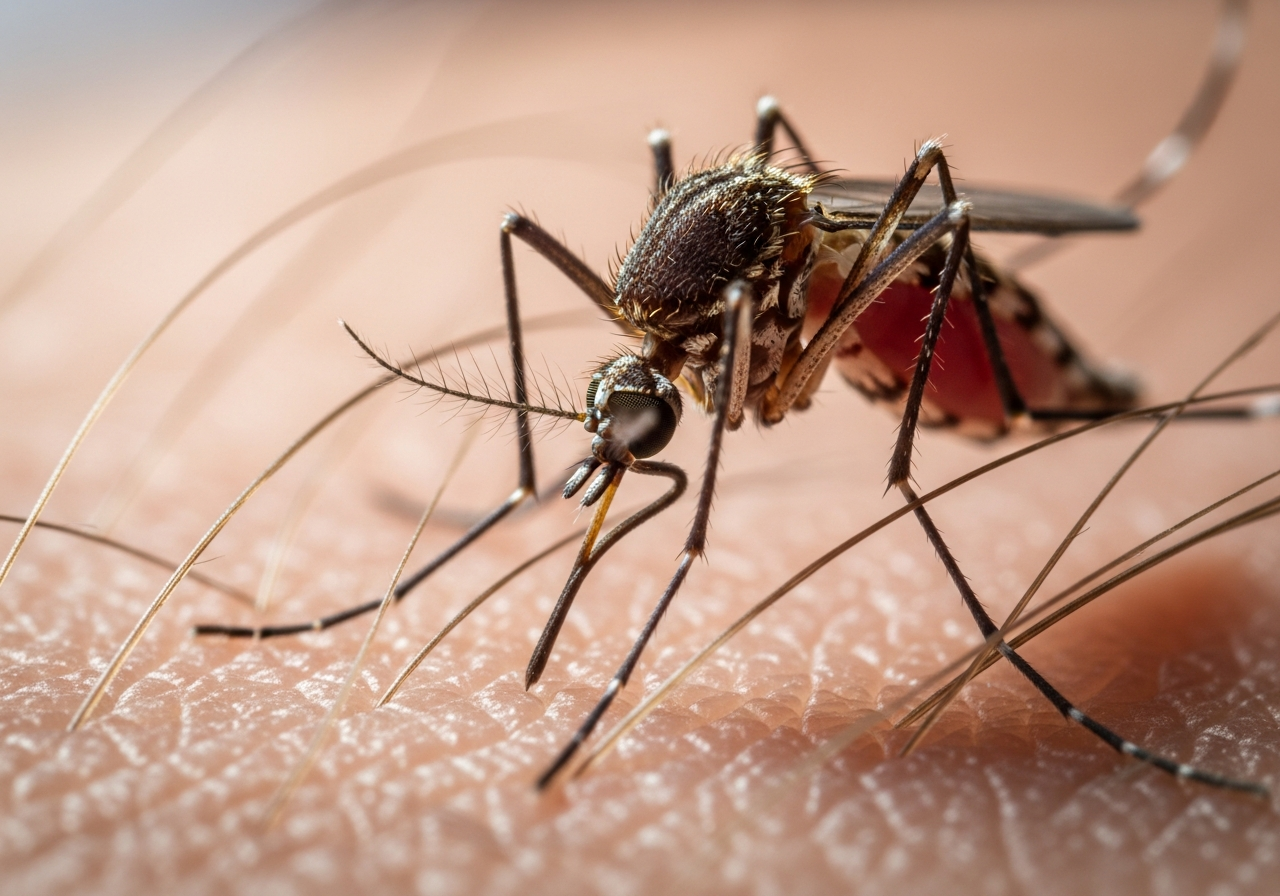
Mosquitoes are tiny, delicate flies, typically just 3 to 6 mm long and weighing only a few millionths of a kilogram. They have a slender body, long thread-like legs, a single pair of narrow wings, and a prominent tube-shaped mouthpart called a proboscis. Females use the proboscis to pierce skin and draw blood, while males lack the equipment to bite. Their fragile build and light weight let them fly and settle almost unnoticed.
Feeding and why females bite
Both male and female mosquitoes feed mainly on flower nectar and plant sugars for energy. Only females bite, and they do so to obtain the protein in blood needed to develop their eggs. A female locates a host using body heat, exhaled carbon dioxide, and scent, then injects saliva that stops the blood from clotting as she feeds. It is this saliva, and the biting itself, that can pass on disease.
Flight and behaviour
Mosquitoes are weak, slow fliers that move at only about 2.5 km/h (1.5 mph), relying on stealth rather than speed. Their wings beat several hundred times a second, producing the familiar high-pitched whine. Many species are most active at dawn and dusk or through the night, resting in cool, shaded spots during the heat of the day. They tend to stay close to the damp places where they hatched.
Life cycle and standing water
Mosquitoes need standing water to breed, which is why they are found near ponds, marshes, ditches, and even water-filled containers. Females lay their eggs on or near the water, and the larvae, known as wrigglers, live in it while feeding on tiny organic matter. After a pupal stage the adult emerges to fly away, completing the cycle in as little as one to two weeks in warm conditions. Adult mosquitoes live only a few weeks.
The deadliest animal to humans
Though tiny, the mosquito is often called the deadliest animal on Earth because of the diseases it carries between people. Different species transmit malaria, dengue, yellow fever, Zika, and West Nile virus, causing hundreds of thousands of human deaths every year. The mosquito itself does not cause the illness, but acts as a carrier that passes microscopic parasites and viruses from one host to the next. This makes mosquito control a major focus of public health worldwide.
Role in nature
Despite their reputation, mosquitoes are part of many food webs. Their aquatic larvae are eaten by fish and other water creatures, and the adults are food for birds, bats, dragonflies, and spiders. Male mosquitoes, and females between blood meals, also visit flowers and can act as minor pollinators. The family Culicidae is widespread and abundant, and the IUCN lists mosquitoes as Least Concern.
Dig deeper into the Mosquito
- Are Mosquitos Dangerous?
Are mosquitos dangerous? Realistic risk, when incidents rise, and safety basics.
- Mosquito: Key Facts
Mosquitos (Culicidae) are insects found across Africa, Asia, Europe, North America, South America, Oceania. The tiny insect with an outsized impact.
- What Do Mosquitos Eat?
What mosquitos eat: Nectar; females also drink blood, foraging style, and seasonal shifts in Worldwide near standing water.
- Where Do Mosquitos Live?
Where mosquitos live: Worldwide near standing water, native range cues, and human overlap. Status Least Concern.
Explore the Mosquito
Compare
Related Insects
Did you know? Mosquito facts
- Mosquitoes are small flying insects whose females bite animals and people to drink blood, which they need to produce eggs.
- Only female mosquitoes bite, and they do it to get the blood protein needed to produce eggs. They find hosts by sensing exhaled carbon dioxide, body heat, and skin odors.
- Yes. Mosquitoes are considered among the deadliest animals to humans because some species spread diseases such as malaria, dengue, yellow fever, and Zika, causing many deaths each year.
- Adult mosquitoes usually live only a few weeks. Their full life cycle from egg to adult can be completed in as little as one to two weeks in warm conditions.
- No. Only female mosquitoes bite for blood. Males feed solely on nectar and plant juices and do not bite people or animals.
- Conservation: Least Concern (IUCN).
Diet & feeding
Mosquito feeds primarily as a nectar; females also drink blood. Only female mosquitoes bite, and they do so to get the protein in blood needed to develop their eggs. They locate hosts by sensing exhaled carbon dioxide, body heat, and skin chemicals. Both males and females actually feed on nectar and plant juices for ev
Adaptations
- Only female mosquitoes bite, and they do so to get the protein in blood needed to develop their eggs. They locate hosts by sensing exhaled carbon dioxide, body heat, and skin chemicals. Both males and females actually feed on nectar and plant juices for everyday energy.
- Mosquitoes are often called the deadliest animals to humans because certain species transmit diseases as they feed. Malaria, dengue, yellow fever, Zika, and West Nile virus are all spread by mosquitoes, causing hundreds of thousands of deaths worldwide each year, mostly from malaria.
Behaviour & ecology
- Only female mosquitoes bite, and they do so to get the protein in blood needed to develop their eggs. They locate hosts by sensing exhaled carbon dioxide, body heat, and skin chemicals. Both males and females actually feed on nectar and plant juices for everyday energy.
- Mosquitoes are often called the deadliest animals to humans because certain species transmit diseases as they feed. Malaria, dengue, yellow fever, Zika, and West Nile virus are all spread by mosquitoes, causing hundreds of thousands of deaths worldwide each year, mostly from malaria.
- Mosquitoes lay their eggs in or near standing water, where the larvae and pupae develop before emerging as flying adults. Because they breed in even small pools, removing standing water around homes is one of the most effective ways to reduce their numbers.
Communication
- Mosquito uses scent, posture, and vocal signals to mark territory and coordinate social behaviour.
- Communication intensity often peaks during breeding seasons and territorial disputes.
Habitat & range
Worldwide near standing water
Ecological role
Mosquito participates in pollination, decomposition, or prey-base support for birds and other insectivores.
Conservation status of the Mosquito
The mosquito (Culicidae) is listed as Least Concern on the IUCN Red List. Least Concern (LC) is the IUCN's lowest-risk category, assigned to widespread, abundant species that have been evaluated and found not to be threatened. It does not mean a species faces no pressures — only that it is not currently at risk of extinction.
The mosquito (Culicidae) is assessed on the IUCN Red List. Look up on the IUCN Red List .
Frequently asked questions about the Mosquito
Why do mosquitoes bite humans?
Only female mosquitoes bite, and they do so to get the protein in blood needed to develop their eggs. Both males and females otherwise feed on nectar and plant sugars.
Are mosquitoes really the deadliest animal?
Yes. Mosquitoes are often called the deadliest animal to humans because they spread diseases such as malaria, dengue, and yellow fever, causing hundreds of thousands of deaths each year.
How long do mosquitoes live?
Adult mosquitoes live only a few weeks. In warm conditions the whole life cycle, from egg through larva and pupa to adult, can be completed in as little as one to two weeks.
Why do mosquitoes need standing water?
Mosquitoes lay their eggs on or near standing water, and the larvae develop in it. Removing sources of still water is one of the most effective ways to reduce mosquito numbers.
How fast can a mosquito fly?
Mosquitoes are slow fliers, moving at only about 2.5 km/h (1.5 mph). They rely on stealth and their small size rather than speed to reach a host.
Do all mosquitoes spread disease?
No. Only certain species, and only biting females, transmit diseases, and only when they have picked up a parasite or virus from an infected host. Many mosquitoes never spread any illness.
What is a group of mosquitos called?
A group of Mosquitos is called a swarm. It is also known as a scourge.
What is a baby mosquito called?
A baby Mosquito is called a larva. It may also be called a wriggler.
Sources & references
This guide is compiled and reviewed against established zoological and conservation references. Key sources for the Mosquito:
-
IUCN Red List of Threatened Species
Conservation status (Least Concern) reflects the IUCN Red List category for Culicidae.
-
iNaturalist — observations & photos
Search citizen-science observations and community IDs for Culicidae. Useful for range checks and recent sightings — not a substitute for formal Red List status.
-
GBIF — occurrence data
Global Biodiversity Information Facility species search for Culicidae. Explore published occurrence records used in range research.
- IUCN Red List — Culicidae.
Conservation status (Least Concern) and population trends.
- Wikipedia — Mosquito.
General taxonomy and overview (cross-check primary sources).
-
Global Animal Guide editorial standards
How we research, source, review, and update every guide for accuracy.