Image sourcing: see credits & licences
Quick answer
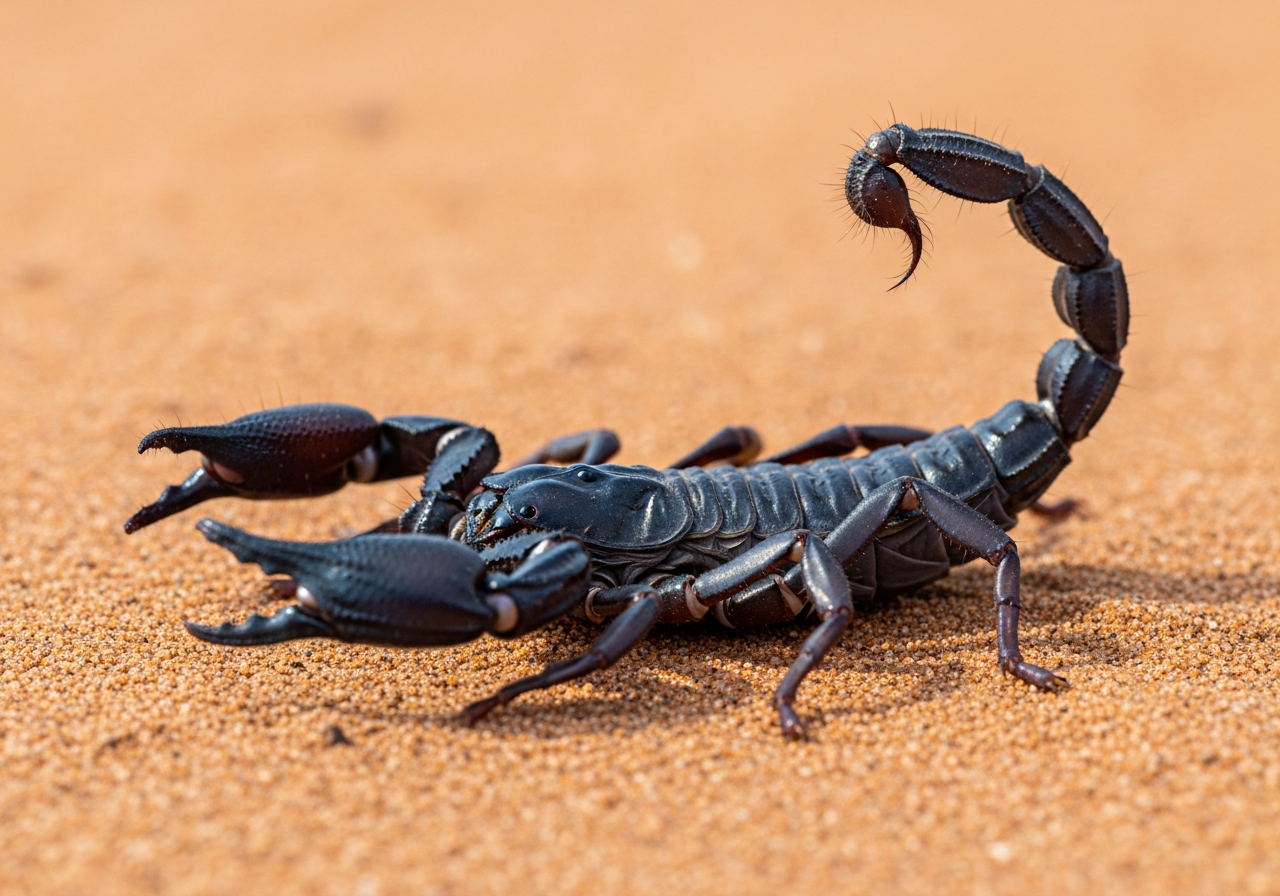
The emperor scorpion is one of the largest scorpions in the world, a glossy black arachnid native to the rainforests of West Africa. It has large pincers, eight legs, and a curved tail tipped with a stinger, and its body glows blue-green under ultraviolet light. Despite its fearsome look, its venom is mild, and it is a popular, docile pet that can live 6 to 8 years.
Top questions about the Emperor Scorpion
Emperor Scorpion facts at a glance
- Weight 30 g
- Length 20 cm
- Top speed 2 km/h
- Lifespan 8 years
| Scientific name | Pandinus imperator |
|---|---|
| Diet | Carnivore (insects, spiders, small vertebrates) |
| Habitat | Rainforests and savannas of West Africa |
| Lifespan | 6–8 years |
| Size | Up to 20 cm (8 in) long |
| Top speed | Slow walker; fast pincer strikes |
| Conservation status | Least Concern (IUCN) |
| Kingdom | Animalia |
|---|---|
| Phylum | Arthropoda |
| Class | Arachnida |
| Order | Scorpiones |
Where it lives
The emperor scorpion (Pandinus imperator) is native to Rainforests and savannas of West Africa, including Nigeria, Ghana, and Togo. — recorded across Africa in this guide’s range summary.
For occurrence records, see GBIF species search and sources below.
How big is a emperor scorpion?
An adult emperor scorpion measures 20 cm long — about 12% of the height of an average adult person (1.73 m) — and weighs around 30 g, a small fraction of an average adult’s body weight (70 kg).
Length vs an average adult’s height (to scale)
What is a group of emperor scorpions called?
Group name (collective noun)
A group of Emperor Scorpions is called a bed. It is also known as a nest.
Baby name
A baby Emperor Scorpion is called a scorpling.
Explore more animal collective nouns and baby animal names .
Pincers and stinger
The emperor scorpion is an arachnid with eight legs, two large front pincers, and a segmented tail ending in a venomous stinger. Large adults rely mainly on their powerful pincers to seize and crush prey, using the stinger less often. Its venom is mild for humans, usually causing only a sting comparable to a bee.
Glowing in the dark
Like other scorpions, the emperor scorpion's exoskeleton contains substances that fluoresce a striking blue-green under ultraviolet light. Researchers use UV lamps to find scorpions at night because of this glow. The reason for the fluorescence is still debated, with theories ranging from light detection to protection from sunlight.
Diet and behavior
Emperor scorpions are nocturnal carnivores that hunt insects, spiders, and occasionally small vertebrates. They detect prey through vibrations and fine sensory hairs, then grab it with their pincers. By day they shelter in burrows or under logs and leaf litter in humid forest floors.
As a pet
Because they are large, slow, and have mild venom, emperor scorpions are among the most popular pet scorpions. They need a warm, humid enclosure with hiding spots and a substrate they can burrow into. They are protected under international trade rules, so captive-bred animals are preferred.
Dig deeper into the Emperor Scorpion
- How Long Do Emperor Scorpions Live?
Emperor Scorpion lifespan is typically 6–8 years. What shortens or extends life, life stages, and status (Least Concern).
- What Do Emperor Scorpions Eat?
What emperor scorpions eat: Carnivore (insects, spiders, small vertebrates), foraging style, and seasonal shifts in Rainforests and savannas of West Africa.
- Where Do Emperor Scorpions Live?
Where emperor scorpions live: Rainforests and savannas of West Africa, native range cues, and human overlap. Status Least Concern.
Explore the Emperor Scorpion
Compare
Related Invertebrates
Range & geography
Did you know? Emperor Scorpion facts
- The emperor scorpion is one of the largest scorpions in the world, a glossy black arachnid native to the rainforests of West Africa.
- Emperor scorpions have mild venom, and their sting is usually no worse than a bee sting for most people. They prefer to use their large pincers and are considered one of the more docile scorpion species.
- Scorpion exoskeletons contain compounds that fluoresce blue-green under ultraviolet light. Scientists use this glow to spot scorpions at night, though the exact reason they fluoresce is still being studied.
- Emperor scorpions are nocturnal carnivores that eat insects, spiders, and sometimes small vertebrates. They sense prey through vibrations and grab it with their large pincers.
- Emperor scorpions typically live about 6 to 8 years, which is long for an invertebrate. Good care in captivity helps them reach the upper end of that range.
- Conservation: Least Concern (IUCN).
Diet & feeding
Emperor Scorpion feeds primarily as a carnivore (insects, spiders, small vertebrates). The emperor scorpion is an arachnid with eight legs, two large front pincers, and a segmented tail ending in a venomous stinger. Large adults rely mainly on their powerful pincers to seize and crush prey, using the stinger less often
Adaptations
- The emperor scorpion is an arachnid with eight legs, two large front pincers, and a segmented tail ending in a venomous stinger. Large adults rely mainly on their powerful pincers to seize and crush prey, using the stinger less often. Its venom is mild for humans, usually causing only a sting comparable to a bee.
- Like other scorpions, the emperor scorpion's exoskeleton contains substances that fluoresce a striking blue-green under ultraviolet light. Researchers use UV lamps to find scorpions at night because of this glow. The reason for the fluorescence is still debated, with theories ranging from light detection to protection from sunlight.
Behaviour & ecology
- The emperor scorpion is an arachnid with eight legs, two large front pincers, and a segmented tail ending in a venomous stinger. Large adults rely mainly on their powerful pincers to seize and crush prey, using the stinger less often. Its venom is mild for humans, usually causing only a sting comparable to a bee.
- Like other scorpions, the emperor scorpion's exoskeleton contains substances that fluoresce a striking blue-green under ultraviolet light. Researchers use UV lamps to find scorpions at night because of this glow. The reason for the fluorescence is still debated, with theories ranging from light detection to protection from sunlight.
- Emperor scorpions are nocturnal carnivores that hunt insects, spiders, and occasionally small vertebrates. They detect prey through vibrations and fine sensory hairs, then grab it with their pincers. By day they shelter in burrows or under logs and leaf litter in humid forest floors.
Communication
- Emperor Scorpion uses scent, posture, and vocal signals to mark territory and coordinate social behaviour.
- Communication intensity often peaks during breeding seasons and territorial disputes.
Habitat & range
Rainforests and savannas of West Africa
Ecological role
Emperor Scorpion acts as a predator that helps regulate prey populations and maintain balance in rainforests and savannas of west africa.
Conservation status of the Emperor Scorpion
The emperor scorpion (Pandinus imperator) is listed as Least Concern on the IUCN Red List. Least Concern (LC) is the IUCN's lowest-risk category, assigned to widespread, abundant species that have been evaluated and found not to be threatened. It does not mean a species faces no pressures — only that it is not currently at risk of extinction.
The emperor scorpion (Pandinus imperator) is assessed on the IUCN Red List. Look up on the IUCN Red List .
Frequently asked questions about the Emperor Scorpion
Is the emperor scorpion dangerous to humans?
Emperor scorpions have mild venom, and their sting is usually no worse than a bee sting for most people. They prefer to use their large pincers and are considered one of the more docile scorpion species.
Why do scorpions glow under UV light?
Scorpion exoskeletons contain compounds that fluoresce blue-green under ultraviolet light. Scientists use this glow to spot scorpions at night, though the exact reason they fluoresce is still being studied.
What do emperor scorpions eat?
Emperor scorpions are nocturnal carnivores that eat insects, spiders, and sometimes small vertebrates. They sense prey through vibrations and grab it with their large pincers.
How long do emperor scorpions live?
Emperor scorpions typically live about 6 to 8 years, which is long for an invertebrate. Good care in captivity helps them reach the upper end of that range.
Are emperor scorpions good pets?
Yes. Their large size, calm temperament, and mild venom make them popular pet scorpions. They need a warm, humid tank with hiding spots and burrowing substrate, and captive-bred animals are best.
What is a group of emperor scorpions called?
A group of Emperor Scorpions is called a bed. It is also known as a nest.
What is a baby emperor scorpion called?
A baby Emperor Scorpion is called a scorpling.
Sources & references
This guide is compiled and reviewed against established zoological and conservation references. Key sources for the Emperor Scorpion:
-
IUCN Red List of Threatened Species
Conservation status (Least Concern) reflects the IUCN Red List category for Pandinus imperator.
-
iNaturalist — observations & photos
Search citizen-science observations and community IDs for Pandinus imperator. Useful for range checks and recent sightings — not a substitute for formal Red List status.
-
GBIF — occurrence data
Global Biodiversity Information Facility species search for Pandinus imperator. Explore published occurrence records used in range research.
- IUCN Red List — Pandinus imperator.
Conservation status (Least Concern) and population trends.
- Animal Diversity Web — Pandinus imperator. University of Michigan Museum of Zoology.
Life history, morphology, and range.
- Wikipedia — Emperor Scorpion.
General taxonomy and overview (cross-check primary sources).
-
Global Animal Guide editorial standards
How we research, source, review, and update every guide for accuracy.