Stingray
Myliobatoidei
Quick answer
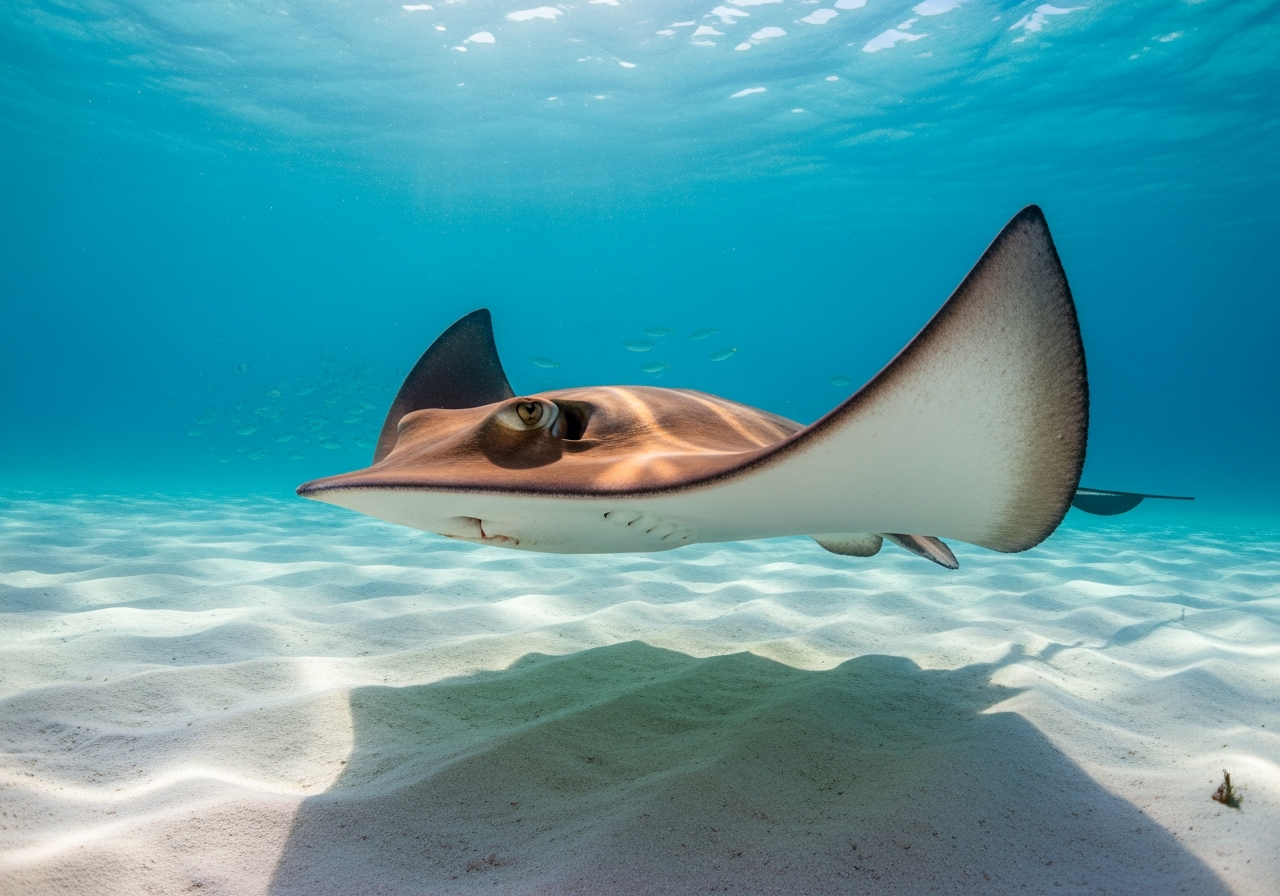
Stingrays are a group of flattened, cartilaginous fish related to sharks, found in coastal seas, reefs, and some rivers across tropical and temperate waters worldwide. They glide along the seafloor on broad wing-like fins and most have one or more venomous spines on the tail for defense. Stingrays feed on bottom-dwelling animals and, depending on the species, can live 15 to 25 years.
Stingray facts at a glance
| Scientific name | Myliobatoidei |
|---|---|
| Diet | Carnivore (mollusks, crustaceans, fish) |
| Habitat | Coastal seas, reefs, and some rivers |
| Lifespan | 15–25 years by species |
| Length | Varies; up to 2 m (6.5 ft) wide in large species |
| Top speed | Glides; fast burst when alarmed |
| Conservation status | Varies by species |
| Kingdom | Animalia |
|---|---|
| Phylum | Chordata |
| Class | Chondrichthyes |
| Order | Myliobatiformes |
Where it lives
Coastal seas, reefs, and some rivers across tropical and temperate waters worldwide.
Behavior and biology
Stingrays are bottom-dwelling fish that swim by rippling or flapping their broad pectoral fins, which form a flat disc shape. They often bury themselves in sand or mud with only their eyes and spiracles showing, both to hide from predators and to ambush prey. Like sharks, they sense the faint electrical signals of hidden animals using special organs around the mouth.
Diet and feeding
Most stingrays are carnivores that feed on bottom-living animals such as clams, snails, shrimp, crabs, and small fish. They use their flattened bodies to pin prey against the seafloor and crush hard shells with strong, plate-like teeth. Their downward-facing mouths are well suited to feeding along the bottom.
The stinging spine
Many stingrays carry one or more barbed, venomous spines partway along the tail, used purely for defense against predators such as sharks. When stepped on or threatened, a stingray can whip its tail upward and drive the spine into an attacker, delivering painful venom. Most injuries to people happen when waders accidentally step on a hidden ray.
Habitat and range
Stingrays live in tropical and temperate waters worldwide, from shallow coastal flats and estuaries to coral reefs, and a few groups live in freshwater rivers of South America and elsewhere. They favor soft, sandy or muddy bottoms where they can bury and forage. Different species range from cool temperate seas to warm tropical lagoons.
Frequently asked questions about the Stingray
Are stingrays dangerous?
Stingrays are not aggressive but can deliver a painful venomous sting in self-defense if stepped on or threatened. Serious injuries are uncommon, and shuffling your feet in shallow water helps avoid stepping on them.
What do stingrays eat?
Most stingrays are carnivores that feed on bottom-dwelling animals such as clams, snails, shrimp, crabs, and small fish, crushing shells with flat, plate-like teeth.
Are stingrays related to sharks?
Yes. Stingrays are cartilaginous fish closely related to sharks, sharing skeletons made of cartilage and the ability to sense the electrical fields of prey.
How do stingrays defend themselves?
Many stingrays have one or more barbed, venomous spines on the tail that they whip upward when threatened. The spines are used only for defense, not for hunting.
Do all stingrays live in the ocean?
Most stingrays live in the sea, but several species, including the river stingrays of South America, live entirely in freshwater rivers and lakes.
How long do stingrays live?
Lifespan varies by species, but many stingrays live around 15 to 25 years, with some larger species living longer.