Image sourcing: see credits & licences
Quick answer
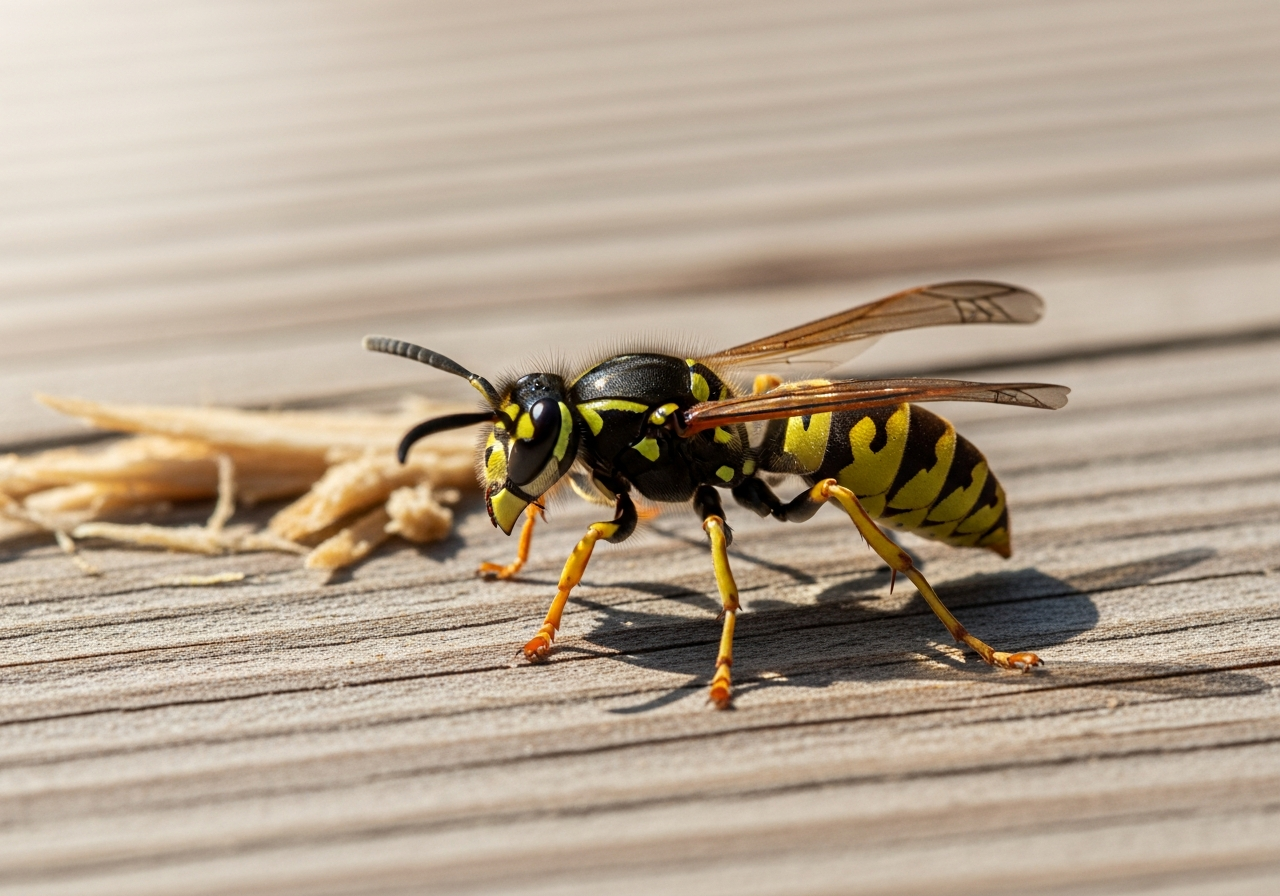
The common wasp (Vespula vulgaris) is a familiar yellow-and-black flying insect of gardens, woodlands, and urban areas across the northern hemisphere. Workers grow to about 1.2 to 1.7 cm long and fly at up to around 25 km/h, living in large paper nests built by a single queen. Wasps are omnivores that hunt insects to feed their grubs and visit nectar and sugary foods themselves. Workers live only a few weeks while queens survive about a year.
Top questions about the Wasp
Wasp facts at a glance
- Weight 0 g
- Length 2 cm
- Top speed 25 km/h
- Lifespan 1 years
| Scientific name | Vespula vulgaris |
|---|---|
| Diet | Omnivore (insects, nectar, sugary foods) |
| Habitat | Gardens, woodlands, and urban areas |
| Lifespan | Workers a few weeks; queens about a year |
| Length | 1.2–1.7 cm (0.5–0.7 in) |
| Top speed | Up to ~25 km/h (16 mph) in flight |
| Conservation status | Least Concern (IUCN) |
| Kingdom | Animalia |
|---|---|
| Phylum | Arthropoda |
| Class | Insecta |
| Order | Hymenoptera |
| Family | Vespidae |
| Genus | Vespula |
Where it lives
The wasp (Vespula vulgaris) is native to Gardens, woodlands, and urban areas worldwide; the common wasp is found across the Northern Hemisphere. — recorded across Europe, Asia, North America, Oceania in this guide’s range summary.
For occurrence records, see GBIF species search and sources below.
How big is a wasp?
An adult wasp measures 2 cm long — about 1% of the height of an average adult person (1.73 m) — and weighs around 0 g, a small fraction of an average adult’s body weight (70 kg).
Length vs an average adult’s height (to scale)
What is a group of wasps called?
Group name (collective noun)
A group of Wasps is called a swarm. It is also known as a colony or a nest.
Baby name
A baby Wasp is called a larva.
Explore more animal collective nouns and baby animal names .
Life inside the colony
Common wasps are social insects that live in colonies founded each spring by a single overwintered queen. She builds a small paper nest from chewed wood fibres and raises the first workers, who then take over expanding the nest and gathering food. By late summer a nest may hold thousands of workers. The colony produces new queens and males in autumn, after which the old nest dies off and only newly mated queens survive the winter.
Flight and foraging
Wasps are strong, agile fliers, reaching speeds of around 25 km/h as they range out from the nest in search of food. Their two pairs of wings and narrow waist give them precise control in the air, letting them hover, dart, and land accurately. Foragers can travel considerable distances and return laden with prey or sugary liquids. Good eyesight and a keen sense of smell help them locate food quickly.
What wasps eat
The common wasp is an omnivore with a diet that shifts through the year. For much of the summer, workers hunt caterpillars, flies, and other insects, which they chew up and feed to the grubs back in the nest. In return, the larvae produce a sugary secretion the adults consume. Later in the season, when the larvae are gone, adults turn to nectar, ripe fruit, and sugary human foods, which is why they become a nuisance at picnics in late summer.
The sting and defence
Unlike honeybees, wasps have a smooth stinger and can sting repeatedly without dying. The sting is used to subdue prey and to defend the nest, and a threatened colony can mount an aggressive collective response. A wasp under attack may also release an alarm pheromone that summons nearby nestmates. For most people a sting is painful but harmless, though some individuals are dangerously allergic.
Role in the garden
As predators of caterpillars, flies, and other insects, common wasps help keep populations of garden pests in check throughout the summer. When they switch to feeding on nectar and fruit later in the season, they also act as occasional pollinators. This makes them more useful to gardeners than their reputation suggests. Their appetite for sugary foods in autumn is simply a sign that the colony's hunting season is ending.
Lifespan and the yearly cycle
The wasp colony follows a strict annual rhythm. Worker wasps live only a few weeks during the busy summer, while a queen can survive about a year, long enough to overwinter and found a new colony the following spring. In autumn the founding queen and her workers die, and only the newly mated young queens live on, sheltering through winter in cracks and crevices. The common wasp is abundant and listed as Least Concern.
Dig deeper into the Wasp
- Wasp: Key Facts
Wasps (Vespula vulgaris) are insects found across Europe, Asia, North America, Oceania. The yellow-and-black predator and scavenger of summer.
- What Do Wasps Eat?
What wasps eat: Omnivore (insects, nectar, sugary foods), foraging style, and seasonal shifts in Gardens, woodlands, and urban areas.
- Where Do Wasps Live?
Where wasps live: Gardens, woodlands, and urban areas, native range cues, and human overlap. Status Least Concern.
Explore the Wasp
Related Insects
Range & geography
Did you know? Wasp facts
- Wasps are stinging insects with slender, often yellow-and-black bodies, of which the common wasp is one of the most familiar.
- Wasps tend to have slender, smooth bodies and are predators or scavengers, while bees are usually furrier and feed mainly on nectar and pollen. Wasps can also sting repeatedly, whereas a honey bee dies after stinging once.
- Wasps sting to defend their nest and to subdue insect prey for their larvae. A smooth stinger lets a female wasp sting several times, and most stings happen when a wasp feels threatened.
- Adult wasps feed mostly on sugars from nectar, fruit, and sweet foods, while they catch insects and spiders to feed their developing young. This hunting makes them useful for controlling garden pests.
- Yes. Wasps help control populations of insect pests, scavenge dead material, and pollinate some plants. Despite their reputation, they provide real benefits to gardens and ecosystems.
- Conservation: Least Concern (IUCN).
Diet & feeding
Wasp feeds primarily as a omnivore (insects, nectar, sugary foods). Wasps fall into two broad groups: social wasps such as the common wasp and hornets that live in colonies, and the far more numerous solitary wasps that live alone. Social wasps build nests from chewed wood fibers, creating a papery material in which th
Adaptations
- Wasps fall into two broad groups: social wasps such as the common wasp and hornets that live in colonies, and the far more numerous solitary wasps that live alone. Social wasps build nests from chewed wood fibers, creating a papery material in which the queen and her workers raise the brood. A colony grows through the summer and then dies off, with only new queens surviving the winter.
- Adult wasps feed mainly on sugars from nectar, fruit, and human food, while they hunt insects and spiders to feed their growing larvae. This makes them valuable natural pest controllers in gardens and on farms. Late in the season, when the colony stops producing brood, foraging workers often turn to sweet foods, which is when they become a nuisance around picnics.
Behaviour & ecology
- Wasps fall into two broad groups: social wasps such as the common wasp and hornets that live in colonies, and the far more numerous solitary wasps that live alone. Social wasps build nests from chewed wood fibers, creating a papery material in which the queen and her workers raise the brood. A colony grows through the summer and then dies off, with only new queens surviving the winter.
- Adult wasps feed mainly on sugars from nectar, fruit, and human food, while they hunt insects and spiders to feed their growing larvae. This makes them valuable natural pest controllers in gardens and on farms. Late in the season, when the colony stops producing brood, foraging workers often turn to sweet foods, which is when they become a nuisance around picnics.
- Female wasps have a smooth stinger that, unlike a honey bee's, is not left behind, so they can sting many times. The sting is used both to subdue prey and to defend the nest. For most people a sting is painful but harmless, though some individuals are allergic and can have severe reactions.
Communication
- Wasp uses scent, posture, and vocal signals to mark territory and coordinate social behaviour.
- Communication intensity often peaks during breeding seasons and territorial disputes.
Habitat & range
Gardens, woodlands, and urban areas
Ecological role
Wasp participates in pollination, decomposition, or prey-base support for birds and other insectivores.
Conservation status of the Wasp
The wasp (Vespula vulgaris) is listed as Least Concern on the IUCN Red List. Least Concern (LC) is the IUCN's lowest-risk category, assigned to widespread, abundant species that have been evaluated and found not to be threatened. It does not mean a species faces no pressures — only that it is not currently at risk of extinction.
The wasp (Vespula vulgaris) is assessed on the IUCN Red List. Look up on the IUCN Red List .
Frequently asked questions about the Wasp
What do wasps eat?
Common wasps are omnivores. In summer they hunt insects such as caterpillars and flies to feed their grubs, while the adults drink nectar and sugary liquids. Later in the year they turn to fruit and sweet human foods, which is why they bother picnics in late summer.
Can a wasp sting more than once?
Yes. Unlike honeybees, wasps have a smooth stinger and can sting repeatedly without harming themselves. They use the sting to subdue prey and to defend their nest.
How long do wasps live?
Worker wasps live only a few weeks during summer. A queen lives about a year, long enough to survive the winter and start a new colony the following spring.
Why do wasps become a nuisance in late summer?
By late summer the queen has stopped producing larvae, so the sugary secretion the larvae fed the adults disappears. The workers then seek out nectar, ripe fruit, and sweet human foods, bringing them to picnics and bins just as the colony's season ends.
Are wasps useful for anything?
Yes. Wasps hunt large numbers of caterpillars, flies, and other insects, helping control garden pests through the summer. When they feed on nectar and fruit later in the year, they can also act as occasional pollinators.
How fast can a wasp fly?
Common wasps can fly at speeds of around 25 km/h (about 16 mph). Their two pairs of wings give them precise control, allowing them to hover, dart, and land accurately while foraging.
What is a group of wasps called?
A group of Wasps is called a swarm. It is also known as a colony or a nest.
What is a baby wasp called?
A baby Wasp is called a larva.
Sources & references
This guide is compiled and reviewed against established zoological and conservation references. Key sources for the Wasp:
-
IUCN Red List of Threatened Species
Conservation status (Least Concern) reflects the IUCN Red List category for Vespula vulgaris.
-
iNaturalist — observations & photos
Search citizen-science observations and community IDs for Vespula vulgaris. Useful for range checks and recent sightings — not a substitute for formal Red List status.
-
GBIF — occurrence data
Global Biodiversity Information Facility species search for Vespula vulgaris. Explore published occurrence records used in range research.
- IUCN Red List — Vespula vulgaris.
Conservation status (Least Concern) and population trends.
- Animal Diversity Web — Vespula vulgaris. University of Michigan Museum of Zoology.
Life history, morphology, and range.
- Wikipedia — Wasp.
General taxonomy and overview (cross-check primary sources).
-
Global Animal Guide editorial standards
How we research, source, review, and update every guide for accuracy.