What Is the Largest Bird in the World?
The ostrich is the heaviest and tallest living bird. Elephant birds and moa were larger but extinct. Wandering albatrosses have the widest wingspan.
Global Animal Guide · June 28, 2026
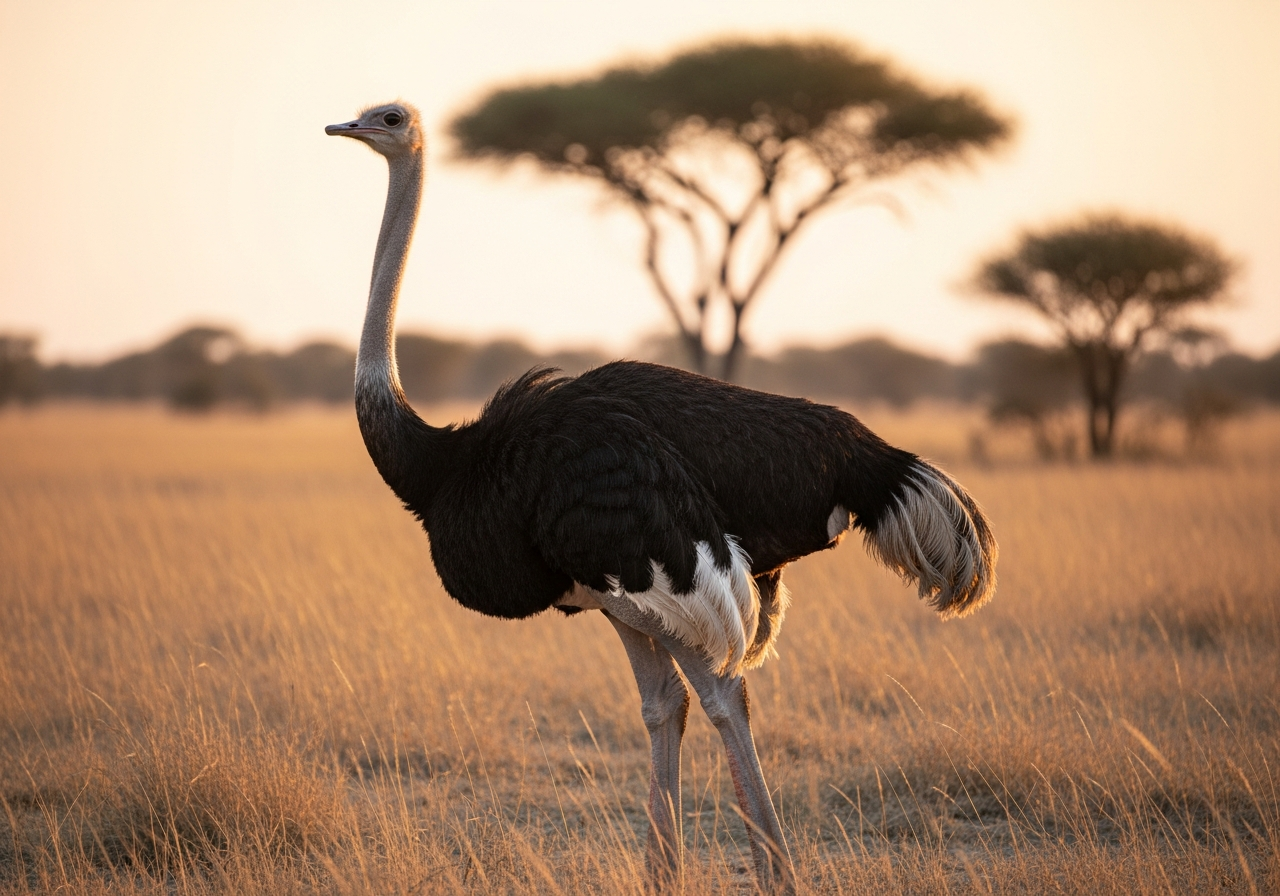
Image sourcing: see credits & licences
Quick answer
The ostrich is the largest living bird by height and weight — males can stand 2.7 m tall and weigh over 150 kg. The wandering albatross has the widest wingspan at up to 3.5 m.
Last updated: June 2026 — figures reflect widely cited scientific estimates.
The ostrich is the largest living bird by every measure that involves the bird itself standing still: a male can reach around 2.7 metres tall and weigh over 150 kg. But “largest” is three different records wearing one name. By wingspan, the wandering albatross wins at up to about 3.5 metres. By the largest bird that ever lived, both are beaten by animals humans drove to extinction within the last thousand years.
Why the ostrich holds the size record
The ostrich is the heaviest and tallest living bird, and it is no coincidence that it cannot fly. Flight imposes a brutal weight budget — every gram must be lifted by muscle, and the power available scales more slowly than the mass being lifted. Abandon flight and the budget disappears. The ostrich has no keeled sternum to anchor flight muscles, its bones are less pneumatised than a flier’s, and its plumage is loose and shaggy rather than locked into aerodynamic vanes, because there is no airflow to keep smooth.
What it spent the savings on is running. The ostrich is the fastest bird on land, sustaining speeds no other biped approaches, with an elongated leg, an enormous tendon-loaded stride, and a foot reduced to just two toes — unique among birds, and the same trick horses used when they reduced to one. Its eyes are the largest of any land vertebrate, which matters on open savanna where seeing a lion at distance is the difference between running and being caught. It lays the largest egg of any living bird, though relative to the mother’s body it is actually rather small.
Females are grey-brown and males black-and-white, and both incubate — the female by day, blending into the ground, the male at night. It is a neat illustration of camouflage doing real work rather than decorative work.
Wingspan belongs to the albatross
The wandering albatross wins a different contest entirely. Its wings, at up to roughly 3.5 metres, are extraordinarily long and narrow — a high aspect ratio, in the same way a glider’s wings differ from a fighter jet’s.
That shape is built for dynamic soaring. The albatross exploits the wind gradient above ocean waves, where air moves slowly near the surface and faster higher up. By repeatedly climbing into the faster air and diving back down, the bird harvests energy from the shear and can cross vast stretches of the Southern Ocean while barely flapping. A tendon lock in the shoulder holds the wing extended without muscular effort. The cost is that it is clumsy at take-off and landing, and needs wind — becalmed, an albatross is close to grounded.
This is why wingspan and weight are separate records. The albatross is long-winged and comparatively light; the ostrich is heavy and wingless. Neither is “bigger” in any absolute sense.
The heaviest birds that can still fly
Between those extremes sits a more revealing record: the heaviest bird capable of powered flight. Contenders include the great bustard and kori bustard, and among soaring birds the Andean condor and the California condor, whose broad, slotted wings ride thermals rather than sea wind. The swan and the largest pelicans crowd the same ceiling.
The consistent finding is that the ceiling sits somewhere around 15–20 kg, and heavy fliers cheat to reach it. Bustards need long take-off runs. Condors depend on thermals and rising air along ridges, and struggle to get airborne in still conditions. The shoebill and the pelican are large but built light for their bulk. Beyond that ceiling, flight stops being worth its cost — and on islands or predator-poor continents, birds have abandoned it again and again.
The giants humans wiped out
The ostrich only holds the record because the actual champions are gone. Elephant birds of Madagascar were the heaviest birds known — massive, barrel-bodied ratites approaching half a tonne, laying eggs with a volume of many chicken eggs. They vanished within roughly the last millennium, after people settled the island.
New Zealand’s moa took the height record instead of the weight one. The largest species stood taller than a person with the neck raised, but were more lightly built than elephant birds. They had no wings at all — not even the vestigial stubs most flightless birds retain — because New Zealand had no land mammals and their only serious predator was Haast’s eagle, the largest eagle known. Moa were hunted out within a couple of centuries of Polynesian settlement, and the eagle, dependent on them, went with them.
The pattern is the point. Giant flightless birds evolve reliably where mammalian predators are absent, and disappear reliably when humans arrive. The kakapo, a flightless parrot, and the takahe are the surviving remnant of New Zealand’s version, both only alive today because of intensive management.
How ratites got everywhere without flying
The ostrich, emu, cassowary, kiwi, rhea, moa and elephant bird are all ratites — flightless birds lacking a keeled breastbone. Their distribution across Africa, Australia, New Zealand, Madagascar and South America was long explained by the break-up of Gondwana: one flightless ancestor, carried apart on drifting continents.
Genetic evidence complicated that tidy story. The closest relatives turn out not to match the geography, and the current view is that flight was lost repeatedly and independently, by flying ancestors that dispersed and then grounded themselves once they arrived somewhere safe. The kiwi’s nearest relative appears to be the extinct elephant bird — an odd pairing of the smallest ratite with the largest, which only makes sense if flight was still on the table when their lineages parted.
That reframes the whole record. Giant size in birds is not an ancient inheritance but a repeated, predictable outcome: remove predators, remove the need to fly, and birds get big.
How the record is measured
Records come from museum specimens, wild measurements and — for extinct species — bone dimensions scaled against living relatives, which is where the error bars widen. Height in a long-necked bird depends on posture, so a “tallest” figure means an alert stance, not a resting one. Wingspan is measured across extended wings, and captive maxima often exceed typical wild birds. Ask which measure a headline is using before comparing two records.
Conservation note
Record-holding species often face habitat loss and climate pressure. Protecting ecosystems preserves not only charismatic winners but the food webs they represent. Wandering albatrosses are threatened chiefly by longline fisheries, where birds seize baited hooks and drown — a problem largely solvable with bird-scaring lines and weighted hooks. The California condor survives only because of captive breeding, and is still poisoned by lead ammunition in carcasses it scavenges. The largest birds are, as a group, slow breeders, and slow breeders do not bounce back.
Sources
Related reading: Animal profiles · Fastest animals on Earth · Support wildlife protection
Frequently asked questions
What Is the Largest Bird in the World
The ostrich is the largest living bird by height and weight — males can stand 2.7 m tall and weigh over 150 kg. The wandering albatross has the widest wingspan at up to 3.5 m.
How do scientists measure this record?
Records come from peer-reviewed studies, GPS tracking, high-speed video, toxicology assays, and acoustic meters — field conditions always add variation.
Can the record holder change?
Yes — new measurements, species reclassification, or better technology can update rankings. Always check whether speed, venom, or size is measured differently.