Quick answer
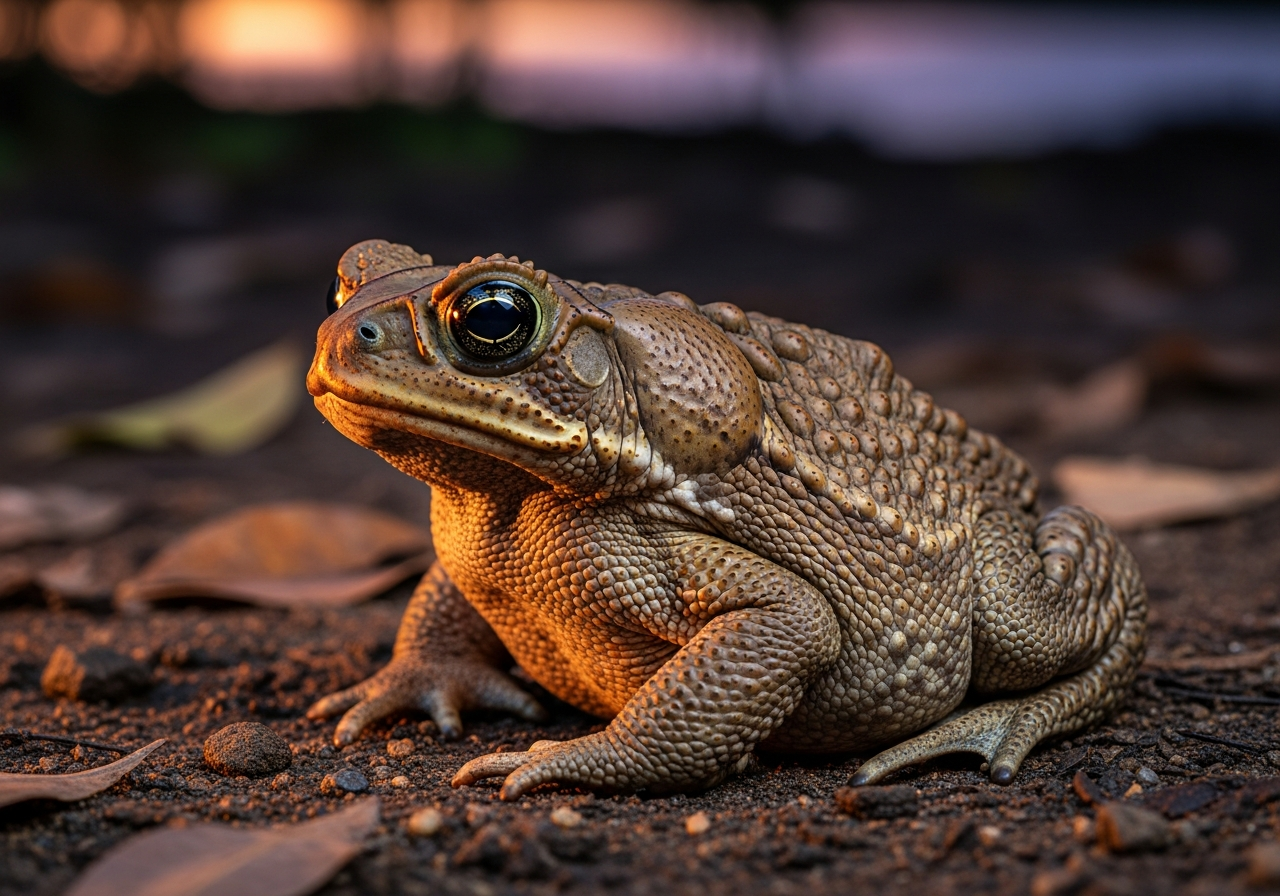
The cane toad is a large, warty terrestrial toad native to the Americas, reaching up to 1 kg (2.2 lb). It secretes a powerful toxin from glands on its shoulders and is famous as a destructive invasive species in Australia, where it was introduced in 1935. Cane toads commonly live 10 to 15 years.
Top questions about the Cane Toad
Cane Toad facts at a glance
- Weight 1 kg
- Length 15 cm
- Top speed 8 km/h
- Lifespan 12 years
| Scientific name | Rhinella marina |
|---|---|
| Diet | Omnivore (insects, small animals, scraps) |
| Habitat | Grassland, woodland, gardens, wetlands |
| Lifespan | 10–15 years in the wild |
| Weight | Up to 1 kg (2.2 lb) |
| Size | 10–15 cm (4–6 in), sometimes larger |
| Conservation status | Least Concern (IUCN) |
| Kingdom | Animalia |
|---|---|
| Phylum | Chordata |
| Class | Amphibia |
| Order | Anura |
| Family | Bufonidae |
| Genus | Rhinella |
Where it lives
The cane toad (Rhinella marina) is native to Native from the southern United States through Central America to northern South America; invasive in Australia and elsewhere. — recorded across North America, South America in this guide’s range summary.
For occurrence records, see GBIF species search and sources below.
How big is a cane toad?
An adult cane toad measures 15 cm long — about 9% of the height of an average adult person (1.73 m) — and weighs around 1.0 kg, about 1% of an average adult’s body weight (70 kg).
Length vs an average adult’s height (to scale)
What is a group of cane toads called?
Group name (collective noun)
A group of Cane Toads is called a knot.
Baby name
A baby Cane Toad is called a tadpole. It may also be called a toadlet.
Explore more animal collective nouns and baby animal names .
Behavior and toxicity
Cane toads are mostly active at night and are not shy of human settlements, often gathering under lights to catch insects. Their main defense is bufotoxin, a potent poison stored in the large parotoid glands behind the eyes. Predators that bite or swallow a cane toad can be sickened or killed, which is why the species is so damaging where native animals have no resistance.
Diet and feeding
Unusually for amphibians, cane toads are opportunistic omnivores. They eat beetles, ants, and other insects, but also small reptiles, frogs, rodents, and even pet food or kitchen scraps. This flexible diet helps them thrive in disturbed and human-modified habitats.
Habitat and range
The cane toad is native to the southern United States, Central America, and northern South America. It was deliberately introduced to many regions, most infamously to Australia in 1935 to control sugarcane beetles. There it spread rapidly and became one of the country's worst invasive species.
Conservation
In its native range the cane toad is listed as Least Concern and is not threatened. The conservation concern is the opposite: where it has been introduced, it poisons native predators and disrupts ecosystems. Management focuses on limiting its spread and protecting vulnerable native wildlife.
Dig deeper into the Cane Toad
- Are Cane Toads Dangerous?
Are cane toads dangerous? Realistic risk, when incidents rise, and safety basics.
- How Long Do Cane Toads Live?
Cane Toad lifespan is typically 10–15 years in the wild. What shortens or extends life, life stages, and status (Least Concern).
- What Do Cane Toads Eat?
What cane toads eat: Omnivore (insects, small animals, scraps), foraging style, and seasonal shifts in Grassland, woodland, gardens, wetlands.
- Where Do Cane Toads Live?
Where cane toads live: Grassland, woodland, gardens, wetlands, native range cues, and human overlap. Status Least Concern.
Explore the Cane Toad
Related Amphibians
Collections
Range & geography
Did you know? Cane Toad facts
- The cane toad is a large, warty terrestrial toad native to the Americas, reaching up to 1 kg (2.2 lb).
- Yes. Cane toads secrete a powerful toxin called bufotoxin from glands behind their eyes. It can sicken or kill predators and pets that bite or swallow the toad.
- Cane toads were introduced to Australia in 1935 to control crop pests but instead spread widely. Their toxin kills native predators that have no resistance, making them one of Australia's most damaging invasive species.
- Cane toads are omnivores. They eat insects such as beetles and ants, as well as small reptiles, frogs, rodents, and even pet food or scraps.
- Cane toads commonly reach 10 to 15 cm (4 to 6 in) and can weigh up to about 1 kg (2.2 lb), making them one of the largest toads in the world.
- Conservation: Least Concern (IUCN).
Diet & feeding
Cane Toad feeds primarily as a omnivore (insects, small animals, scraps). Unusually for amphibians, cane toads are opportunistic omnivores. They eat beetles, ants, and other insects, but also small reptiles, frogs, rodents, and even pet food or kitchen scraps. This flexible diet helps them thrive in disturbed and human
Adaptations
- Cane toads are mostly active at night and are not shy of human settlements, often gathering under lights to catch insects. Their main defense is bufotoxin, a potent poison stored in the large parotoid glands behind the eyes. Predators that bite or swallow a cane toad can be sickened or killed, which is why the species is so damaging where native animals have no resistance.
- Unusually for amphibians, cane toads are opportunistic omnivores. They eat beetles, ants, and other insects, but also small reptiles, frogs, rodents, and even pet food or kitchen scraps. This flexible diet helps them thrive in disturbed and human-modified habitats.
Behaviour & ecology
- Cane toads are mostly active at night and are not shy of human settlements, often gathering under lights to catch insects. Their main defense is bufotoxin, a potent poison stored in the large parotoid glands behind the eyes. Predators that bite or swallow a cane toad can be sickened or killed, which is why the species is so damaging where native animals have no resistance.
- Unusually for amphibians, cane toads are opportunistic omnivores. They eat beetles, ants, and other insects, but also small reptiles, frogs, rodents, and even pet food or kitchen scraps. This flexible diet helps them thrive in disturbed and human-modified habitats.
- The cane toad is native to the southern United States, Central America, and northern South America. It was deliberately introduced to many regions, most infamously to Australia in 1935 to control sugarcane beetles. There it spread rapidly and became one of the country's worst invasive species.
Communication
- Cane Toad uses scent, posture, and vocal signals to mark territory and coordinate social behaviour.
- Communication intensity often peaks during breeding seasons and territorial disputes.
Habitat & range
Grassland, woodland, gardens, wetlands
Ecological role
Cane Toad plays a recognised ecological role in grassland, woodland, gardens, wetlands.
Conservation status of the Cane Toad
The cane toad (Rhinella marina) is listed as Least Concern on the IUCN Red List. Least Concern (LC) is the IUCN's lowest-risk category, assigned to widespread, abundant species that have been evaluated and found not to be threatened. It does not mean a species faces no pressures — only that it is not currently at risk of extinction.
The cane toad (Rhinella marina) is assessed on the IUCN Red List. Look up on the IUCN Red List .
Frequently asked questions about the Cane Toad
Are cane toads poisonous?
Yes. Cane toads secrete a powerful toxin called bufotoxin from glands behind their eyes. It can sicken or kill predators and pets that bite or swallow the toad.
Why are cane toads a problem in Australia?
Cane toads were introduced to Australia in 1935 to control crop pests but instead spread widely. Their toxin kills native predators that have no resistance, making them one of Australia's most damaging invasive species.
What do cane toads eat?
Cane toads are omnivores. They eat insects such as beetles and ants, as well as small reptiles, frogs, rodents, and even pet food or scraps.
How big do cane toads get?
Cane toads commonly reach 10 to 15 cm (4 to 6 in) and can weigh up to about 1 kg (2.2 lb), making them one of the largest toads in the world.
How long do cane toads live?
In the wild cane toads typically live 10 to 15 years, and they can live even longer in captivity.
What is a group of cane toads called?
A group of Cane Toads is called a knot.
What is a baby cane toad called?
A baby Cane Toad is called a tadpole. It may also be called a toadlet.
Sources & references
This guide is compiled and reviewed against established zoological and conservation references. Key sources for the Cane Toad:
-
IUCN Red List of Threatened Species
Conservation status (Least Concern) reflects the IUCN Red List category for Rhinella marina.
-
iNaturalist — observations & photos
Search citizen-science observations and community IDs for Rhinella marina. Useful for range checks and recent sightings — not a substitute for formal Red List status.
-
GBIF — occurrence data
Global Biodiversity Information Facility species search for Rhinella marina. Explore published occurrence records used in range research.
- IUCN Red List — Rhinella marina.
Conservation status (Least Concern) and population trends.
- Animal Diversity Web — Rhinella marina. University of Michigan Museum of Zoology.
Life history, morphology, and range.
- Wikipedia — Cane Toad.
General taxonomy and overview (cross-check primary sources).
-
Global Animal Guide editorial standards
How we research, source, review, and update every guide for accuracy.