Frilled Lizard
Chlamydosaurus kingii
Quick answer
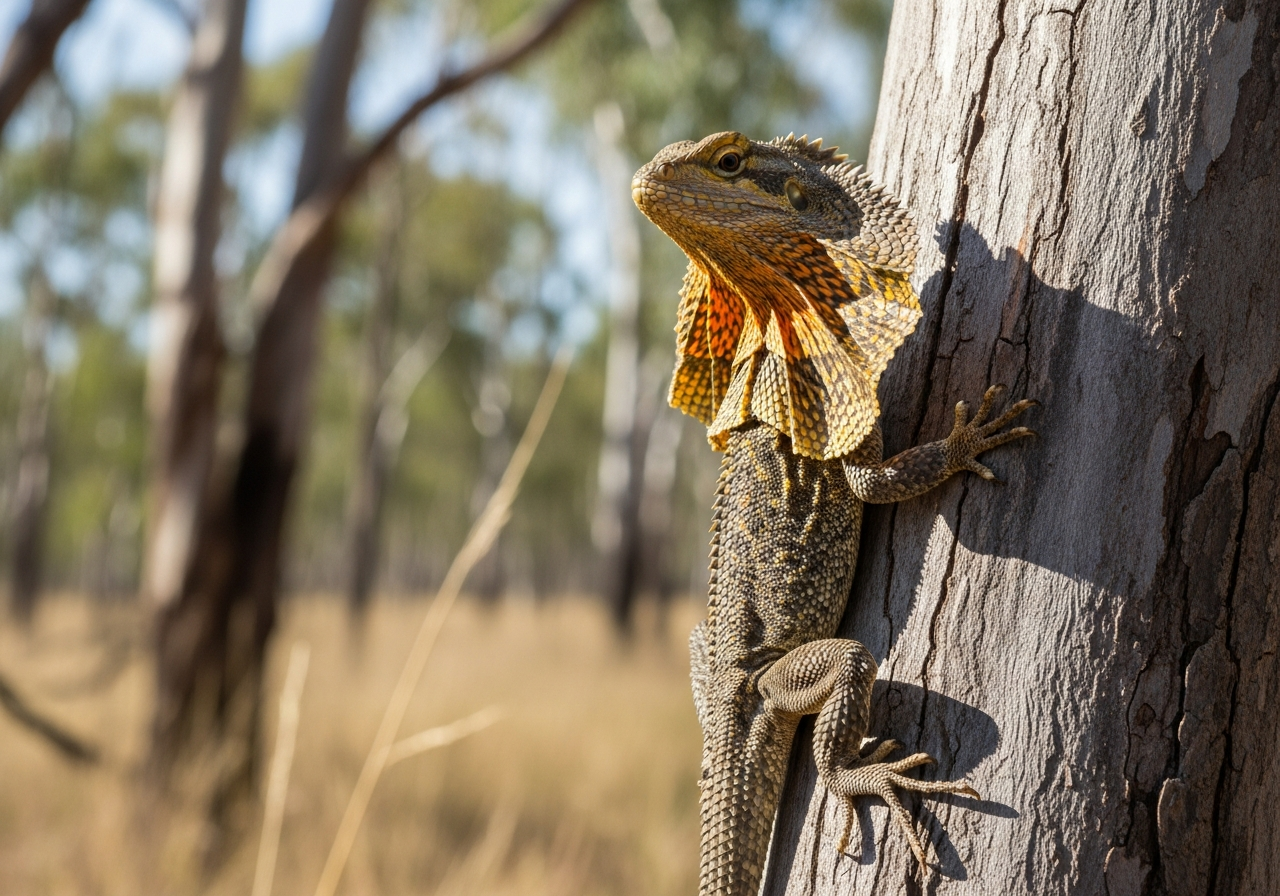
The frilled lizard is a tree-dwelling lizard of northern Australia and southern New Guinea, famous for the large frill of skin around its neck. When threatened it opens this frill wide, gapes its mouth, and hisses to look far bigger before fleeing on its hind legs. Frilled lizards grow up to about 90 cm (3 ft) including the tail, eat insects and small animals, and live around 10 to 20 years.
Frilled Lizard facts at a glance
| Scientific name | Chlamydosaurus kingii |
|---|---|
| Diet | Carnivore (mainly insects) |
| Habitat | Tropical woodlands and dry forest |
| Lifespan | 10–20 years |
| Length | Up to 0.9 m (3 ft) including tail |
| Weight | About 0.5 kg (1.1 lb) |
| Conservation status | Least Concern (IUCN) |
| Kingdom | Animalia |
|---|---|
| Phylum | Chordata |
| Class | Reptilia |
| Order | Squamata |
| Family | Agamidae |
| Genus | Chlamydosaurus |
Where it lives
Tropical and warm-temperate woodlands of northern Australia and southern New Guinea.
Behavior and the frill display
The frilled lizard spends most of its time in trees, where its grey-brown coloring keeps it camouflaged against bark. When alarmed it drops to the ground, raises the brightly colored frill, opens its mouth, and hisses to startle a predator. If the bluff fails it sprints away on its hind legs in a comical upright run, sometimes called bicycle-running.
Diet and feeding
Frilled lizards are carnivores that feed mainly on insects such as beetles, ants, termites, and cicadas, along with spiders and small lizards. They hunt by sitting and watching from a tree trunk, then darting down to snatch prey. They are most active and feed most heavily during the warm, wet season.
Habitat and range
This species lives in the tropical and warm-temperate woodlands and dry forests of northern Australia and southern New Guinea. It favors areas with scattered trees that offer both basking spots and cover. During the dry season frilled lizards become far less active and may remain high in the trees, conserving energy.
A standout trait
The frill is supported by long rods of cartilage connected to the jaw, so opening the mouth automatically spreads the frill wide. Besides startling predators, the display is used in contests between rival males and in courtship. The frill also helps with temperature control by exposing or hiding its surface to the sun.
Frequently asked questions about the Frilled Lizard
Why do frilled lizards have a frill?
The frill is mainly a defense. When the lizard flares it along with a gaping mouth and hiss, it suddenly looks much larger and more threatening, often startling a predator long enough to escape.
What do frilled lizards eat?
Frilled lizards are carnivores that eat mostly insects such as beetles, ants, and cicadas, plus spiders and small lizards. They hunt by watching from a tree and darting to grab prey.
Can frilled lizards run on two legs?
Yes. When fleeing, frilled lizards often rise up and sprint on their hind legs, a distinctive upright dash that helps them reach the safety of a tree quickly.
How big do frilled lizards get?
Frilled lizards grow up to about 90 cm (3 ft) in total length, with the tail making up most of that. Males are generally larger than females.
Where do frilled lizards live?
They live in the tropical woodlands and dry forests of northern Australia and southern New Guinea, spending much of their time in trees.
Are frilled lizards dangerous?
No. Frilled lizards are harmless to humans. Their dramatic display is pure bluff, and they would rather flee than fight, though a large one can give a harmless nip if handled.