Giant Panda
Ailuropoda melanoleuca
Quick answer
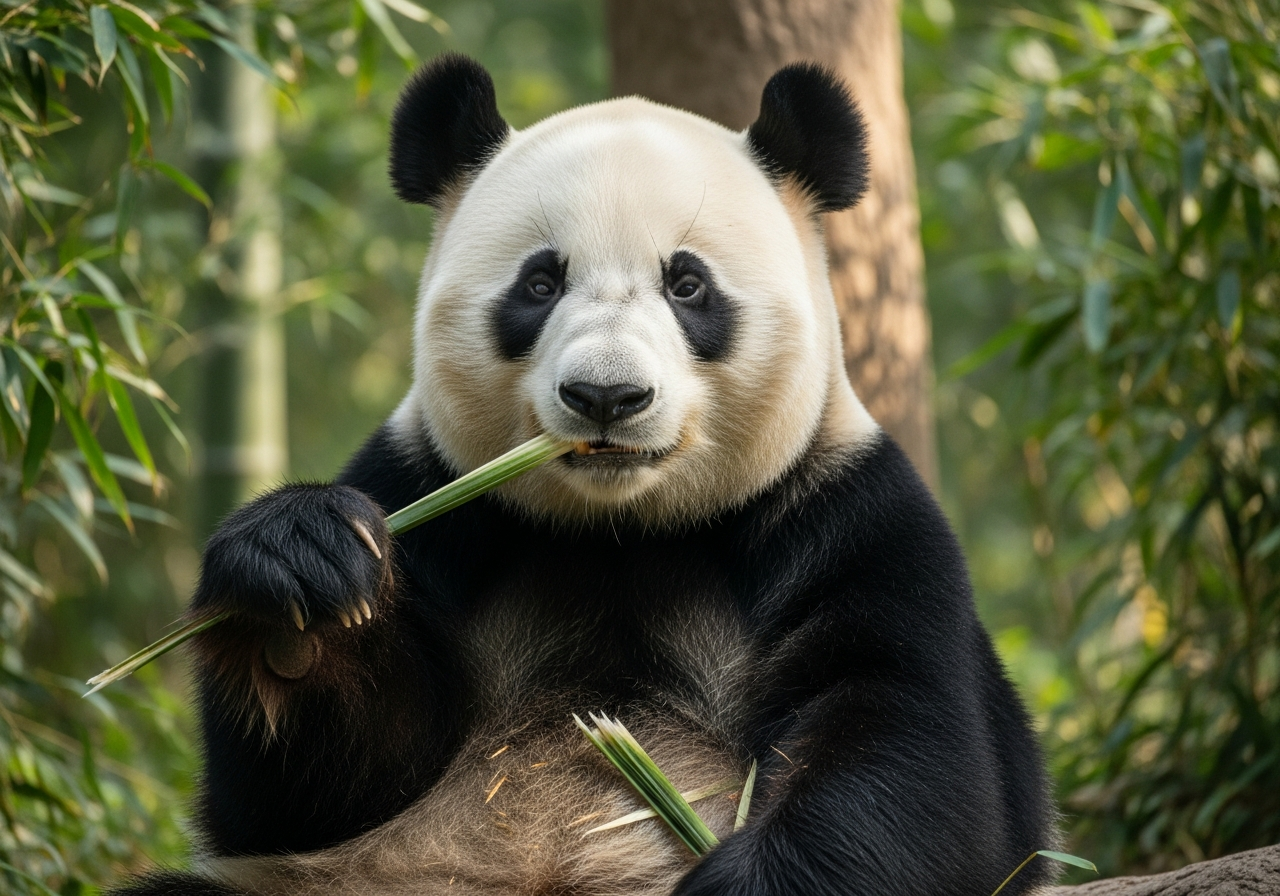
The giant panda is a bear native to the mountain forests of central China that eats almost nothing but bamboo. Despite being a carnivore by classification, it spends up to 14 hours a day eating bamboo. Thanks to major conservation efforts, it was downgraded from Endangered to Vulnerable in 2016. Wild pandas live around 20 years.
Giant Panda facts at a glance
| Scientific name | Ailuropoda melanoleuca |
|---|---|
| Diet | Herbivore (almost entirely bamboo) |
| Habitat | Temperate mountain forests of central China |
| Lifespan | ~20 years in the wild |
| Weight | 70–120 kg (155–265 lb) |
| Daily bamboo intake | 12–38 kg (26–84 lb) |
| Conservation status | Vulnerable (IUCN) |
| Kingdom | Animalia |
|---|---|
| Phylum | Chordata |
| Class | Mammalia |
| Order | Carnivora |
| Family | Ursidae |
| Genus | Ailuropoda |
A bear that eats bamboo
Although classified as a carnivore, the giant panda's diet is about 99% bamboo. Because bamboo is low in nutrients, pandas must eat enormous quantities, between 12 and 38 kg per day, and spend much of their waking life feeding.
The pseudo-thumb
Pandas have an enlarged wrist bone that works like an opposable thumb, letting them grip bamboo stalks with precision. This adaptation makes them remarkably efficient at stripping and eating bamboo.
Behavior
Giant pandas are mostly solitary and use scent marking to communicate and avoid one another outside the breeding season. Cubs are born tiny and pink, about the size of a stick of butter, and develop slowly over their first year.
Conservation success
The giant panda is a global symbol of wildlife conservation. Decades of habitat protection and reserve creation in China helped its numbers recover enough for the IUCN to reclassify it from Endangered to Vulnerable in 2016, though habitat fragmentation remains a threat.
Frequently asked questions about the Giant Panda
What do giant pandas eat?
Giant pandas eat almost entirely bamboo, which makes up about 99% of their diet. An adult panda can eat between 12 and 38 kg of bamboo every day.
Are giant pandas still endangered?
No. Thanks to conservation efforts, the giant panda was reclassified from Endangered to Vulnerable in 2016. It still faces risks from habitat fragmentation, so protection continues.
Why do pandas eat so much bamboo?
Bamboo is low in nutrients and difficult to digest, so pandas must eat huge amounts to meet their energy needs, often feeding for up to 14 hours a day.
Do pandas have thumbs?
Pandas have a 'pseudo-thumb,' an enlarged wrist bone that acts like an opposable thumb. It lets them grip and strip bamboo stalks efficiently.
How long do giant pandas live?
Wild giant pandas live around 20 years, while pandas in captivity can live to 30 years or more with consistent food and veterinary care.
Where do giant pandas live?
Giant pandas live only in the temperate mountain forests of central China, where dense bamboo provides their primary food source.