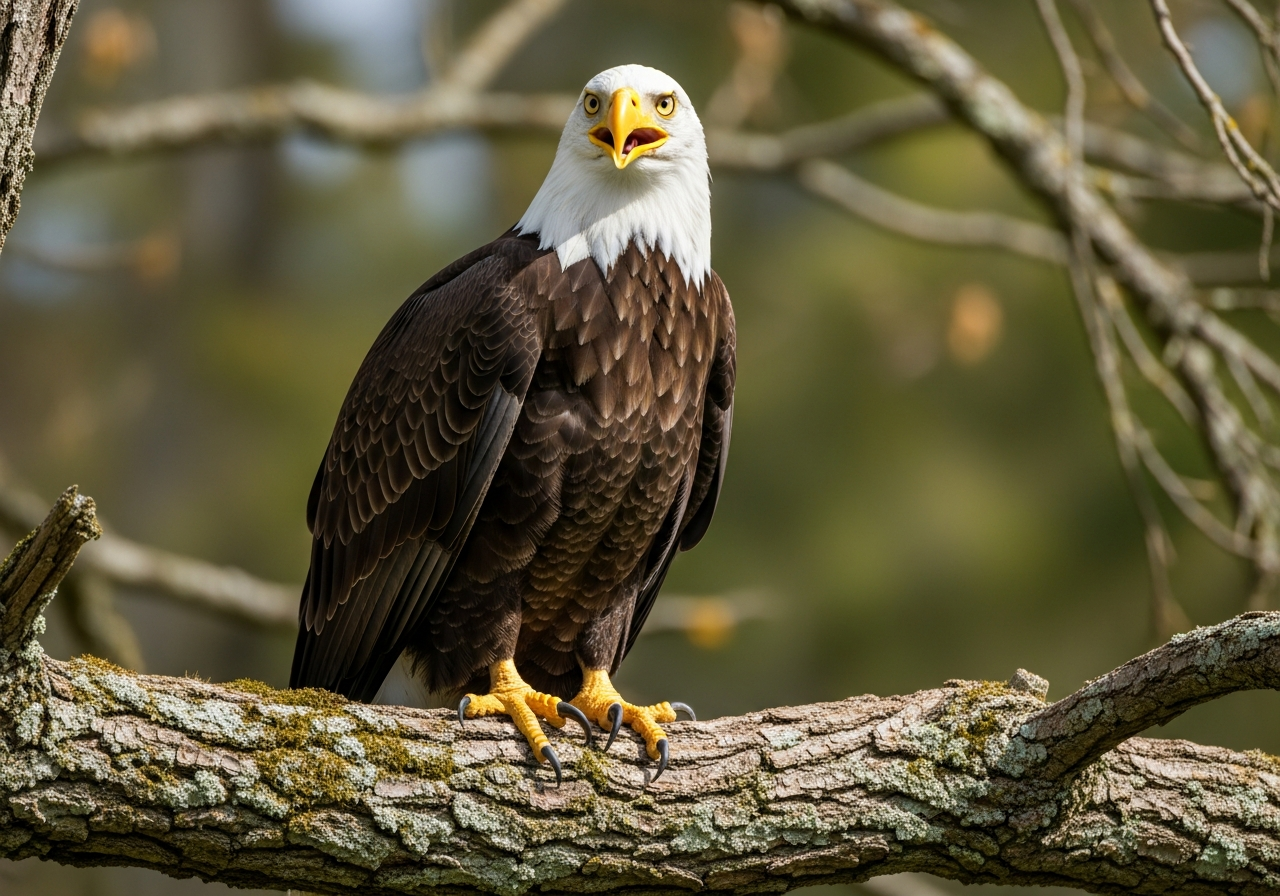
Golden Eagle
Aquila chrysaetos
Quick answer
The golden eagle is a powerful bird of prey found across the Northern Hemisphere, named for the golden-brown feathers on its head and neck. With a wingspan of more than 2 m (7 ft), it hunts hares, marmots, and other mammals and can dive at over 240 km/h (150 mph). Revered in many cultures, golden eagles often live 20 to 30 years in the wild.
Golden Eagle facts at a glance
| Scientific name | Aquila chrysaetos |
|---|---|
| Diet | Carnivore (hares, marmots, birds, carrion) |
| Habitat | Mountains, open hills, and tundra |
| Lifespan | 20–30 years in the wild |
| Wingspan | 1.8–2.3 m (6–7.5 ft) |
| Top speed | Over 240 km/h (150 mph) in a dive |
| Conservation status | Least Concern (IUCN) |
| Kingdom | Animalia |
|---|---|
| Phylum | Chordata |
| Class | Aves |
| Order | Accipitriformes |
| Family | Accipitridae |
| Genus | Aquila |
Where it lives
Mountains and open country across North America, Europe, North Africa, and much of Asia.
Power and hunting
Golden eagles are formidable hunters that use surprise, speed, and immense gripping strength to take prey as large as foxes, young deer, and cranes, though most meals are hares, rabbits, and ground squirrels. They patrol vast territories, soaring on rising air and then folding their wings into a steep dive to strike prey with their talons.
Appearance
Adults are dark brown with the lustrous golden feathers on the head and nape that give the species its name. They are among the largest eagles, with long, broad wings and a fairly long tail suited to soaring and maneuvering over rugged terrain. Young birds show distinctive white patches in the wings and tail that fade as they mature.
Habitat and range
The golden eagle is one of the most widespread eagles in the world, living across North America, Europe, North Africa, and much of Asia. It favors open and mountainous country, including highlands, cliffs, moorland, and tundra, where it can find updrafts for soaring and open ground for hunting.
Culture and conservation
Golden eagles have been symbols of strength and courage for thousands of years and remain sacred to many Indigenous peoples. While the species is not globally threatened, individual populations face dangers from poisoning, collisions with vehicles and power lines, and habitat loss, and they are legally protected across much of their range.
Frequently asked questions about the Golden Eagle
How fast can a golden eagle fly?
Golden eagles cruise at around 45 to 50 km/h (28 to 32 mph) but can reach more than 240 km/h (150 mph) when diving on prey, making them among the fastest animals on Earth.
What do golden eagles eat?
They are carnivores that mainly hunt medium-sized mammals such as hares, rabbits, marmots, and ground squirrels. They also take birds and reptiles and will feed on carrion, especially in winter.
How big is a golden eagle?
Golden eagles have a wingspan of roughly 1.8 to 2.3 m (6 to 7.5 ft) and weigh around 3 to 6 kg (7 to 13 lb), with females noticeably larger than males.
What is the difference between a golden eagle and a bald eagle?
Adult bald eagles have a white head and tail and eat a lot of fish, while golden eagles are all brown with golden nape feathers and hunt mainly mammals. Golden eagles also have feathered legs down to the toes.
How long do golden eagles live?
In the wild golden eagles often live 20 to 30 years, and protected individuals in captivity have lived past 40 years.
Are golden eagles endangered?
Globally the golden eagle is listed as Least Concern, but some regional populations are declining and the birds are protected by law against hunting, poisoning, and disturbance.