Image sourcing: see credits & licences
Quick answer
The Pacman frog (Ceratophrys ornata) is a round, big-mouthed horned frog from the grasslands and wetlands of South America, named for its resemblance to the arcade character. It reaches about 10 to 15 cm and up to 0.3 kg, with females much larger than males. It is a sit-and-wait ambush predator that buries itself and lunges at almost anything that passes. Listed as Near Threatened, it can live six to ten years, and longer in captivity.
Top questions about the Pacman Frog
Pacman Frog facts at a glance
- Weight 300 g
- Length 15 cm
- Top speed 4 km/h
- Lifespan 8 years
| Scientific name | Ceratophrys ornata |
|---|---|
| Diet | Carnivore (insects, small vertebrates) |
| Habitat | Grasslands and wetlands |
| Lifespan | 6–10 years, longer in captivity |
| Length | 10–15 cm (4–6 in) body length |
| Weight | Up to about 0.3 kg (0.7 lb) |
| Conservation status | Near Threatened (IUCN) |
| Kingdom | Animalia |
|---|---|
| Phylum | Chordata |
| Class | Amphibia |
| Order | Anura |
| Family | Ceratophryidae |
| Genus | Ceratophrys |
Where it lives
The pacman frog (Ceratophrys ornata) is native to Grasslands and wetlands of Argentina, Uruguay, and southern Brazil. — recorded across South America in this guide’s range summary.
For occurrence records, see GBIF species search and sources below.
How big is a pacman frog?
An adult pacman frog measures 15 cm long — about 9% of the height of an average adult person (1.73 m) — and weighs around 300 g, a small fraction of an average adult’s body weight (70 kg).
Length vs an average adult’s height (to scale)
What is a group of pacman frogs called?
Group name (collective noun)
A group of Pacman Frogs is called an army.
Baby name
A baby Pacman Frog is called a tadpole.
Explore more animal collective nouns and baby animal names .
Appearance and identification
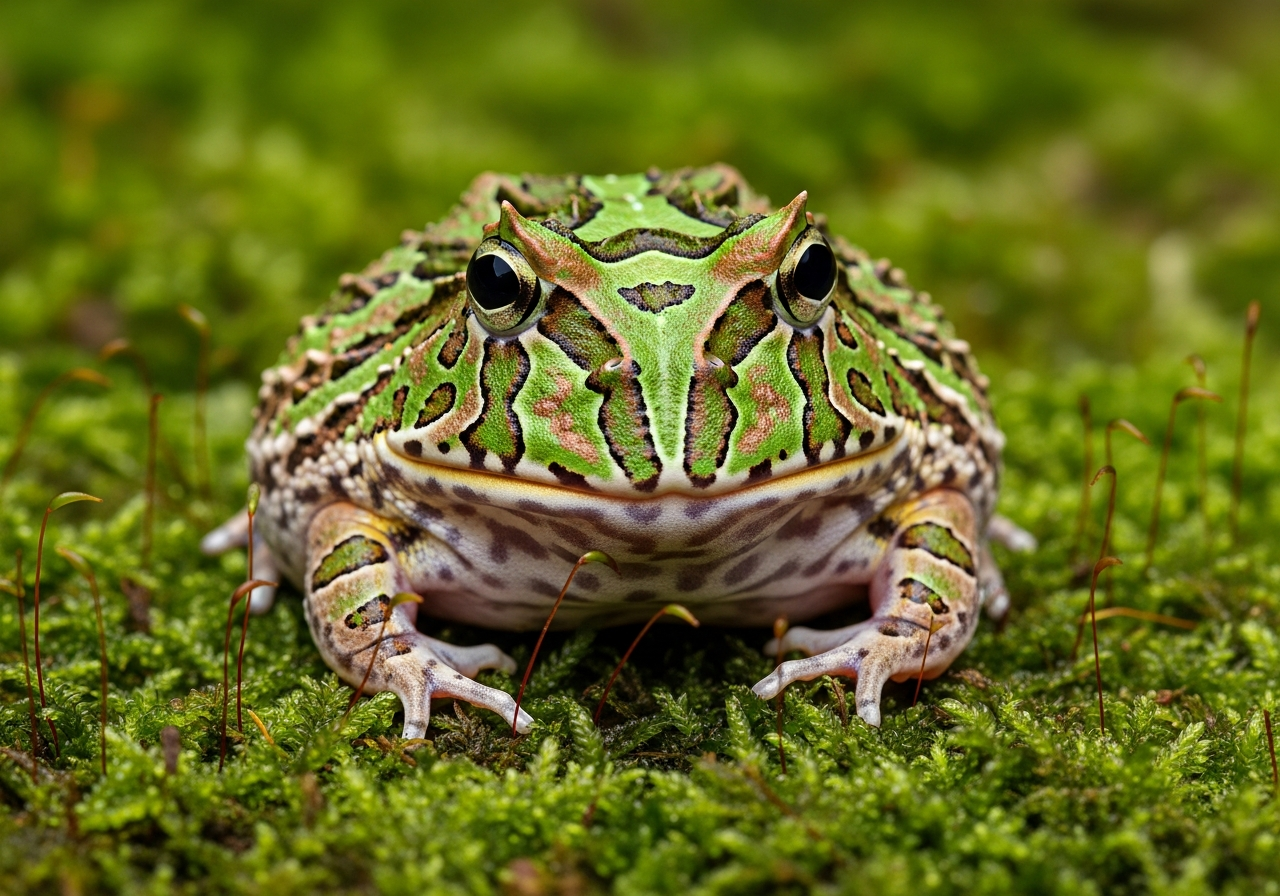
The Pacman frog is almost as wide as it is long, a squat, rounded amphibian dominated by an enormous mouth. Adults reach roughly 10 to 15 cm (4 to 6 in) in body length and up to about 0.3 kg, with females noticeably larger and heavier than males. Colours range from bright green to brown, tan, and red, often blotched to mimic leaf litter. Small horn-like projections above the eyes give the group its other name, the ornate horned frog.
Ambush hunting and diet
This is a classic sit-and-wait ambush predator that buries itself in soil or leaf litter with only its eyes and mouth exposed. When prey wanders within reach it lunges and engulfs it in a single powerful gulp, gripping with tooth-like projections in the jaw. It is a carnivore with an enormous appetite, taking insects, worms, other frogs, lizards, small rodents, and even prey nearly its own size. Its motto is essentially to swallow first, and Pacman frogs will sometimes attempt meals too large to manage.
Habitat and lifestyle
Ceratophrys ornata lives in the grasslands and wetlands of Argentina, Uruguay, and southern Brazil, favouring damp, low-lying ground. It is largely sedentary, spending most of its time partly buried and waiting for food rather than roaming. During dry spells it can form a protective cocoon of shed skin and remain dormant underground until rain returns. This low-energy lifestyle suits an animal built around ambush rather than pursuit.
Reproduction and life cycle
Breeding is triggered by heavy seasonal rains, when temporary pools form across the grasslands. Males call to attract females, which lay large clutches of eggs in the water. The tadpoles are aggressive and carnivorous, preying on other tadpoles and even one another as they develop. After metamorphosis the tiny froglets take on the ambush lifestyle of the adults, growing quickly if food is plentiful.
Lifespan and in captivity
In the wild Pacman frogs generally live six to ten years, and well-kept captive animals often live longer. Their hardiness, striking looks, and undemanding, sedentary habits have made them popular in the pet trade. Keepers must take care with feeding, as the frogs will overeat readily and are prone to obesity. Their willingness to bite anything that moves also means they are best watched rather than handled.
Conservation status
The Pacman frog is listed as Near Threatened by the IUCN, with populations under pressure across parts of its range. Habitat loss from the conversion of grassland and wetland to agriculture is the main concern, along with collection for the pet trade. Because it depends on seasonal pools to breed, changes to water and land use hit it hard. Protecting intact grassland and wetland habitat is central to its future.
Dig deeper into the Pacman Frog
- How Long Do Pacman Frogs Live?
Pacman Frog lifespan is typically 6–10 years, longer in captivity. What shortens or extends life, life stages, and status (Near Threatened).
- What Do Pacman Frogs Eat?
What pacman frogs eat: Carnivore (insects, small vertebrates), foraging style, and seasonal shifts in Grasslands and wetlands.
- Where Do Pacman Frogs Live?
Where pacman frogs live: Grasslands and wetlands, native range cues, and human overlap. Status Near Threatened.
Explore the Pacman Frog
Related Amphibians
Range & geography
Did you know? Pacman Frog facts
- The Pacman frog, or Argentine horned frog, is a large, round, ground-dwelling frog from South America named for its huge mouth and appetite.
- It is named after the video game character because of its round body and enormous, wide mouth that seems to take up much of its face, which it uses to gulp down large prey.
- Pacman frogs are carnivores that eat insects, worms, other frogs, small reptiles, and even small mammals. They are ambush predators that try to swallow almost anything they can fit in their mouth.
- In the wild they generally live 6 to 10 years, and with good care in captivity they can live even longer, sometimes well over a decade.
- They are popular beginner amphibians because they are hardy and need little space, but they require a humid enclosure with deep substrate for burrowing and careful feeding to avoid obesity. They are best watched rather than handled.
- Conservation: Near Threatened (IUCN).
Diet & feeding
Pacman Frog feeds primarily as a carnivore (insects, small vertebrates). Pacman frogs are almost entirely sedentary, spending much of their time half-buried in soil or leaf litter with only the eyes and wide mouth exposed. They wait motionless for prey to wander close, then lunge with a powerful bite. Their enormous mo
Adaptations
- Pacman frogs are almost entirely sedentary, spending much of their time half-buried in soil or leaf litter with only the eyes and wide mouth exposed. They wait motionless for prey to wander close, then lunge with a powerful bite. Their enormous mouth gives them their nickname, and they can attempt to swallow animals nearly their own size.
- These frogs are voracious carnivores that eat insects, spiders, worms, other frogs, small reptiles, and even small mammals. They have tiny tooth-like structures and strong jaws to grip struggling prey. In captivity their appetite is so large that overfeeding and obesity are common problems.
Behaviour & ecology
- Pacman frogs are almost entirely sedentary, spending much of their time half-buried in soil or leaf litter with only the eyes and wide mouth exposed. They wait motionless for prey to wander close, then lunge with a powerful bite. Their enormous mouth gives them their nickname, and they can attempt to swallow animals nearly their own size.
- These frogs are voracious carnivores that eat insects, spiders, worms, other frogs, small reptiles, and even small mammals. They have tiny tooth-like structures and strong jaws to grip struggling prey. In captivity their appetite is so large that overfeeding and obesity are common problems.
- The Argentine horned frog lives in the grasslands, marshes, and wetlands of Argentina, Uruguay, and southern Brazil. It favors damp, low-lying areas where it can burrow into soft ground. During dry spells it can form a protective cocoon of shed skin and lie dormant until rains return.
Communication
- Pacman Frog uses scent, posture, and vocal signals to mark territory and coordinate social behaviour.
- Communication intensity often peaks during breeding seasons and territorial disputes.
Habitat & range
Grasslands and wetlands
Ecological role
Pacman Frog acts as a predator that helps regulate prey populations and maintain balance in grasslands and wetlands.
Conservation status of the Pacman Frog
The pacman frog (Ceratophrys ornata) is listed as Near Threatened on the IUCN Red List. Near Threatened (NT) means a species does not yet qualify as threatened but is close to it, or likely to become so in the near future without ongoing conservation. It is a watch-list category just below Vulnerable.
The pacman frog (Ceratophrys ornata) is assessed on the IUCN Red List. Look up on the IUCN Red List .
Frequently asked questions about the Pacman Frog
Why is it called a Pacman frog?
The name comes from its round shape and huge mouth, which recall the arcade character Pac-Man. It is also known as the ornate horned frog after the small horn-like projections above its eyes.
What do Pacman frogs eat?
They are carnivores with a large appetite, eating insects, worms, other frogs, lizards, and small rodents. As sit-and-wait ambush predators they lunge at almost anything that moves within reach, sometimes attempting prey nearly their own size.
How big do Pacman frogs get?
Adults reach about 10 to 15 cm (4 to 6 in) in body length and up to roughly 0.3 kg. Females are considerably larger and heavier than males.
How long do Pacman frogs live?
In the wild they typically live six to ten years, and captive individuals often live longer with good care. Careful feeding matters, as they overeat readily and can become obese.
Where do Pacman frogs live?
They inhabit the grasslands and wetlands of South America, including Argentina, Uruguay, and southern Brazil. They spend most of their lives partly buried, waiting to ambush passing prey.
Are Pacman frogs endangered?
They are listed as Near Threatened by the IUCN. Habitat loss from agriculture and collection for the pet trade are the main pressures on wild populations.
What is a group of pacman frogs called?
A group of Pacman Frogs is called an army.
What is a baby pacman frog called?
A baby Pacman Frog is called a tadpole.
Sources & references
This guide is compiled and reviewed against established zoological and conservation references. Key sources for the Pacman Frog:
-
IUCN Red List of Threatened Species
Conservation status (Near Threatened) reflects the IUCN Red List category for Ceratophrys ornata.
-
iNaturalist — observations & photos
Search citizen-science observations and community IDs for Ceratophrys ornata. Useful for range checks and recent sightings — not a substitute for formal Red List status.
-
GBIF — occurrence data
Global Biodiversity Information Facility species search for Ceratophrys ornata. Explore published occurrence records used in range research.
- IUCN Red List — Ceratophrys ornata.
Conservation status (Near Threatened) and population trends.
- Animal Diversity Web — Ceratophrys ornata. University of Michigan Museum of Zoology.
Life history, morphology, and range.
- Wikipedia — Pacman Frog.
General taxonomy and overview (cross-check primary sources).
-
Global Animal Guide editorial standards
How we research, source, review, and update every guide for accuracy.