Quick answer
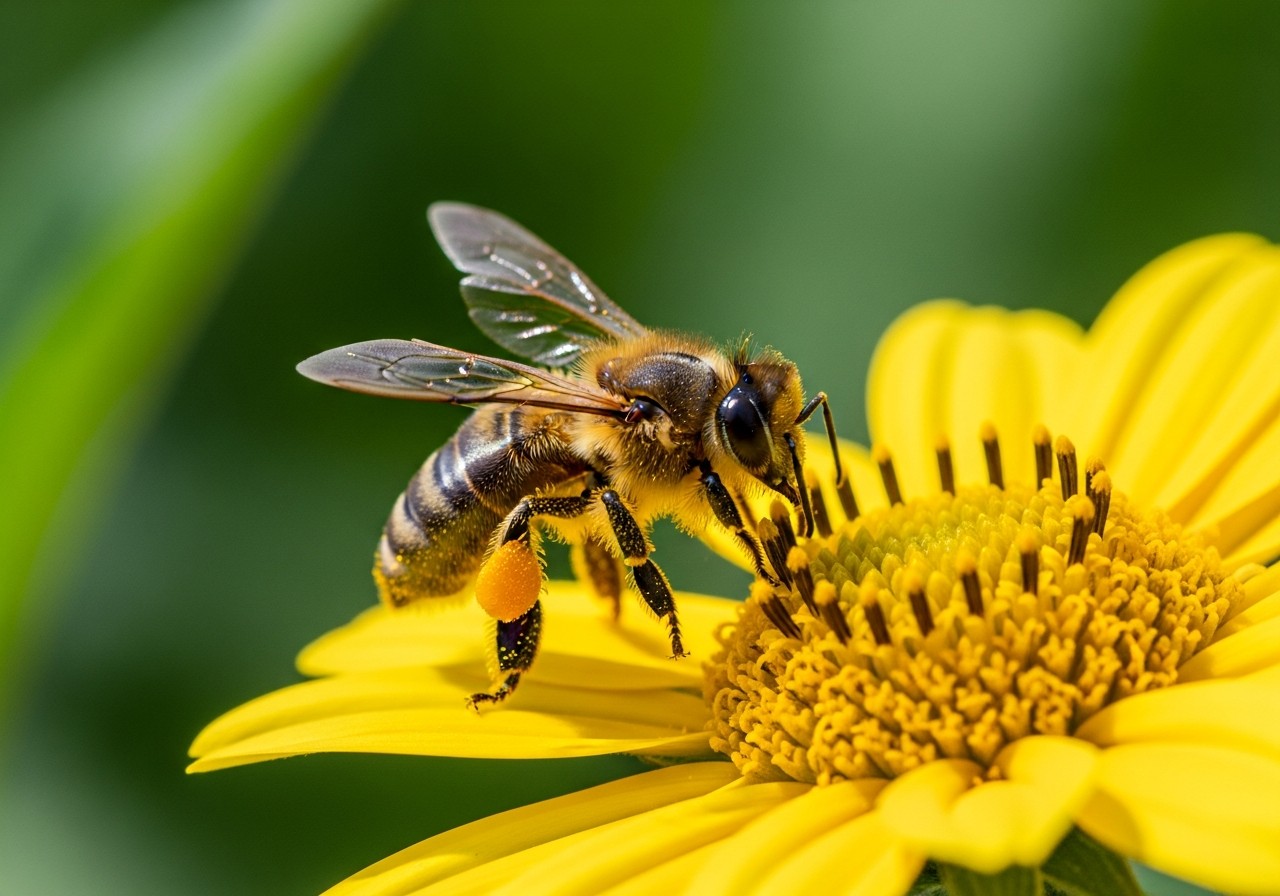
The honey bee is a social insect that lives in colonies of tens of thousands, built around a single egg-laying queen. Honey bees pollinate a large share of the crops people rely on, make honey from flower nectar, and communicate the location of food through a "waggle dance." Worker bees live only a few weeks in summer, while a queen can live several years.
Top questions about the Honey Bee
Honey Bee facts at a glance
- Weight 0 g
- Length 2 cm
- Top speed 28 km/h
- Lifespan 1 years
| Scientific name | Apis mellifera |
|---|---|
| Diet | Nectar and pollen |
| Habitat | Worldwide wherever flowering plants grow |
| Lifespan | Workers ~6 weeks; queens 2–5 years |
| Colony size | 20,000–80,000 bees |
| Top speed | ~28 km/h (17 mph) |
| Conservation status | Not formally evaluated by IUCN |
| Kingdom | Animalia |
|---|---|
| Phylum | Arthropoda |
| Class | Insecta |
| Order | Hymenoptera |
| Family | Apidae |
| Genus | Apis |
Where it lives
The honey bee (Apis mellifera) is native to Native to Europe, Africa, and western Asia; now kept by beekeepers worldwide. — recorded across Europe, Africa, Asia in this guide’s range summary.
For occurrence records, see GBIF species search and sources below.
How big is a honey bee?
An adult honey bee measures 2 cm long — about 1% of the height of an average adult person (1.73 m) — and weighs around 0 g, a small fraction of an average adult’s body weight (70 kg).
Length vs an average adult’s height (to scale)
What is a group of honey bees called?
Group name (collective noun)
A group of Honey Bees is called a swarm. It is also known as a colony or a hive.
Baby name
A baby Honey Bee is called a larva.
Explore more animal collective nouns and baby animal names .
Life in the colony
A honey bee colony is a single tightly organized society. One queen lays all the eggs, thousands of female workers forage, build comb, feed young, and defend the hive, and male drones exist mainly to mate. Tasks shift as a worker ages, from cleaning and nursing inside the hive to foraging outside.
Pollination and honey
As bees move between flowers collecting nectar and pollen, they transfer pollen and fertilize plants. This pollination underpins a large portion of global food crops. Back at the hive, bees convert nectar into honey, a stored food that sustains the colony through times when flowers are scarce.
The waggle dance
Honey bees share the location of good food sources through a remarkable behavior called the waggle dance. A returning forager moves in a figure-eight pattern, and the angle and duration of the central "waggle" run encode the direction and distance of the flowers relative to the sun.
Threats and importance
Honey bees face pressure from habitat loss, pesticides, parasites such as the varroa mite, and disease. Because they pollinate so many crops, their health is closely tied to food security, and beekeepers and researchers work to keep colonies strong.
Dig deeper into the Honey Bee
- Honey Bee: Key Facts
The honey bee is a social insect that lives in colonies of tens of thousands, built around a single egg-laying queen.
- How Long Do Honey Bees Live?
Honey Bee lifespan is typically Workers ~6 weeks; queens 2–5 years. What shortens or extends life, life stages, and status (Not Evaluated).
- What Do Honey Bees Eat?
What honey bees eat: Nectar and pollen, foraging style, and seasonal shifts in Worldwide wherever flowering plants grow.
- Where Do Honey Bees Live?
Where honey bees live: Worldwide wherever flowering plants grow, native range cues, and human overlap. Status Not Evaluated.
Explore the Honey Bee
Compare
Related Insects
Range & geography
Did you know? Honey Bee facts
- The honey bee is a social insect that lives in colonies of tens of thousands, built around a single egg-laying queen.
- A healthy honey bee colony usually contains 20,000 to 80,000 bees in summer, made up of one queen, many thousands of female workers, and some male drones.
- Honey bees pollinate a large share of the crops people eat, helping plants produce fruits, vegetables, nuts, and seeds. They also produce honey and beeswax.
- The waggle dance is how a honey bee tells hive mates where to find food. The direction and length of its waggling run encode the direction and distance to the flowers.
- Summer worker bees live only about six weeks, while the queen can live two to five years. Workers raised in autumn can survive through the winter.
- Conservation: Not formally evaluated by IUCN.
Diet & feeding
Honey Bee feeds primarily as a nectar and pollen. A honey bee colony is a single tightly organized society. One queen lays all the eggs, thousands of female workers forage, build comb, feed young, and defend the hive, and male drones exist mainly to mate. Tasks shift as a worker ages, from cleaning and nursing inside t
Adaptations
- A honey bee colony is a single tightly organized society. One queen lays all the eggs, thousands of female workers forage, build comb, feed young, and defend the hive, and male drones exist mainly to mate. Tasks shift as a worker ages, from cleaning and nursing inside the hive to foraging outside.
- As bees move between flowers collecting nectar and pollen, they transfer pollen and fertilize plants. This pollination underpins a large portion of global food crops. Back at the hive, bees convert nectar into honey, a stored food that sustains the colony through times when flowers are scarce.
Behaviour & ecology
- A honey bee colony is a single tightly organized society. One queen lays all the eggs, thousands of female workers forage, build comb, feed young, and defend the hive, and male drones exist mainly to mate. Tasks shift as a worker ages, from cleaning and nursing inside the hive to foraging outside.
- As bees move between flowers collecting nectar and pollen, they transfer pollen and fertilize plants. This pollination underpins a large portion of global food crops. Back at the hive, bees convert nectar into honey, a stored food that sustains the colony through times when flowers are scarce.
- Honey bees share the location of good food sources through a remarkable behavior called the waggle dance. A returning forager moves in a figure-eight pattern, and the angle and duration of the central \
Communication
- Honey Bee uses scent, posture, and vocal signals to mark territory and coordinate social behaviour.
- Communication intensity often peaks during breeding seasons and territorial disputes.
Habitat & range
Worldwide wherever flowering plants grow
Ecological role
Honey Bee participates in pollination, decomposition, or prey-base support for birds and other insectivores.
Conservation status of the Honey Bee
The honey bee (Apis mellifera) is listed as Not Evaluated on the IUCN Red List. Not Evaluated (NE) means a species has not yet been assessed against the IUCN Red List criteria. A lack of evaluation does not imply a species is safe — only that no formal assessment has been completed.
The honey bee (Apis mellifera) is assessed on the IUCN Red List. Look up on the IUCN Red List .
Frequently asked questions about the Honey Bee
How many bees live in a hive?
A healthy honey bee colony usually contains 20,000 to 80,000 bees in summer, made up of one queen, many thousands of female workers, and some male drones.
Why are honey bees important?
Honey bees pollinate a large share of the crops people eat, helping plants produce fruits, vegetables, nuts, and seeds. They also produce honey and beeswax.
What is the waggle dance?
The waggle dance is how a honey bee tells hive mates where to find food. The direction and length of its waggling run encode the direction and distance to the flowers.
How long do honey bees live?
Summer worker bees live only about six weeks, while the queen can live two to five years. Workers raised in autumn can survive through the winter.
Do honey bees die when they sting?
Worker honey bees usually die after stinging a mammal, because their barbed stinger and part of their body are torn away. They sting mainly to defend the colony.
How fast can a honey bee fly?
Honey bees fly at around 28 km/h (17 mph) when traveling to flowers, and a bit slower when returning loaded with nectar and pollen.
What is a group of honey bees called?
A group of Honey Bees is called a swarm. It is also known as a colony or a hive.
What is a baby honey bee called?
A baby Honey Bee is called a larva.
Sources & references
This guide is compiled and reviewed against established zoological and conservation references. Key sources for the Honey Bee:
-
IUCN Red List of Threatened Species
Conservation status (Not Evaluated) reflects the IUCN Red List category for Apis mellifera.
-
iNaturalist — observations & photos
Search citizen-science observations and community IDs for Apis mellifera. Useful for range checks and recent sightings — not a substitute for formal Red List status.
-
GBIF — occurrence data
Global Biodiversity Information Facility species search for Apis mellifera. Explore published occurrence records used in range research.
- IUCN Red List — Apis mellifera.
Conservation status (Not Evaluated) and population trends.
- Animal Diversity Web — Apis mellifera. University of Michigan Museum of Zoology.
Life history, morphology, and range.
- Wikipedia — Honey Bee.
General taxonomy and overview (cross-check primary sources).
-
Global Animal Guide editorial standards
How we research, source, review, and update every guide for accuracy.