Moray Eel
Muraenidae
Quick answer
Moray eels are a family of elongated, snake-like fish that live in crevices of coral reefs and rocky seabeds in tropical and temperate seas worldwide. They range from small species to giants over 3 m (10 ft) long, and they have a second set of jaws in the throat that helps them swallow prey. Mostly nocturnal ambush hunters, morays can live around 10 to 30 years depending on the species.
Moray Eel facts at a glance
| Scientific name | Muraenidae |
|---|---|
| Diet | Carnivore (fish, crustaceans, cephalopods) |
| Habitat | Coral reefs and rocky crevices |
| Lifespan | 10–30 years by species |
| Length | Varies; up to 3 m (10 ft) in large species |
| Top speed | Fast strike from cover |
| Conservation status | Varies by species |
| Kingdom | Animalia |
|---|---|
| Phylum | Chordata |
| Class | Actinopterygii |
| Order | Anguilliformes |
| Family | Muraenidae |
Behavior and biology
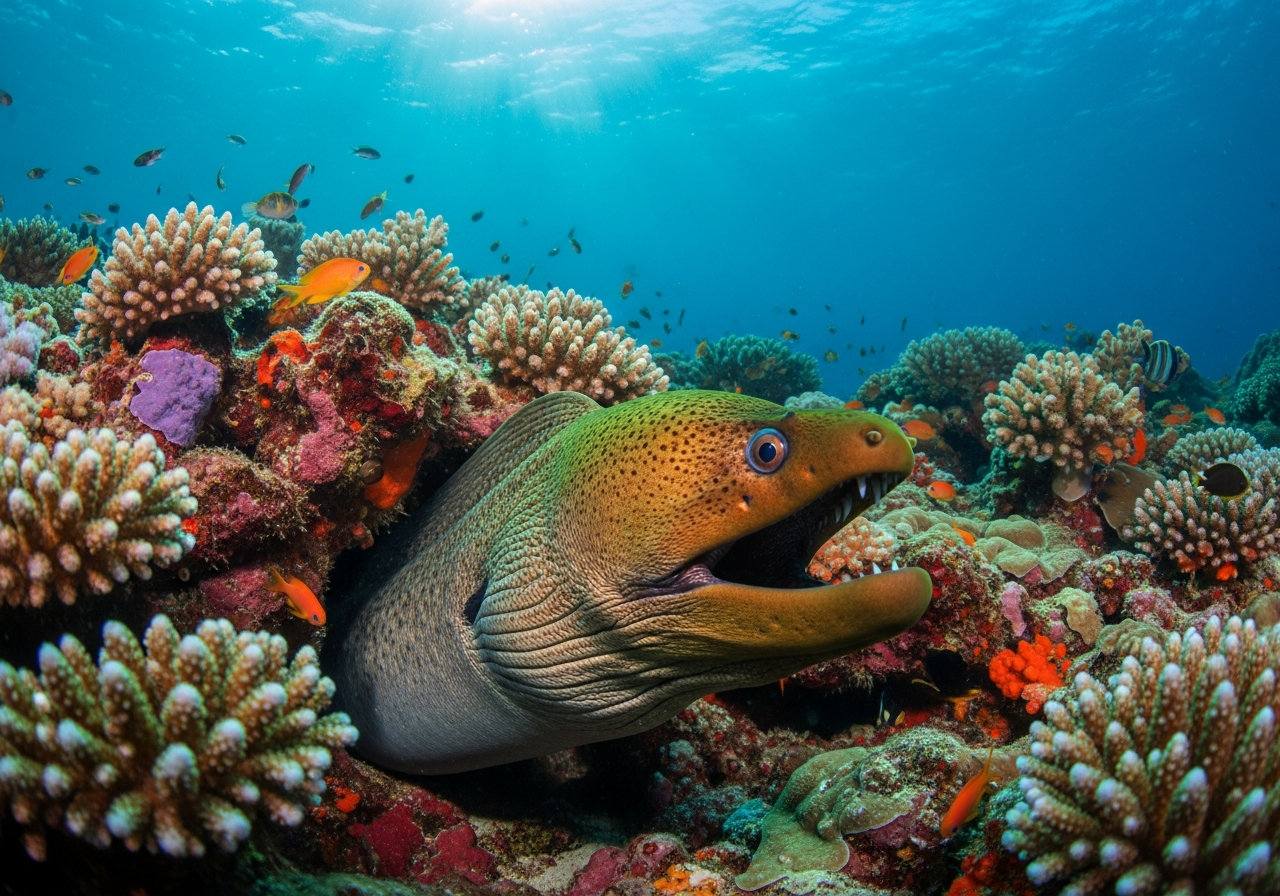
Moray eels spend most of the day hidden in reef crevices, holes, and rocky cracks, often with only their head showing as they open and close their mouths to pump water over the gills for breathing. This constant gaping makes them look menacing, but it is mainly a way to breathe rather than a threat. They have poor eyesight and rely heavily on a keen sense of smell to detect food.
Diet and the second jaws
Morays are carnivores that ambush fish, crustaceans, octopuses, and squid, lunging from cover to seize prey. Many species have a remarkable second set of jaws, called pharyngeal jaws, that shoot forward from the throat to grip and pull prey down the gullet. This adaptation helps them swallow food in their narrow burrows where suction feeding is difficult.
Habitat and range
There are many species of moray eel living in tropical and temperate seas around the world, mostly on coral reefs and rocky shores. They occupy a range of depths from shallow lagoons to deeper reef slopes, always favoring places with plenty of hiding spots. Some species also enter brackish water near river mouths.
Interaction with humans
Moray eels are not aggressive toward divers but can bite if cornered, threatened, or hand-fed, and their backward-curving teeth can cause serious wounds. Some species also carry ciguatera toxin in their flesh, making certain large morays unsafe to eat. They are generally best observed without disturbing them in their crevices.
Frequently asked questions about the Moray Eel
Are moray eels dangerous?
Moray eels are not aggressive but will bite if threatened, cornered, or fed by hand. Their sharp, backward-curving teeth can cause deep wounds, so divers should avoid reaching into crevices.
What do moray eels eat?
Morays are carnivores that ambush fish, crustaceans, octopuses, and squid, striking from cover and using a second set of throat jaws to pull prey down.
Why do moray eels open and close their mouths?
The constant gaping pumps water over their gills so they can breathe. It looks threatening but is mostly a normal breathing action rather than aggression.
How big do moray eels get?
Size varies widely by species, from small morays under a meter to giants such as the giant moray, which can exceed 3 m (10 ft) in length.
Can you eat moray eel?
Some morays are eaten, but several species can accumulate ciguatera toxin in their flesh, which can cause serious illness. For that reason eating large reef morays is risky.
How long do moray eels live?
Depending on the species, moray eels can live from about 10 years to 30 years or more, with larger species generally living longer.