Image sourcing: see credits & licences
Quick answer
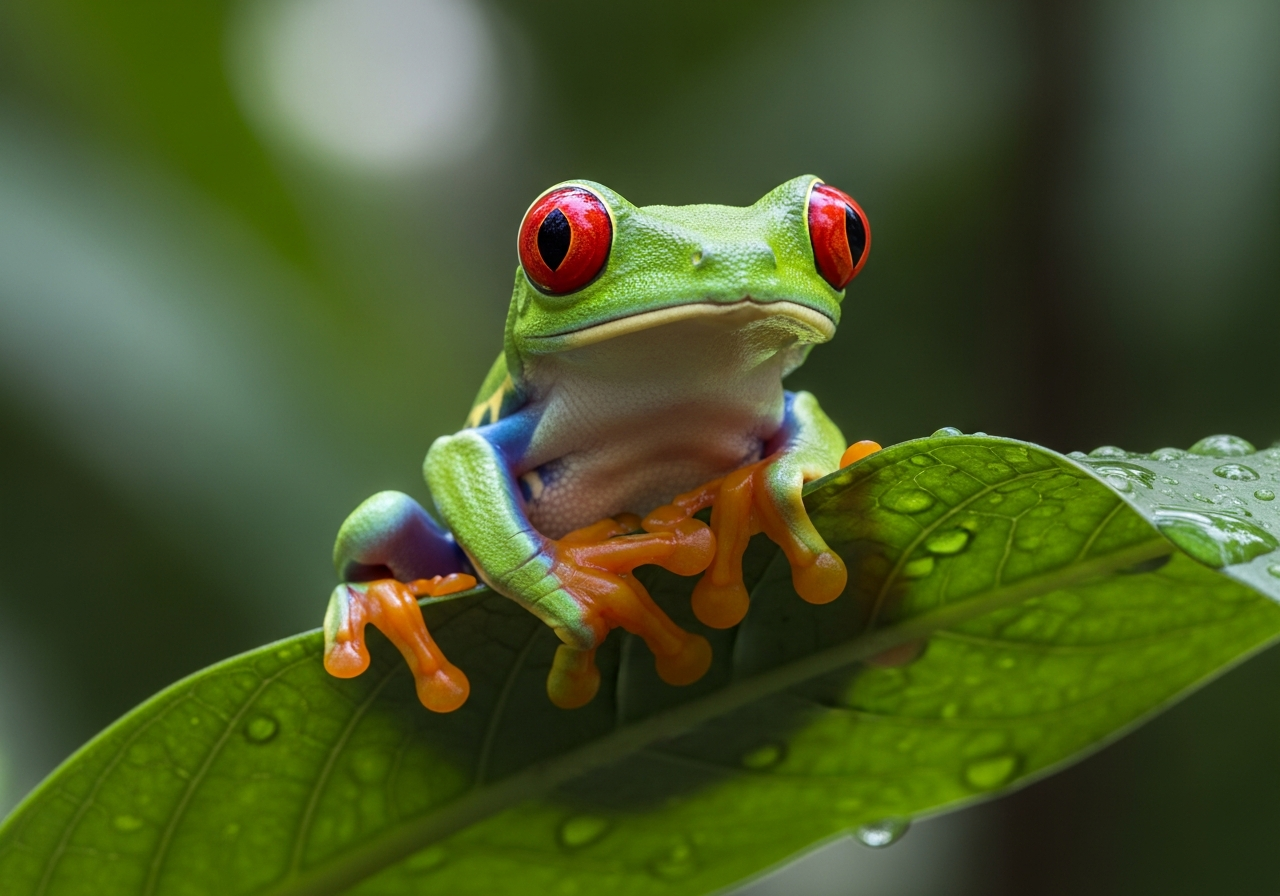
The red-eyed tree frog is a small, brightly colored amphibian of Central American rainforests, famous for its vivid red eyes, green body, and orange feet. It is nocturnal and arboreal, spending its days asleep camouflaged on leaves. These frogs typically live around 5 years in the wild.
Top questions about the Red-Eyed Tree Frog
Red-Eyed Tree Frog facts at a glance
- Weight 15 g
- Length 7 cm
- Top speed 8 km/h
- Lifespan 5 years
| Scientific name | Agalychnis callidryas |
|---|---|
| Diet | Insectivore (crickets, moths, flies) |
| Habitat | Lowland and humid rainforest canopy |
| Lifespan | About 5 years in the wild |
| Weight | 6–15 g (0.2–0.5 oz) |
| Size | 5–7 cm (2–3 in) body length |
| Conservation status | Least Concern (IUCN) |
| Kingdom | Animalia |
|---|---|
| Phylum | Chordata |
| Class | Amphibia |
| Order | Anura |
| Family | Phyllomedusidae |
| Genus | Agalychnis |
Where it lives
The red-eyed tree frog (Agalychnis callidryas) is native to The humid lowland rainforests of Central America, from southern Mexico through Costa Rica and Panama. — recorded across North America in this guide’s range summary.
For occurrence records, see GBIF species search and sources below.
How big is a red-eyed tree frog?
An adult red-eyed tree frog measures 7 cm long — about 4% of the height of an average adult person (1.73 m) — and weighs around 15 g, a small fraction of an average adult’s body weight (70 kg).
Length vs an average adult’s height (to scale)
What is a group of red-eyed tree frogs called?
Group name (collective noun)
A group of Red-Eyed Tree Frogs is called an army.
Baby name
A baby Red-Eyed Tree Frog is called a tadpole.
Explore more animal collective nouns and baby animal names .
Behavior and startle defense
Red-eyed tree frogs are nocturnal and sleep by day with their colorful limbs tucked away and only green skin showing. If a predator disturbs them, they suddenly flash their bright red eyes and orange feet, a tactic called deimatic or startle coloration that can buy a moment to leap to safety. They are agile climbers with sticky toe pads.
Diet and feeding
These frogs are insectivores that hunt at night, eating crickets, moths, flies, grasshoppers, and other small invertebrates. They catch prey with a quick flick of a sticky tongue. Juveniles take smaller prey such as fruit flies and pinhead crickets.
Habitat and range
The red-eyed tree frog lives in the humid lowland rainforests of Central America, from southern Mexico through Costa Rica and Panama. It depends on warm temperatures, high humidity, and ponds or pools where it lays eggs on overhanging leaves. The hatching tadpoles drop into the water below.
Conservation
The species is currently listed as Least Concern, but it relies entirely on intact, humid rainforest. Deforestation, pollution, and climate change are long-term threats to its habitat. As a striking flagship species, it is widely used to promote rainforest conservation.
Dig deeper into the Red-Eyed Tree Frog
- How Long Do Red-Eyed Tree Frogs Live?
Red-Eyed Tree Frog lifespan is typically About 5 years in the wild. What shortens or extends life, life stages, and status (Least Concern).
- What Do Red-Eyed Tree Frogs Eat?
What red-eyed tree frogs eat: Insectivore (crickets, moths, flies), foraging style, and seasonal shifts in Lowland and humid rainforest canopy.
- Where Do Red-Eyed Tree Frogs Live?
Where red-eyed tree frogs live: Lowland and humid rainforest canopy, native range cues, and human overlap. Status Least Concern.
Explore the Red-Eyed Tree Frog
Related Amphibians
Range & geography
Did you know? Red-Eyed Tree Frog facts
- The red-eyed tree frog is a small, brightly colored amphibian of Central American rainforests, famous for its vivid red eyes, green body, and orange feet.
- The bright red eyes are thought to startle predators. When disturbed while resting, the frog flashes its red eyes and orange feet, which can confuse an attacker long enough for the frog to escape.
- No. Unlike poison dart frogs, red-eyed tree frogs are not poisonous. They rely on camouflage and their startling colors rather than toxins for defense.
- They are insectivores that eat crickets, moths, flies, grasshoppers, and other small invertebrates, catching them at night with a sticky tongue.
- In the wild they live around 5 years. With good care in captivity they can sometimes live longer.
- Conservation: Least Concern (IUCN).
Diet & feeding
Red-Eyed Tree Frog feeds primarily as a insectivore (crickets, moths, flies). These frogs are insectivores that hunt at night, eating crickets, moths, flies, grasshoppers, and other small invertebrates. They catch prey with a quick flick of a sticky tongue. Juveniles take smaller prey such as fruit flies and pinhead cr
Adaptations
- Red-eyed tree frogs are nocturnal and sleep by day with their colorful limbs tucked away and only green skin showing. If a predator disturbs them, they suddenly flash their bright red eyes and orange feet, a tactic called deimatic or startle coloration that can buy a moment to leap to safety. They are agile climbers with sticky toe pads.
- These frogs are insectivores that hunt at night, eating crickets, moths, flies, grasshoppers, and other small invertebrates. They catch prey with a quick flick of a sticky tongue. Juveniles take smaller prey such as fruit flies and pinhead crickets.
Behaviour & ecology
- Red-eyed tree frogs are nocturnal and sleep by day with their colorful limbs tucked away and only green skin showing. If a predator disturbs them, they suddenly flash their bright red eyes and orange feet, a tactic called deimatic or startle coloration that can buy a moment to leap to safety. They are agile climbers with sticky toe pads.
- These frogs are insectivores that hunt at night, eating crickets, moths, flies, grasshoppers, and other small invertebrates. They catch prey with a quick flick of a sticky tongue. Juveniles take smaller prey such as fruit flies and pinhead crickets.
- The red-eyed tree frog lives in the humid lowland rainforests of Central America, from southern Mexico through Costa Rica and Panama. It depends on warm temperatures, high humidity, and ponds or pools where it lays eggs on overhanging leaves. The hatching tadpoles drop into the water below.
Communication
- Red-Eyed Tree Frog uses scent, posture, and vocal signals to mark territory and coordinate social behaviour.
- Communication intensity often peaks during breeding seasons and territorial disputes.
Habitat & range
Lowland and humid rainforest canopy
Ecological role
Red-Eyed Tree Frog plays a recognised ecological role in lowland and humid rainforest canopy.
Conservation status of the Red-Eyed Tree Frog
The red-eyed tree frog (Agalychnis callidryas) is listed as Least Concern on the IUCN Red List. Least Concern (LC) is the IUCN's lowest-risk category, assigned to widespread, abundant species that have been evaluated and found not to be threatened. It does not mean a species faces no pressures — only that it is not currently at risk of extinction.
The red-eyed tree frog (Agalychnis callidryas) is assessed on the IUCN Red List. Look up on the IUCN Red List .
Frequently asked questions about the Red-Eyed Tree Frog
Why do red-eyed tree frogs have red eyes?
The bright red eyes are thought to startle predators. When disturbed while resting, the frog flashes its red eyes and orange feet, which can confuse an attacker long enough for the frog to escape.
Are red-eyed tree frogs poisonous?
No. Unlike poison dart frogs, red-eyed tree frogs are not poisonous. They rely on camouflage and their startling colors rather than toxins for defense.
What do red-eyed tree frogs eat?
They are insectivores that eat crickets, moths, flies, grasshoppers, and other small invertebrates, catching them at night with a sticky tongue.
How long do red-eyed tree frogs live?
In the wild they live around 5 years. With good care in captivity they can sometimes live longer.
Where do red-eyed tree frogs live?
They live in the humid lowland rainforests of Central America, from southern Mexico through Costa Rica and Panama, spending most of their time in the trees.
What is a group of red-eyed tree frogs called?
A group of Red-Eyed Tree Frogs is called an army.
What is a baby red-eyed tree frog called?
A baby Red-Eyed Tree Frog is called a tadpole.
Sources & references
This guide is compiled and reviewed against established zoological and conservation references. Key sources for the Red-Eyed Tree Frog:
-
IUCN Red List of Threatened Species
Conservation status (Least Concern) reflects the IUCN Red List category for Agalychnis callidryas.
-
iNaturalist — observations & photos
Search citizen-science observations and community IDs for Agalychnis callidryas. Useful for range checks and recent sightings — not a substitute for formal Red List status.
-
GBIF — occurrence data
Global Biodiversity Information Facility species search for Agalychnis callidryas. Explore published occurrence records used in range research.
- IUCN Red List — Agalychnis callidryas.
Conservation status (Least Concern) and population trends.
- Animal Diversity Web — Agalychnis callidryas. University of Michigan Museum of Zoology.
Life history, morphology, and range.
- Wikipedia — Red-Eyed Tree Frog.
General taxonomy and overview (cross-check primary sources).
-
Global Animal Guide editorial standards
How we research, source, review, and update every guide for accuracy.