Image sourcing: see credits & licences
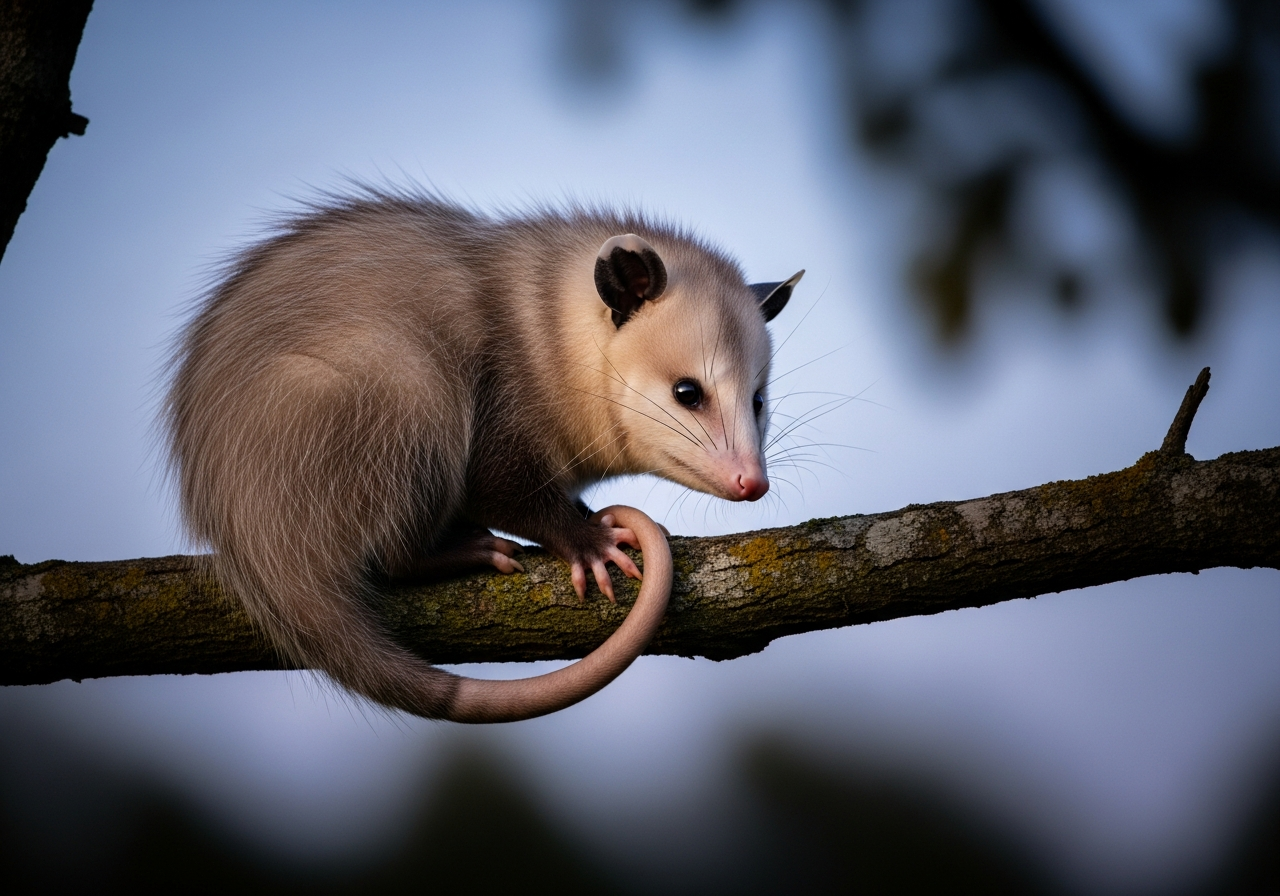
The opossum (Didelphis virginiana) is a mammal of the family Didelphidae, in the order Didelphimorphia.
Quick answer
The Virginia opossum is the only marsupial native to the United States and Canada, carrying its young in a pouch like a kangaroo. It is a cat-sized, grey-furred animal with a pointed pink snout, a prehensile tail, and 50 teeth — more than any other North American land mammal. Famous for 'playing possum', it eats almost anything, including ticks, and usually lives only 2 to 4 years.
Top questions about the Opossum
Opossum facts at a glance
- Weight 6 kg
- Length 90 cm
- Top speed 24 km/h
- Lifespan 4 years
| Scientific name | Didelphis virginiana |
|---|---|
| Diet | Omnivore (insects, carrion, fruit, eggs) |
| Habitat | Woodland, farmland, suburbs of North America |
| Lifespan | 2–4 years |
| Weight | 2–6 kg (4–13 lb) |
| Top speed | 24 km/h (15 mph) |
| Conservation status | Least Concern (IUCN) |
| Kingdom | Animalia |
|---|---|
| Phylum | Chordata |
| Class | Mammalia |
| Order | Didelphimorphia |
| Family | Didelphidae |
| Genus | Didelphis |
Where it lives
The opossum (Didelphis virginiana) is native to Across the eastern and central United States, expanding north into Canada and along the coasts; the only marsupial north of Mexico. — recorded across North America in this guide’s range summary.
For occurrence records, see GBIF species search and sources below.
How big is a opossum?
An adult opossum measures 90 cm long — about 52% of the height of an average adult person (1.73 m) — and weighs around 6.0 kg, about 9% of an average adult’s body weight (70 kg).
Length vs an average adult’s height (to scale)
What is a group of opossums called?
Group name (collective noun)
A group of Opossums is called a passel.
Baby name
A baby Opossum is called a joey.
Explore more animal collective nouns and baby animal names .
A marsupial in North America
Unlike the continent's other mammals, the Virginia opossum is a marsupial: its young are born tiny and undeveloped after just under two weeks, then crawl into the mother's pouch to keep growing. Once they outgrow the pouch, the joeys ride on her back. This makes the opossum a close relative of kangaroos and koalas rather than of the rodents it superficially resembles.
Playing possum
When badly frightened and unable to flee, an opossum may involuntarily fall into a near-comatose state — lying still with its mouth open, tongue out, and emitting a foul smell — that can last from minutes to hours. This 'playing possum' is not a conscious trick but a reflex that makes predators lose interest in what appears to be a rotting carcass. More often, a cornered opossum first hisses, growls, and bares its many teeth.
Diet and benefits
Opossums are opportunistic omnivores that eat insects, slugs, worms, carrion, fruit, eggs, small animals, and human food waste, making them valuable natural clean-up crews. They also groom away and eat large numbers of ticks. A low body temperature makes them poorly suited to carrying rabies, so they very rarely transmit the disease compared with many other wild mammals.
Range and survival
Originally a southern species, the Virginia opossum has expanded north and west and now lives across much of the United States and into Canada, helped by its broad diet and tolerance of human landscapes. It is listed as Least Concern. Its main challenges are short lifespan, cold winters that can frostbite its naked ears and tail, and heavy losses to vehicles and predators.
Dig deeper into the Opossum
- How Long Do Opossums Live?
Opossum lifespan is typically 2–4 years. What shortens or extends life, life stages, and status (Least Concern).
- What Do Opossums Eat?
What opossums eat: Omnivore (insects, carrion, fruit, eggs), foraging style, and seasonal shifts in Woodland, farmland, suburbs of North America.
- Where Do Opossums Live?
Where opossums live: Woodland, farmland, suburbs of North America, native range cues, and human overlap. Status Least Concern.
Explore the Opossum
Range & geography
Did you know? Opossum facts
- The Virginia opossum is the only marsupial native to the United States and Canada, carrying its young in a pouch like a kangaroo.
- A group of opossums is called a passel. Opossums are mostly solitary, so groups usually consist of a mother with her young, and because they are marsupials a baby opossum is called a joey.
- Playing dead is an involuntary reflex triggered by extreme fear. The opossum collapses, drools, and gives off a foul odour that makes it seem like a rotting carcass, causing many predators to lose interest.
- Opossums very rarely carry rabies. Their naturally low body temperature makes it hard for the virus to survive, so they pose a much lower rabies risk than many other wild mammals.
- Generally yes. Opossums eat insects, slugs, carrion, rodents, and many ticks, helping to clean up and control pests. They are not aggressive and prefer to bluff or play dead rather than fight.
- Conservation: Least Concern (IUCN).
Diet & feeding
Opossum feeds primarily as a omnivore (insects, carrion, fruit, eggs). Opossums are opportunistic omnivores that eat insects, slugs, worms, carrion, fruit, eggs, small animals, and human food waste, making them valuable natural clean-up crews. They also groom away and eat large numbers of ticks. A low body temperature
Adaptations
- Unlike the continent's other mammals, the Virginia opossum is a marsupial: its young are born tiny and undeveloped after just under two weeks, then crawl into the mother's pouch to keep growing. Once they outgrow the pouch, the joeys ride on her back. This makes the opossum a close relative of kangaroos and koalas rather than of the rodents it superficially resembles.
- When badly frightened and unable to flee, an opossum may involuntarily fall into a near-comatose state — lying still with its mouth open, tongue out, and emitting a foul smell — that can last from minutes to hours. This 'playing possum' is not a conscious trick but a reflex that makes predators lose interest in what appears to be a rotting carcass. More often, a cornered opossum first hisses, growls, and bares its many teeth.
Behaviour & ecology
- Unlike the continent's other mammals, the Virginia opossum is a marsupial: its young are born tiny and undeveloped after just under two weeks, then crawl into the mother's pouch to keep growing. Once they outgrow the pouch, the joeys ride on her back. This makes the opossum a close relative of kangaroos and koalas rather than of the rodents it superficially resembles.
- When badly frightened and unable to flee, an opossum may involuntarily fall into a near-comatose state — lying still with its mouth open, tongue out, and emitting a foul smell — that can last from minutes to hours. This 'playing possum' is not a conscious trick but a reflex that makes predators lose interest in what appears to be a rotting carcass. More often, a cornered opossum first hisses, growls, and bares its many teeth.
- Opossums are opportunistic omnivores that eat insects, slugs, worms, carrion, fruit, eggs, small animals, and human food waste, making them valuable natural clean-up crews. They also groom away and eat large numbers of ticks. A low body temperature makes them poorly suited to carrying rabies, so they very rarely transmit the disease compared with many other wild mammals.
Communication
- Opossum uses scent, posture, and vocal signals to mark territory and coordinate social behaviour.
- Communication intensity often peaks during breeding seasons and territorial disputes.
Habitat & range
Woodland, farmland, suburbs of North America
Ecological role
Opossum plays a recognised ecological role in woodland, farmland, suburbs of north america.
Conservation status of the Opossum
The opossum (Didelphis virginiana) is listed as Least Concern on the IUCN Red List. Least Concern (LC) is the IUCN's lowest-risk category, assigned to widespread, abundant species that have been evaluated and found not to be threatened. It does not mean a species faces no pressures — only that it is not currently at risk of extinction.
The opossum (Didelphis virginiana) is assessed on the IUCN Red List. Look up on the IUCN Red List .
Frequently asked questions about the Opossum
What is a group of opossums called?
A group of opossums is called a passel. Opossums are mostly solitary, so groups usually consist of a mother with her young, and because they are marsupials a baby opossum is called a joey.
Why do opossums play dead?
Playing dead is an involuntary reflex triggered by extreme fear. The opossum collapses, drools, and gives off a foul odour that makes it seem like a rotting carcass, causing many predators to lose interest.
Do opossums carry rabies?
Opossums very rarely carry rabies. Their naturally low body temperature makes it hard for the virus to survive, so they pose a much lower rabies risk than many other wild mammals.
Are opossums good to have around?
Generally yes. Opossums eat insects, slugs, carrion, rodents, and many ticks, helping to clean up and control pests. They are not aggressive and prefer to bluff or play dead rather than fight.
Is it 'opossum' or 'possum'?
In North America the animal is the opossum, often shortened to possum in speech. True possums are a separate group of marsupials found in Australia and nearby islands.
What is a baby opossum called?
A baby Opossum is called a joey.
Sources & references
This guide is compiled and reviewed against established zoological and conservation references. Key sources for the Opossum:
-
IUCN Red List of Threatened Species
Conservation status (Least Concern) reflects the IUCN Red List category for Didelphis virginiana.
-
iNaturalist — observations & photos
Search citizen-science observations and community IDs for Didelphis virginiana. Useful for range checks and recent sightings — not a substitute for formal Red List status.
-
GBIF — occurrence data
Global Biodiversity Information Facility species search for Didelphis virginiana. Explore published occurrence records used in range research.
- IUCN Red List — Didelphis virginiana.
Conservation status (Least Concern) and population trends.
- Animal Diversity Web — Didelphis virginiana. University of Michigan Museum of Zoology.
Life history, morphology, and range.
- Wikipedia — Opossum.
General taxonomy and overview (cross-check primary sources).
-
Global Animal Guide editorial standards
How we research, source, review, and update every guide for accuracy.