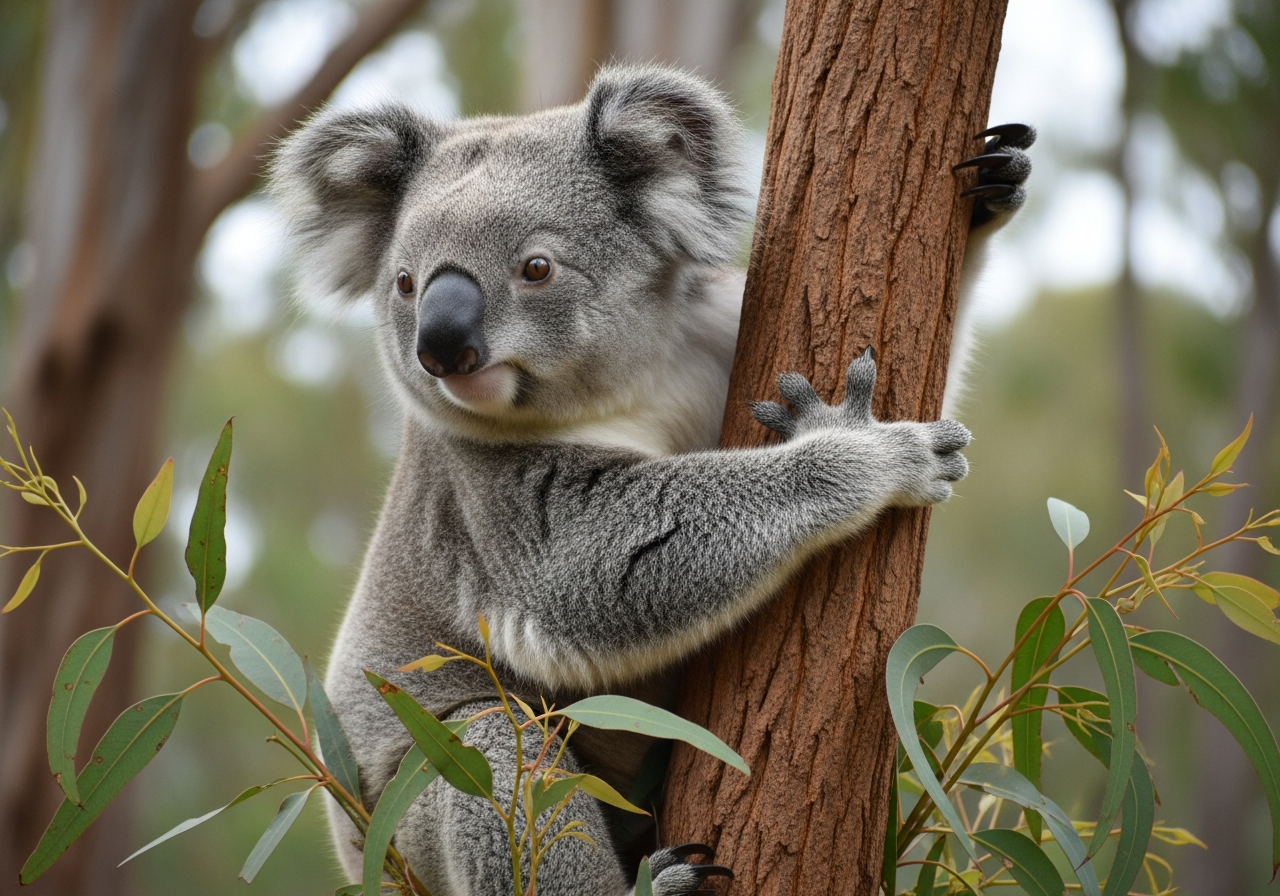
The koala (Phascolarctos cinereus) is a mammal of the family Phascolarctidae, in the order Diprotodontia.
Quick answer
The koala is a tree-dwelling marsupial native to eastern Australia, famous for its diet of eucalyptus leaves and for sleeping up to 20 hours a day. Despite often being called a bear, it is a marsupial that carries its young in a pouch. Wild koalas typically live around 13 to 18 years.
Top questions about the Koala
Also available in Español (Koala)
Koala facts at a glance
- Weight 14 kg
- Length 80 cm
- Top speed 30 km/h
- Lifespan 16 years
| Scientific name | Phascolarctos cinereus |
|---|---|
| Diet | Herbivore (eucalyptus specialist) |
| Habitat | Eucalyptus forest and woodland |
| Lifespan | 13–18 years in the wild |
| Weight | 4–14 kg (9–31 lb) |
| Top speed | About 30 km/h (19 mph) over short bursts |
| Conservation status | Vulnerable (IUCN) |
| Kingdom | Animalia |
|---|---|
| Phylum | Chordata |
| Class | Mammalia |
| Order | Diprotodontia |
| Family | Phascolarctidae |
| Genus | Phascolarctos |
Where it lives
The koala (Phascolarctos cinereus) is native to The eucalyptus forests of eastern and southeastern Australia. — recorded across Oceania in this guide’s range summary.
For occurrence records, see GBIF species search and sources below.
How big is a koala?
An adult koala measures 80 cm long — about 46% of the height of an average adult person (1.73 m) — and weighs around 14 kg, about 20% of an average adult’s body weight (70 kg).
Length vs an average adult’s height (to scale)
What is a group of koalas called?
Group name (collective noun)
A group of Koalas is called a colony.
Baby name
A baby Koala is called a joey.
Explore more animal collective nouns and baby animal names .
A specialized leaf diet
Koalas eat almost nothing but eucalyptus leaves, which are tough, low in nutrients, and toxic to most animals. A special digestive system lets koalas break down these leaves and neutralize the toxins. Because the diet provides so little energy, koalas sleep up to 20 hours a day to conserve it.
Life in the trees
Koalas are superbly adapted to life in the canopy, with strong limbs, rough paw pads, and two opposable thumbs on each front paw for gripping branches. They rarely come down to the ground, where they are slow and vulnerable, and they get most of their water from the moisture in leaves.
Raising a joey
Like other marsupials, koalas give birth to a tiny, undeveloped joey that crawls into the mother's pouch to keep growing. After about six months it begins riding on her back. Young koalas eat a special form of their mother's droppings to gain the gut microbes needed to digest eucalyptus.
Conservation
Koalas are listed as Vulnerable, and populations in parts of eastern Australia are declining sharply. Habitat loss, bushfires, disease, vehicle strikes, and dog attacks are the main threats, and protecting and replanting eucalyptus forest is central to their recovery.
Dig deeper into the Koala
- Are Koalas Endangered?
IUCN lists koalas as Vulnerable (2014). Australia listed combined QLD/NSW/ACT populations Endangered in 2022. Not bears.
- How Long Do Koalas Live?
Wild koalas often live about 13–18 years; cars, dogs, chlamydia and fire cut the average. IUCN Vulnerable.
- Koala: Key Facts
The koala is a tree-dwelling marsupial native to eastern Australia, famous for its diet of eucalyptus leaves and for sleeping up to 20 hours a day.
- What Do Koalas Eat?
Koalas eat almost nothing but eucalyptus leaves — not bamboo, not people-food. Marsupials, not bears.
- Where Do Koalas Live?
Koalas live in eastern Australian eucalyptus woodland — not China, not Africa. IUCN Vulnerable.
Explore the Koala
Compare
Close relatives
- Red-necked Wallaby Same order
- Goodfellow's Tree-kangaroo Same order
- Sugar Glider Same order
- Red Kangaroo Same order
Collections
Range & geography
Did you know? Koala facts
- Koalas are marsupials, not bears, and carry their young in a pouch.
- They eat eucalyptus leaves that are toxic to most animals.
- Koalas sleep up to 18–22 hours a day to conserve energy from a low-nutrient diet.
- Each koala has unique fingerprints, remarkably similar to a human's.
- Joeys eat their mother's 'pap' to gain the gut microbes needed to digest eucalyptus.
- Habitat loss, disease, and bushfires have made koalas endangered in parts of Australia.
Diet & feeding
Koalas feed almost exclusively on eucalyptus leaves, selecting particular species and even individual trees, and obtain most of their water from foliage.
Adaptations
- A specialised gut and liver detoxify eucalyptus compounds poisonous to other animals. (Nowak 1999)
- An enlarged caecum ferments tough, fibrous leaves to release scarce nutrients.
- Sharp claws and opposable digits grip and climb smooth eucalyptus trunks.
- A very low metabolic rate and long sleep conserve energy on a poor diet.
Behaviour & ecology
- Koalas are solitary and largely nocturnal, spending most of their time in trees.
- Individuals occupy overlapping home ranges centred on favoured food trees.
- Males bellow loudly to advertise presence during the breeding season.
- Joeys ride on the mother's back after leaving the pouch.
Communication
- Males produce a deep, resonant bellow far lower than expected for their size.
- Scent-marking from a chest gland advertises territory and status.
- Vocal squeaks and screams feature in distress and disputes.
Habitat & range
Koalas live in eucalyptus woodlands and forests of eastern and southeastern Australia, depending entirely on the presence of suitable food trees.
Ecological role
As specialist eucalyptus folivores, koalas are an iconic indicator species whose decline reflects the loss and fragmentation of Australian woodland.
Conservation status of the Koala
The koala (Phascolarctos cinereus) is listed as Vulnerable on the IUCN Red List. Vulnerable (VU) means a species faces a high risk of extinction in the medium-term future. It is the lowest-risk of the three 'threatened' IUCN categories — one step below Endangered, which is itself below Critically Endangered — and is often an early warning that a population is in trouble.
Main threats to the koala
- Habitat loss and land clearing
- Bushfires and drought (climate change)
- Vehicle strikes and dog attacks
- Disease (chlamydia)
Koala (Phascolarctos cinereus) was most recently assessed for the IUCN Red List in 2014. View the full IUCN assessment .
Frequently asked questions about the Koala
Is a koala a bear?
No. Although it is often called a koala bear, the koala is a marsupial, not a bear. Like kangaroos, it carries and nurses its young in a pouch.
What do koalas eat?
Koalas eat almost exclusively eucalyptus leaves. These leaves are tough and toxic to most animals, but koalas have a specialized digestive system that lets them break them down safely.
Why do koalas sleep so much?
Koalas sleep up to 20 hours a day because their eucalyptus diet provides very little energy. Resting for most of the day helps them conserve what energy they have for digestion and movement.
Are koalas endangered?
Koalas are listed as Vulnerable by the IUCN, and some populations in eastern Australia are declining steeply due to habitat loss, bushfires, and disease.
Do koalas drink water?
Koalas get most of their water from the moisture in eucalyptus leaves and historically drank rarely. During heatwaves and droughts, however, they are increasingly seen drinking from water sources.
What is a group of koalas called?
A group of Koalas is called a colony.
What is a baby koala called?
A baby Koala is called a joey.
Sources & references
This guide is compiled and reviewed against established zoological and conservation references. Key sources for the Koala:
-
IUCN Red List of Threatened Species
Conservation status (Vulnerable) reflects the IUCN Red List category for Phascolarctos cinereus, most recently assessed in 2014.
-
iNaturalist — observations & photos
Search citizen-science observations and community IDs for Phascolarctos cinereus. Useful for range checks and recent sightings — not a substitute for formal Red List status.
-
GBIF — occurrence data
Global Biodiversity Information Facility species search for Phascolarctos cinereus. Explore published occurrence records used in range research.
- Woinarski, J. & Burbidge, A. A. (2020). Phascolarctos cinereus. IUCN Red List of Threatened Species.
Status (Vulnerable) and threats.
- Animal Diversity Web — Phascolarctos cinereus. University of Michigan Museum of Zoology.
Life history, morphology, and range.
- Nowak, R. M. (1999). Walker's Mammals of the World (6th ed.). Johns Hopkins University Press.
Physiology and diet.
-
Global Animal Guide editorial standards
How we research, source, review, and update every guide for accuracy.
Want to help directly? Learn how to symbolically adopt a koala and support its conservation.