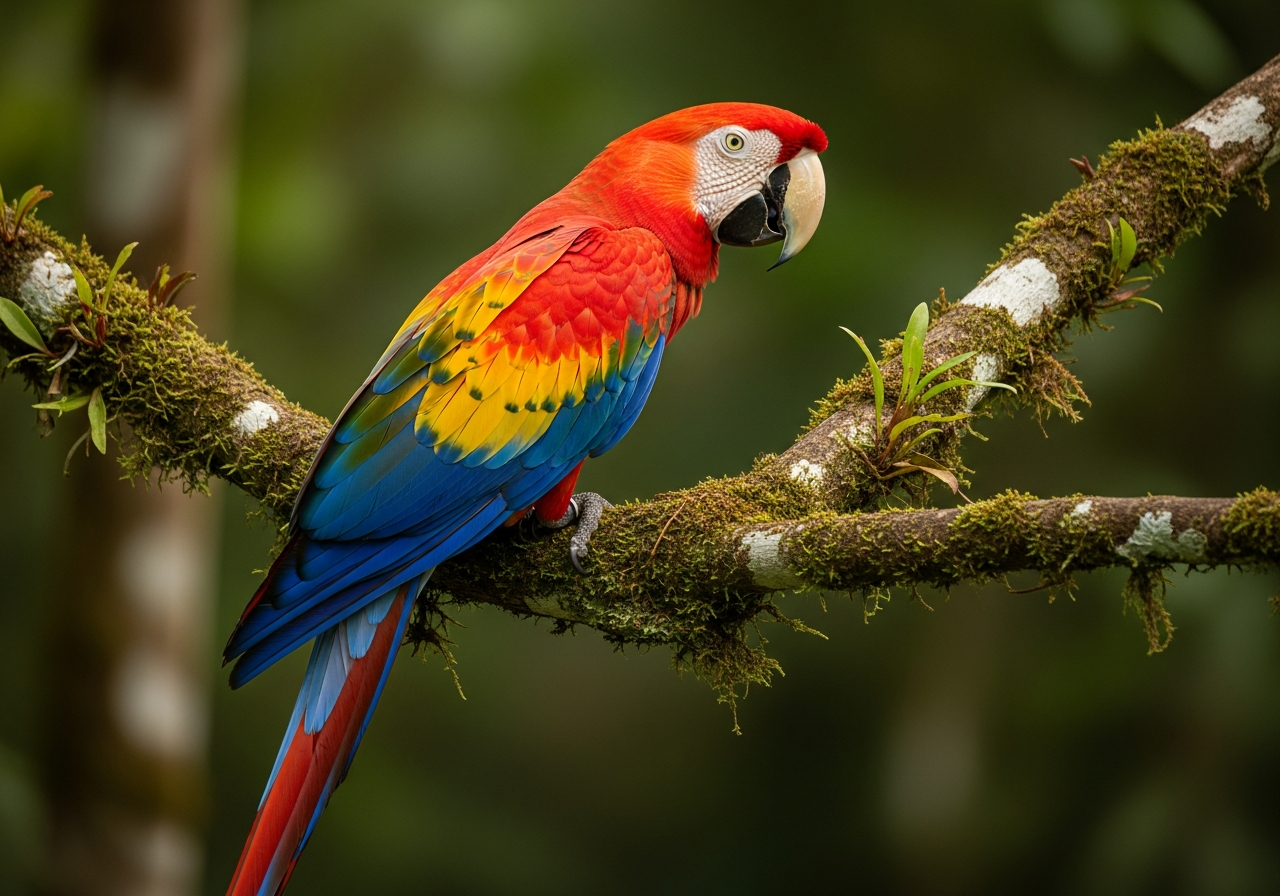
Scarlet Macaw
Ara macao
Quick answer
The scarlet macaw is a large, brightly colored parrot native to the rainforests of Central and South America, famous for its red, yellow, and blue plumage. Highly intelligent and social, it can mimic sounds, use its strong beak to crack hard nuts, and form lifelong pair bonds. Scarlet macaws are long-lived, often reaching 40 to 50 years and sometimes longer in captivity.
Scarlet Macaw facts at a glance
| Scientific name | Ara macao |
|---|---|
| Diet | Omnivore (fruit, nuts, seeds, flowers) |
| Habitat | Tropical rainforest and woodland |
| Lifespan | 40–50 years, longer in captivity |
| Length | 81–96 cm (32–38 in) including tail |
| Top speed | Up to 56 km/h (35 mph) |
| Conservation status | Least Concern (IUCN) |
| Kingdom | Animalia |
|---|---|
| Phylum | Chordata |
| Class | Aves |
| Order | Psittaciformes |
| Family | Psittacidae |
| Genus | Ara |
Where it lives
Humid lowland rainforests from southern Mexico and Central America across the Amazon Basin of South America.
Intelligence and behavior
Scarlet macaws are among the most intelligent birds, able to solve problems, use their feet like hands, and mimic words and sounds. They are highly social, gathering in noisy flocks and communicating with loud squawks that carry far through the forest. Pairs are devoted to each other, often flying wing to wing and preening their partner.
Diet and the clay licks
These macaws eat fruit, nuts, seeds, and flowers, and their immensely powerful beaks can crack nuts that few other animals can open. In parts of the Amazon they gather at exposed riverbank clay, known as clay licks, where they eat mineral-rich soil that is thought to help neutralize toxins in their diet and supply important nutrients.
Habitat and range
Scarlet macaws live in humid lowland rainforests and nearby woodlands from southern Mexico through Central America and across much of the Amazon Basin in South America. They nest in cavities high in large trees and need expanses of mature forest to find enough food and suitable nesting sites.
Pets and conservation
Their beauty and intelligence have made scarlet macaws popular in the pet trade, but they are demanding, long-lived, and loud, and wild populations have suffered from trapping and deforestation. They are protected by international trade rules, and reintroduction projects are helping restore them to areas where they had disappeared.
Frequently asked questions about the Scarlet Macaw
How long do scarlet macaws live?
Scarlet macaws are very long-lived. In the wild they often reach 40 to 50 years, and well-cared-for birds in captivity can live 60 years or more.
What do scarlet macaws eat?
They are omnivores that eat fruit, nuts, seeds, and flowers. Their powerful beaks crack hard nuts, and they often visit clay licks to eat mineral-rich soil that may help with digestion.
Can scarlet macaws talk?
Yes, to a degree. Scarlet macaws are intelligent and can learn to mimic words and household sounds, though they are generally less talkative than some other parrots like the African grey.
Do scarlet macaws make good pets?
They can bond strongly with people but are challenging pets. They live for decades, are very loud, need large enclosures and lots of stimulation, and can give a powerful bite, so they suit only experienced keepers.
Are scarlet macaws endangered?
The species is listed as Least Concern overall, but some local populations have been lost to trapping for the pet trade and deforestation. Trade is regulated and reintroduction programs are helping recovery.
Why are scarlet macaws so colorful?
Their bold red, yellow, and blue feathers help them recognize one another and communicate within the flock. In the dappled rainforest the colors can also be surprisingly hard to pick out among leaves and fruit.