Image sourcing: see credits & licences
Quick answer
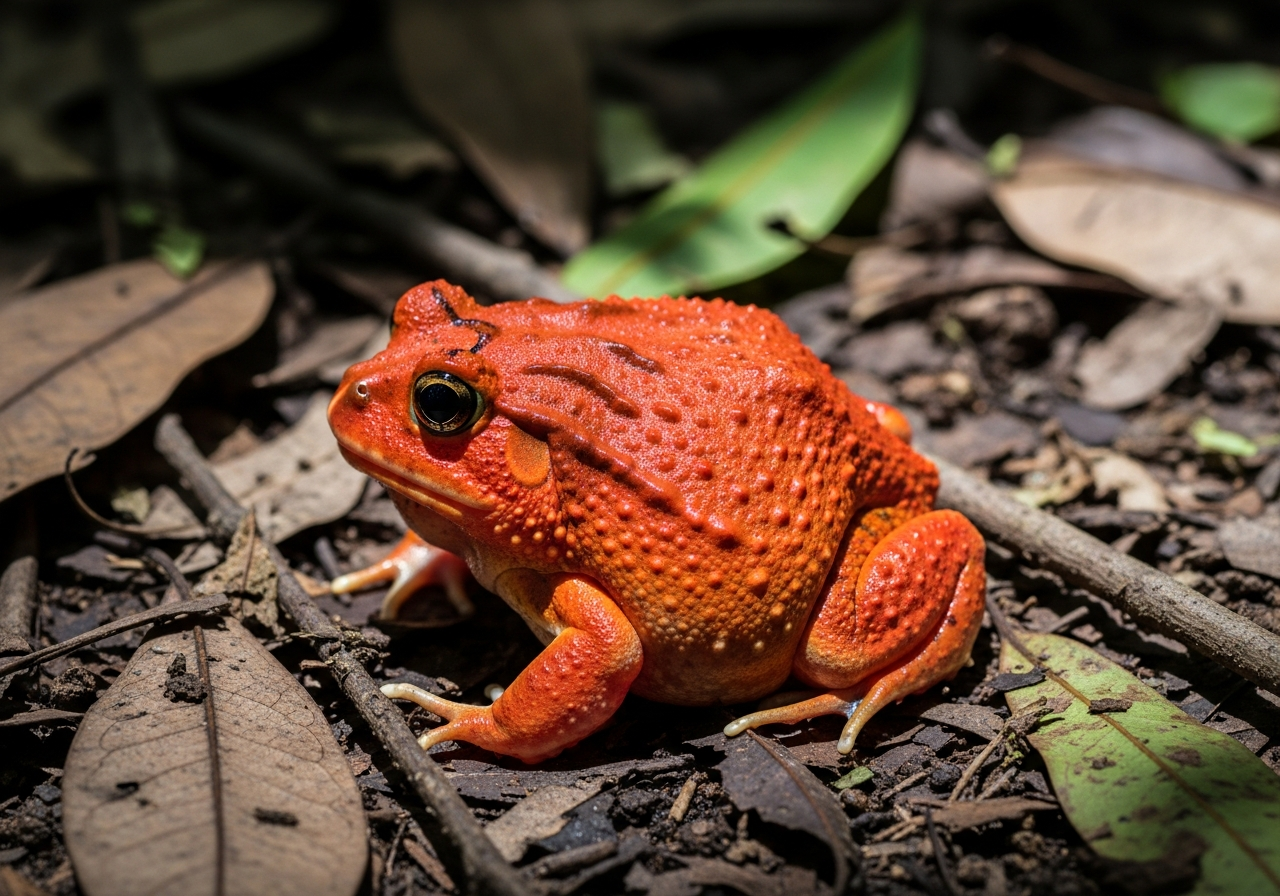
The tomato frog is a round, brightly colored frog found only in Madagascar, named for the deep red-orange skin of the females. When threatened it puffs up and can ooze a sticky, irritating secretion that gums up a predator's mouth. Tomato frogs are burrowing ambush hunters that can live around 6 to 8 years, and longer in captivity.
Top questions about the Tomato Frog
Tomato Frog facts at a glance
- Weight 60 g
- Length 10 cm
- Top speed 4 km/h
- Lifespan 7 years
| Scientific name | Dyscophus antongilii |
|---|---|
| Diet | Carnivore (insects, worms, small invertebrates) |
| Habitat | Rainforest floor, swamps, and ditches |
| Lifespan | 6–8 years, longer in captivity |
| Length | 6–10 cm (2.4–4 in); females larger |
| Weight | Around 40–230 g (1.4–8 oz) |
| Conservation status | Least Concern (IUCN) |
| Kingdom | Animalia |
|---|---|
| Phylum | Chordata |
| Class | Amphibia |
| Order | Anura |
| Family | Microhylidae |
| Genus | Dyscophus |
Where it lives
The tomato frog (Dyscophus antongilii) is native to Rainforest floors, swamps, and ditches of northeastern Madagascar. — recorded across Africa in this guide’s range summary.
For occurrence records, see GBIF species search and sources below.
How big is a tomato frog?
An adult tomato frog measures 10 cm long — about 6% of the height of an average adult person (1.73 m) — and weighs around 60 g, a small fraction of an average adult’s body weight (70 kg).
Length vs an average adult’s height (to scale)
What is a group of tomato frogs called?
Group name (collective noun)
A group of Tomato Frogs is called an army.
Baby name
A baby Tomato Frog is called a tadpole.
Explore more animal collective nouns and baby animal names .
Behavior and defense
Tomato frogs are mostly nocturnal and spend the day partly buried in soil or leaf litter, emerging at night to feed. Their bright color warns predators that they are unpleasant to eat. If grabbed, a tomato frog puffs itself up to look larger and secretes a thick, sticky substance from its skin that can glue up a predator's mouth and cause irritation.
Diet and feeding
These frogs are sit-and-wait carnivores that eat insects, worms, and other small invertebrates. They ambush prey that wanders close, lunging forward and swallowing it whole. In captivity they readily take crickets, worms, and other feeder insects.
Habitat and range
The tomato frog is endemic to northeastern Madagascar, where it lives on the rainforest floor and in swamps, ditches, and slow waters, often near human settlements. It favors damp, shaded ground where it can burrow. After heavy rains, the frogs gather in shallow pools to breed.
Conservation
Once a major conservation concern, the tomato frog is now listed as Least Concern following improved population data, though it has a limited range. Habitat loss, drainage of wetlands, and past collection for the pet trade remain pressures. Most tomato frogs in the pet trade today are captive-bred, easing demand on wild populations.
Dig deeper into the Tomato Frog
- How Long Do Tomato Frogs Live?
Tomato Frog lifespan is typically 6–8 years, longer in captivity. What shortens or extends life, life stages, and status (Least Concern).
- What Do Tomato Frogs Eat?
What tomato frogs eat: Carnivore (insects, worms, small invertebrates), foraging style, and seasonal shifts in Rainforest floor, swamps, and ditches.
- Where Do Tomato Frogs Live?
Where tomato frogs live: Rainforest floor, swamps, and ditches, native range cues, and human overlap. Status Least Concern.
Explore the Tomato Frog
Related Amphibians
Range & geography
Did you know? Tomato Frog facts
- The tomato frog is a round, brightly colored frog found only in Madagascar, named for the deep red-orange skin of the females.
- It is named for its round shape and the bright red-orange color of the females, which makes them look strikingly like a ripe tomato. Males are usually smaller and a more muted yellow-orange.
- They are not deadly, but when threatened they secrete a thick, sticky substance from their skin that can gum up a predator's mouth and irritate the eyes and skin, so they should be handled with care.
- Tomato frogs are carnivores that ambush insects, worms, and other small invertebrates, swallowing prey whole as it wanders within reach.
- They are found only in northeastern Madagascar, living on the rainforest floor and in swamps, ditches, and slow waters, often close to human settlements.
- Conservation: Least Concern (IUCN).
Diet & feeding
Tomato Frog feeds primarily as a carnivore (insects, worms, small invertebrates). Tomato frogs are mostly nocturnal and spend the day partly buried in soil or leaf litter, emerging at night to feed. Their bright color warns predators that they are unpleasant to eat. If grabbed, a tomato frog puffs itself up to look lar
Adaptations
- Tomato frogs are mostly nocturnal and spend the day partly buried in soil or leaf litter, emerging at night to feed. Their bright color warns predators that they are unpleasant to eat. If grabbed, a tomato frog puffs itself up to look larger and secretes a thick, sticky substance from its skin that can glue up a predator's mouth and cause irritation.
- These frogs are sit-and-wait carnivores that eat insects, worms, and other small invertebrates. They ambush prey that wanders close, lunging forward and swallowing it whole. In captivity they readily take crickets, worms, and other feeder insects.
Behaviour & ecology
- Tomato frogs are mostly nocturnal and spend the day partly buried in soil or leaf litter, emerging at night to feed. Their bright color warns predators that they are unpleasant to eat. If grabbed, a tomato frog puffs itself up to look larger and secretes a thick, sticky substance from its skin that can glue up a predator's mouth and cause irritation.
- These frogs are sit-and-wait carnivores that eat insects, worms, and other small invertebrates. They ambush prey that wanders close, lunging forward and swallowing it whole. In captivity they readily take crickets, worms, and other feeder insects.
- The tomato frog is endemic to northeastern Madagascar, where it lives on the rainforest floor and in swamps, ditches, and slow waters, often near human settlements. It favors damp, shaded ground where it can burrow. After heavy rains, the frogs gather in shallow pools to breed.
Communication
- Tomato Frog uses scent, posture, and vocal signals to mark territory and coordinate social behaviour.
- Communication intensity often peaks during breeding seasons and territorial disputes.
Habitat & range
Rainforest floor, swamps, and ditches
Ecological role
Tomato Frog acts as a predator that helps regulate prey populations and maintain balance in rainforest floor, swamps, and ditches.
Conservation status of the Tomato Frog
The tomato frog (Dyscophus antongilii) is listed as Least Concern on the IUCN Red List. Least Concern (LC) is the IUCN's lowest-risk category, assigned to widespread, abundant species that have been evaluated and found not to be threatened. It does not mean a species faces no pressures — only that it is not currently at risk of extinction.
The tomato frog (Dyscophus antongilii) is assessed on the IUCN Red List. Look up on the IUCN Red List .
Frequently asked questions about the Tomato Frog
Why is it called a tomato frog?
It is named for its round shape and the bright red-orange color of the females, which makes them look strikingly like a ripe tomato. Males are usually smaller and a more muted yellow-orange.
Are tomato frogs poisonous?
They are not deadly, but when threatened they secrete a thick, sticky substance from their skin that can gum up a predator's mouth and irritate the eyes and skin, so they should be handled with care.
What do tomato frogs eat?
Tomato frogs are carnivores that ambush insects, worms, and other small invertebrates, swallowing prey whole as it wanders within reach.
Where do tomato frogs live?
They are found only in northeastern Madagascar, living on the rainforest floor and in swamps, ditches, and slow waters, often close to human settlements.
How long do tomato frogs live?
In the wild tomato frogs generally live around 6 to 8 years, and with good care in captivity they can live considerably longer.
Are tomato frogs good pets?
They are popular pets because of their bold color and hardy nature, but they need a humid enclosure with substrate for burrowing and should be handled sparingly due to their skin secretions.
What is a group of tomato frogs called?
A group of Tomato Frogs is called an army.
What is a baby tomato frog called?
A baby Tomato Frog is called a tadpole.
Sources & references
This guide is compiled and reviewed against established zoological and conservation references. Key sources for the Tomato Frog:
-
IUCN Red List of Threatened Species
Conservation status (Least Concern) reflects the IUCN Red List category for Dyscophus antongilii.
-
iNaturalist — observations & photos
Search citizen-science observations and community IDs for Dyscophus antongilii. Useful for range checks and recent sightings — not a substitute for formal Red List status.
-
GBIF — occurrence data
Global Biodiversity Information Facility species search for Dyscophus antongilii. Explore published occurrence records used in range research.
- IUCN Red List — Dyscophus antongilii.
Conservation status (Least Concern) and population trends.
- Animal Diversity Web — Dyscophus antongilii. University of Michigan Museum of Zoology.
Life history, morphology, and range.
- Wikipedia — Tomato Frog.
General taxonomy and overview (cross-check primary sources).
-
Global Animal Guide editorial standards
How we research, source, review, and update every guide for accuracy.