Toco Toucan
Ramphastos toco
Quick answer
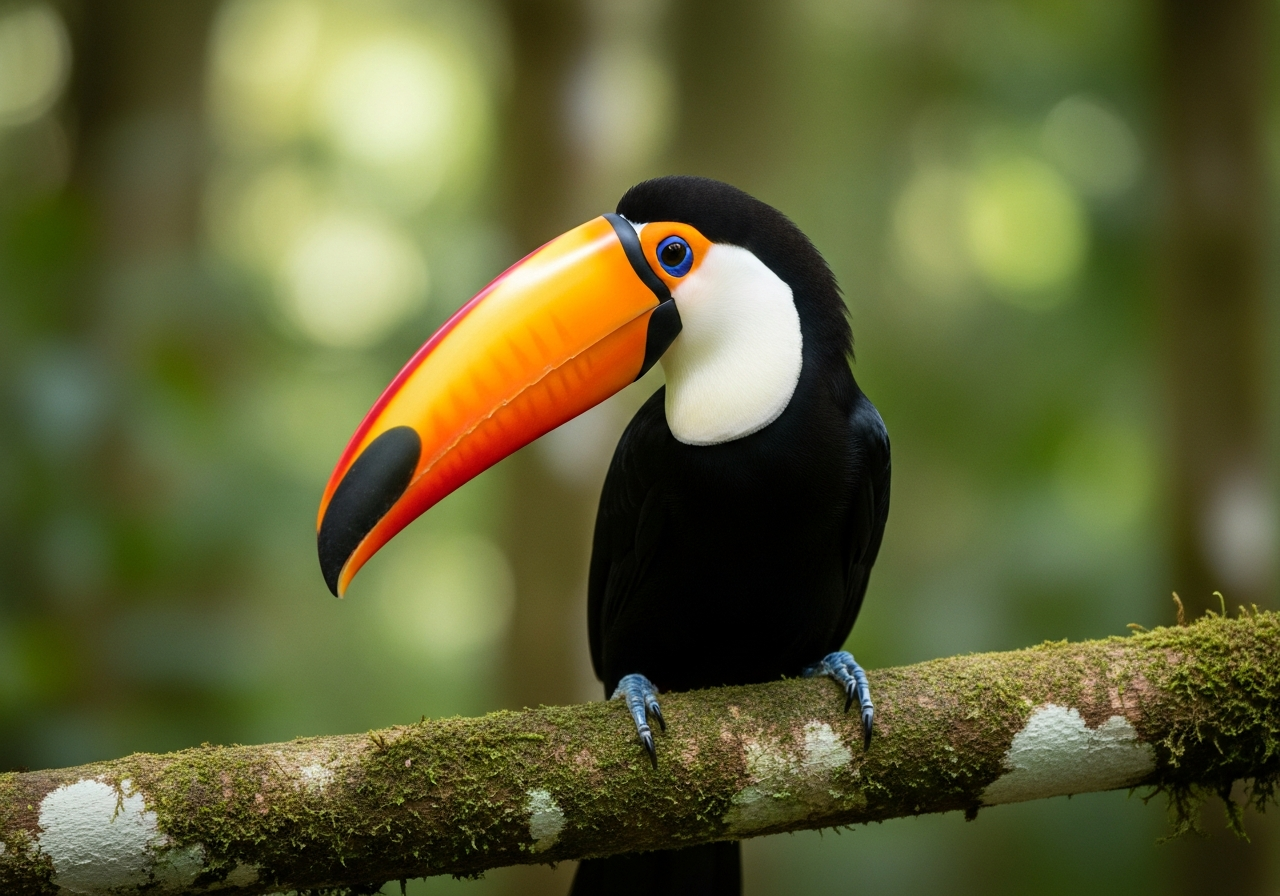
The toco toucan is the largest toucan, instantly recognized by its huge orange bill, which can be nearly 20 cm (8 in) long yet is surprisingly light. Native to South America, it uses the bill to reach fruit and to regulate its body temperature. Toco toucans live in small flocks in forests and savannas and can live around 20 years.
Toco Toucan facts at a glance
| Scientific name | Ramphastos toco |
|---|---|
| Diet | Omnivore (mostly fruit) |
| Habitat | Rainforest edges, woodland, savanna |
| Lifespan | About 20 years |
| Bill length | Up to 20 cm (8 in) |
| Weight | 500–860 g (1.1–1.9 lb) |
| Conservation status | Least Concern (IUCN) |
| Kingdom | Animalia |
|---|---|
| Phylum | Chordata |
| Class | Aves |
| Order | Piciformes |
| Family | Ramphastidae |
| Genus | Ramphastos |
Where it lives
Forest edges, woodlands, and savannas across central and eastern South America.
Behavior and the bill
The toco toucan's enormous bill is made of lightweight keratin over a honeycomb of bone, so it is far lighter than it looks. Besides reaching food, the bill acts as a radiator, releasing body heat to help the bird stay cool. Toucans are social, often moving through the forest in small noisy groups and tossing food into the air to catch in their bills.
Diet and feeding
Toco toucans eat mainly fruit, which they pluck and swallow whole, making them important seed dispersers for many rainforest trees. They also eat insects, eggs, and sometimes nestlings of other birds, giving them a varied omnivorous diet. The long bill lets them reach fruit on thin branches that cannot support their weight.
Habitat and range
Unlike most toucans, the toco toucan favors more open country, living along forest edges, woodlands, and tree-dotted savannas across central and eastern South America. It ranges through Brazil, the Guianas, and into Bolivia, Paraguay, and Argentina. It nests in tree cavities, often reusing holes made by other animals.
Conservation
The toco toucan is listed as Least Concern, with a wide range and a large population that tolerates some habitat disturbance. It still faces local threats from deforestation and from capture for the pet trade. Protecting tracts of forest and woodland helps secure its future.
Frequently asked questions about the Toco Toucan
Why do toucans have such big bills?
The large bill helps toucans reach fruit on branches too thin to perch on and also works as a radiator that releases heat to regulate body temperature. Despite its size, the bill is very light.
What do toucans eat?
Toco toucans eat mostly fruit, which they swallow whole, but they also take insects, eggs, and small animals. By dropping seeds across the forest, they help many trees reproduce.
Is a toucan's bill heavy?
No. The bill is made of keratin over a honeycomb-like bony structure, making it surprisingly light for its size, so it does not unbalance the bird in flight.
Where do toco toucans live?
Toco toucans live in central and eastern South America, favoring forest edges, woodlands, and savannas rather than deep rainforest. They range across Brazil and neighboring countries.
How long do toucans live?
Toco toucans live around 20 years, with some captive birds reaching longer. Lifespan in the wild depends on habitat quality and predation.
Are toco toucans endangered?
No. The toco toucan is listed as Least Concern thanks to its wide range and large population, though deforestation and the pet trade are local concerns.