What Is the Most Venomous Snake in the World?
The inland taipan has the most toxic venom of any snake, but the saw-scaled viper kills more people. Here is how scientists rank snake venom and why deadliness depends on more than toxicity alone.
Global Animal Guide · June 28, 2026
Quick answer
The inland taipan produces the most toxic snake venom measured in lab tests, but the saw-scaled viper causes more human deaths because it lives near densely populated areas and bites readily.
Last updated: June 2026 — figures reflect widely cited scientific estimates.
Most venomous and most deadly are two different titles
By laboratory measure, the inland taipan of central Australia has the most toxic venom of any snake on Earth. Drop for drop, nothing else tested comes close.
It has also, as far as the record shows, never killed anyone. It lives in remote black-soil plains, is shy, is rarely encountered, and every known bite has involved a handler or a herpetologist. It is not aggressive, and the few victims have survived with antivenom.
The snake that actually kills people in large numbers is the saw-scaled viper — a small, irritable, widespread species of Africa, the Middle East and South Asia whose venom is nowhere near the taipan’s on a toxicity chart. It lives where people farm, walk barefoot and sleep on the ground; it is easily provoked; and it bites readily. That is the whole lesson of this question. Toxicity is a property of a molecule. Deadliness is a property of a situation.
How venom toxicity is actually measured — and what LD50 hides
Venom rankings come from LD50 assays: the dose required to kill half of a test group, expressed per kilogram of body weight. It is a real and useful measure, but almost every popular ranking abuses it in the same three ways.
It is a mouse. LD50 figures are overwhelmingly murine. Venom is adapted to a snake’s actual prey, and a compound devastating to a rodent may be far less so to a primate. Snakes that specialise in reptiles or birds often score oddly against a mouse benchmark in both directions.
The route changes everything. The same venom yields wildly different numbers injected intravenously, subcutaneously, intraperitoneally or intramuscularly. A real bite is roughly subcutaneous or intramuscular. Rankings that quietly use intravenous figures — the most flattering — inflate a snake’s standing dramatically, and mixing routes within one league table makes it meaningless.
Potency is not dose. LD50 says nothing about how much venom the snake delivers. Yield is a separate variable, and often the decisive one.
Yield, fangs and delivery: the variables that matter in a real bite
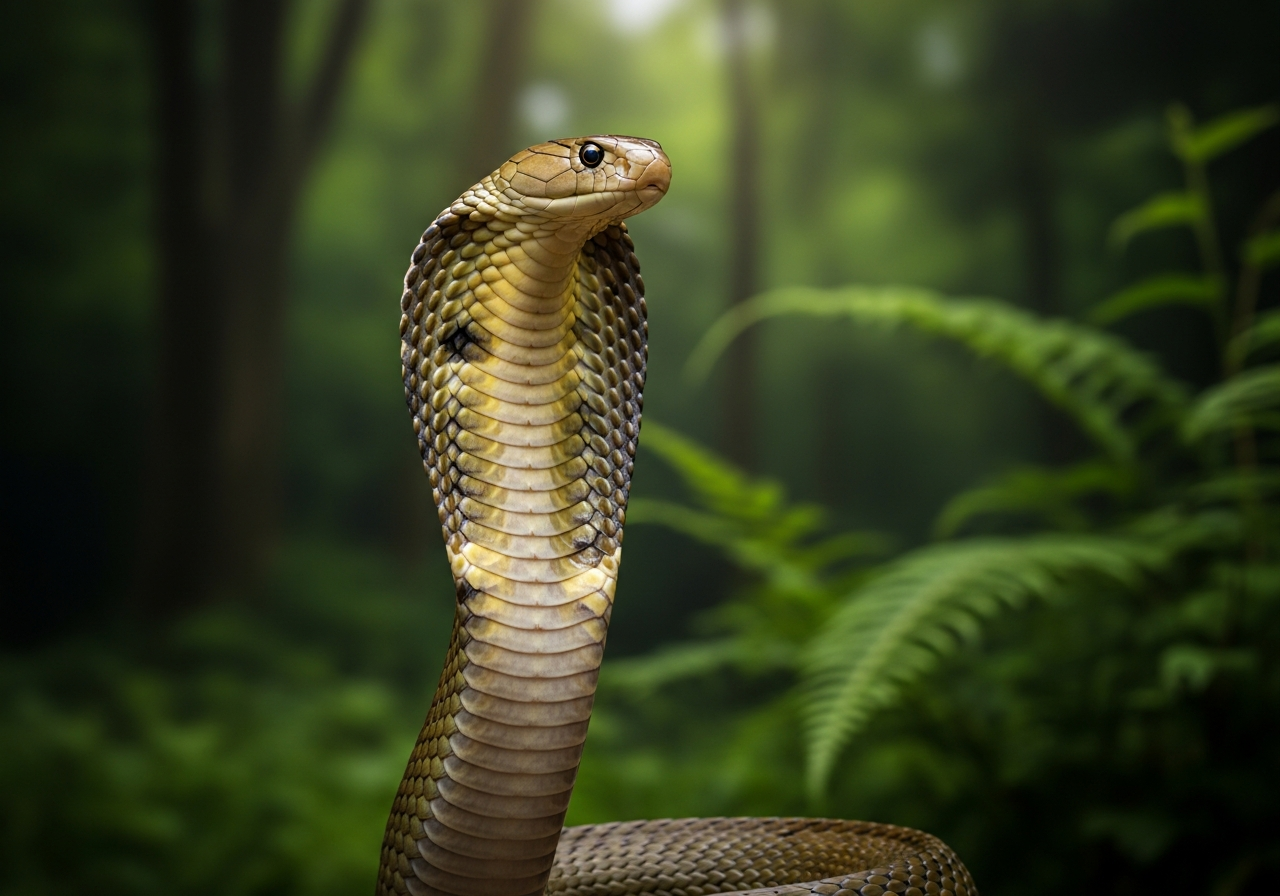
A king cobra has venom of only moderate potency by taipan standards, but it is the longest venomous snake in the world and can inject an enormous volume in a single bite — enough to be lethal without any exceptional toxicity. Sheer quantity substitutes for concentration.
The gaboon viper makes the same argument with hardware. It has the longest fangs of any snake, a heavy body, and a very large yield, delivered deep into tissue. The black mamba is fast, nervous and neurotoxic, and its reputation for chasing people is largely mythology — it is a snake that wants an escape route and becomes dangerous when it does not have one.
Then there is the dry bite. Venom is metabolically expensive and exists for hunting, not for arguments with animals too big to eat. Snakes meter it, and a substantial share of defensive bites — the proportion varies by species — inject little or no venom at all. This is why bite statistics and envenoming statistics are different datasets, and why conflating them distorts every ranking built on them.
Different venoms, different deaths
Venom is not one substance. It is a complex cocktail, and species differ in what their cocktails do.
Neurotoxic venoms, typical of elapids — taipans, cobras, mambas, coral snakes — attack nerve signalling and kill by paralysing the muscles of breathing. Death can be relatively fast, and a victim on a ventilator may survive to be treated.
Haemotoxic and cytotoxic venoms, typical of vipers — the saw-scaled viper, puff adder, rattlesnakes, eastern diamondback — wreck blood clotting and destroy tissue. These kill more slowly, through haemorrhage and organ failure, and they maim survivors: necrosis, amputation, permanent disability. The boomslang is a rear-fanged outlier whose haemotoxic effects can be delayed for many hours, long enough for a victim to believe the bite was trivial.
The inland taipan’s venom is notable partly because it combines potent neurotoxins with procoagulants and myotoxins — it is efficient, not merely strong. That efficiency is thought to reflect its diet of rats in an environment where prey must be killed fast and not lost.
The snakes that actually kill people
The World Health Organization estimates that snakebite envenoming kills roughly 81,000 to 138,000 people a year, and leaves perhaps three times that number with permanent disability. It is classified as a neglected tropical disease.
Almost none of that toll comes from the celebrity species. In India, the “Big Four” — saw-scaled viper, Russell’s viper, spectacled cobra and common krait — account for the great majority of deaths. The common krait is a particularly grim case: nocturnal, drawn into houses after rodents, with a bite that is often nearly painless, so victims sleep through the envenoming and are found in the morning.
The deaths cluster among agricultural workers with poor access to antivenom, poor transport, and no reliable cold chain to store it. The same bite is survivable in one country and fatal in another, which means most of the mortality is a healthcare failure rather than a fact of biology.
Myths worth dropping
The single most repeated claim in this area — that Belcher’s sea snake or the “hook-nosed sea snake” is the most venomous snake in the world — traces to a misreading of an old toxicology table and has been propagated for decades. Sea snakes do have highly toxic venom, but the specific ranking is an error, not a finding.
Two more are worth retiring. Baby snakes are not more dangerous than adults on the grounds that they “cannot control their venom” — adults deliver far more of it, and the claim does not survive contact with the yield data. And venomous snakes are not vermin to be cleared: they are significant rodent predators, several are threatened by habitat loss and persecution, and antivenom itself depends on the continued existence of the very species people fear. The inland taipan, the most venomous snake alive, is essentially harmless to anyone who is not holding it.
Sources
Related reading: Animal profiles · Fastest animals on Earth · Support wildlife protection
Frequently asked questions
What Is the Most Venomous Snake in the World
The inland taipan produces the most toxic snake venom measured in lab tests, but the saw-scaled viper causes more human deaths because it lives near densely populated areas and bites readily.
How do scientists measure this record?
Records come from peer-reviewed studies, GPS tracking, high-speed video, toxicology assays, and acoustic meters — field conditions always add variation.
Can the record holder change?
Yes — new measurements, species reclassification, or better technology can update rankings. Always check whether speed, venom, or size is measured differently.