Image sourcing: see credits & licences
Quick answer
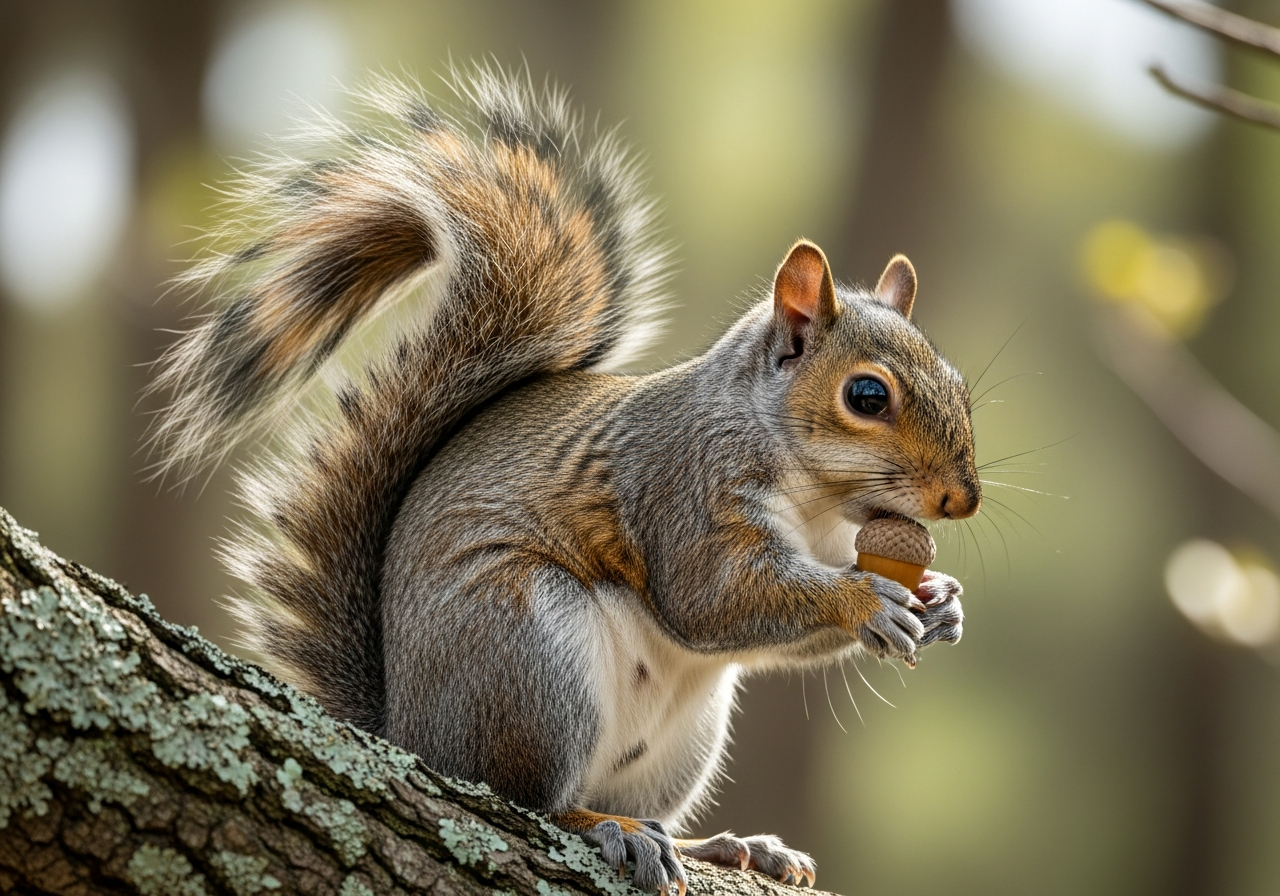
Squirrels are agile tree-climbing rodents best known from the eastern gray squirrel, a familiar resident of woodlands, parks, and gardens across North America and much of Europe. They are mostly herbivorous, feeding on nuts, seeds, and fruit, and famously bury food caches to survive winter. Adults typically measure 23 to 30 cm (9 to 12 in) in body length plus a long bushy tail, and wild gray squirrels usually live around 6 years. Squirrels as a family live nearly worldwide.
Top questions about the Squirrel
Squirrel facts at a glance
- Weight 550 g
- Length 28 cm
- Top speed 32 km/h
- Lifespan 6 years
| Scientific name | Sciurus carolinensis |
|---|---|
| Diet | Omnivore (mostly nuts, seeds, fruit) |
| Habitat | Woodlands, parks, and gardens |
| Lifespan | About 6 years in the wild |
| Weight | 400–700 g (0.9–1.5 lb) |
| Top speed | Up to 32 km/h (20 mph) |
| Conservation status | Least Concern (IUCN) |
| Kingdom | Animalia |
|---|---|
| Phylum | Chordata |
| Class | Mammalia |
| Order | Rodentia |
| Family | Sciuridae |
| Genus | Sciurus |
Where it lives
The squirrel (Sciurus carolinensis) is native to Woodlands, parks, and gardens across North America and Europe (the eastern gray squirrel; squirrels as a family live nearly worldwide). — recorded across North America, Europe in this guide’s range summary.
For occurrence records, see GBIF species search and sources below.
How big is a squirrel?
An adult squirrel measures 28 cm long — about 16% of the height of an average adult person (1.73 m) — and weighs around 550 g, about 1% of an average adult’s body weight (70 kg).
Length vs an average adult’s height (to scale)
What is a group of squirrels called?
Group name (collective noun)
A group of Squirrels is called a scurry. It is also known as a dray.
Baby name
A baby Squirrel is called a kit. It may also be called a kitten or a pup.
Explore more animal collective nouns and baby animal names .
Behavior and agility
Squirrels are remarkably acrobatic, leaping between branches and running headfirst down tree trunks thanks to ankle joints that rotate to grip bark. Their long, bushy tails aid balance, act as a rudder during jumps, and serve as a blanket in cold weather. They are active by day and stay alert for predators, flicking their tails and giving sharp calls when alarmed. Gray squirrels build leafy nests called dreys high in trees.
Diet and food caching
Squirrels are mostly herbivorous, eating nuts, seeds, acorns, fruit, buds, and fungi, and occasionally insects or eggs. They are famous for caching food, burying thousands of nuts each autumn to eat through winter. Many of these buried seeds are never recovered and grow into new trees, making squirrels important seed dispersers. They use spatial memory and smell to relocate their hidden stores.
Habitat and range
The eastern gray squirrel is native to eastern North America but has been introduced widely in Britain, Ireland, and parts of continental Europe, where it often outcompetes native red squirrels. Squirrels as a family live on nearly every continent except Antarctica and Australia. Gray squirrels thrive in deciduous and mixed forests and have adapted well to city parks and suburban gardens. They do not hibernate and remain active year-round.
Reproduction and life cycle
Female gray squirrels usually have one or two litters a year, each with two to four young born blind and hairless in a tree nest. The young are weaned at around 10 weeks and become independent soon after. Most squirrels die young, but those that survive their first year may live around six years in the wild. Predators include hawks, owls, foxes, and domestic cats.
Dig deeper into the Squirrel
- How Fast Is A Squirrel?
Squirrel top speed is up to about 32 km/h (20 mph). Sprint vs endurance and what limits pace.
- How Long Do Squirrels Live?
Squirrel lifespan is typically About 6 years in the wild. What shortens or extends life, life stages, and status (Least Concern).
- Squirrel: Key Facts
Squirrels are agile tree-climbing rodents best known from the eastern gray squirrel, a familiar resident of woodlands, parks, and gardens across North…
- What Do Squirrels Eat?
What squirrels eat: Omnivore (mostly nuts, seeds, fruit), foraging style, and seasonal shifts in Woodlands, parks, and gardens.
- Where Do Squirrels Live?
Where squirrels live: Woodlands, parks, and gardens, native range cues, and human overlap. Status Least Concern.
Explore the Squirrel
Range & geography
Did you know? Squirrel facts
- Squirrels are agile tree-climbing rodents best known from the eastern gray squirrel, a familiar resident of woodlands, parks, and gardens across North America and much of Europe.
- Squirrels eat mostly nuts, seeds, acorns, fruit, buds, and fungi, and they occasionally take insects or eggs. They bury surplus food in autumn to survive the winter.
- Squirrels use a mix of spatial memory and smell to relocate buried food. Many caches are never recovered, and those forgotten seeds often grow into new trees.
- Wild gray squirrels typically live around six years, though many die in their first year. In captivity, protected from predators, they can live considerably longer.
- Gray squirrels do not hibernate. They stay active all winter, relying on stored food caches and fat reserves, and shelter in their nests during the coldest spells.
- Conservation: Least Concern (IUCN).
Diet & feeding
Squirrel feeds primarily as a omnivore (mostly nuts, seeds, fruit). Squirrels are remarkably acrobatic, leaping between branches and running headfirst down tree trunks thanks to ankle joints that rotate to grip bark. Their long, bushy tails aid balance, act as a rudder during jumps, and serve as a blanket in cold weath
Adaptations
- Squirrels are remarkably acrobatic, leaping between branches and running headfirst down tree trunks thanks to ankle joints that rotate to grip bark. Their long, bushy tails aid balance, act as a rudder during jumps, and serve as a blanket in cold weather. They are active by day and stay alert for predators, flicking their tails and giving sharp calls when alarmed. Gray squirrels build leafy nests called dreys high in trees.
- Squirrels are mostly herbivorous, eating nuts, seeds, acorns, fruit, buds, and fungi, and occasionally insects or eggs. They are famous for caching food, burying thousands of nuts each autumn to eat through winter. Many of these buried seeds are never recovered and grow into new trees, making squirrels important seed dispersers. They use spatial memory and smell to relocate their hidden stores.
Behaviour & ecology
- Squirrels are remarkably acrobatic, leaping between branches and running headfirst down tree trunks thanks to ankle joints that rotate to grip bark. Their long, bushy tails aid balance, act as a rudder during jumps, and serve as a blanket in cold weather. They are active by day and stay alert for predators, flicking their tails and giving sharp calls when alarmed. Gray squirrels build leafy nests called dreys high in trees.
- Squirrels are mostly herbivorous, eating nuts, seeds, acorns, fruit, buds, and fungi, and occasionally insects or eggs. They are famous for caching food, burying thousands of nuts each autumn to eat through winter. Many of these buried seeds are never recovered and grow into new trees, making squirrels important seed dispersers. They use spatial memory and smell to relocate their hidden stores.
- The eastern gray squirrel is native to eastern North America but has been introduced widely in Britain, Ireland, and parts of continental Europe, where it often outcompetes native red squirrels. Squirrels as a family live on nearly every continent except Antarctica and Australia. Gray squirrels thrive in deciduous and mixed forests and have adapted well to city parks and suburban gardens. They do not hibernate and remain active year-round.
Communication
- Squirrel uses scent, posture, and vocal signals to mark territory and coordinate social behaviour.
- Communication intensity often peaks during breeding seasons and territorial disputes.
Habitat & range
Woodlands, parks, and gardens
Ecological role
Squirrel plays a recognised ecological role in woodlands, parks, and gardens.
Conservation status of the Squirrel
The squirrel (Sciurus carolinensis) is listed as Least Concern on the IUCN Red List. Least Concern (LC) is the IUCN's lowest-risk category, assigned to widespread, abundant species that have been evaluated and found not to be threatened. It does not mean a species faces no pressures — only that it is not currently at risk of extinction.
The squirrel (Sciurus carolinensis) is assessed on the IUCN Red List. Look up on the IUCN Red List .
Frequently asked questions about the Squirrel
What do squirrels eat?
Squirrels eat mostly nuts, seeds, acorns, fruit, buds, and fungi, and they occasionally take insects or eggs. They bury surplus food in autumn to survive the winter.
Do squirrels remember where they bury nuts?
Squirrels use a mix of spatial memory and smell to relocate buried food. Many caches are never recovered, and those forgotten seeds often grow into new trees.
How long do squirrels live?
Wild gray squirrels typically live around six years, though many die in their first year. In captivity, protected from predators, they can live considerably longer.
Do squirrels hibernate?
Gray squirrels do not hibernate. They stay active all winter, relying on stored food caches and fat reserves, and shelter in their nests during the coldest spells.
Why are gray squirrels a problem in Europe?
Introduced gray squirrels outcompete native red squirrels for food and habitat and carry a virus that is deadly to reds. This has caused red squirrel declines across much of Britain and Ireland.
Can squirrels climb down trees headfirst?
Yes. Squirrels can rotate their hind ankles to point their claws backward, letting them grip the bark and run down tree trunks headfirst.
What is a group of squirrels called?
A group of Squirrels is called a scurry. It is also known as a dray.
What is a baby squirrel called?
A baby Squirrel is called a kit. It may also be called a kitten or a pup.
Sources & references
This guide is compiled and reviewed against established zoological and conservation references. Key sources for the Squirrel:
-
IUCN Red List of Threatened Species
Conservation status (Least Concern) reflects the IUCN Red List category for Sciurus carolinensis.
-
iNaturalist — observations & photos
Search citizen-science observations and community IDs for Sciurus carolinensis. Useful for range checks and recent sightings — not a substitute for formal Red List status.
-
GBIF — occurrence data
Global Biodiversity Information Facility species search for Sciurus carolinensis. Explore published occurrence records used in range research.
- IUCN Red List — Sciurus carolinensis.
Conservation status (Least Concern) and population trends.
- Animal Diversity Web — Sciurus carolinensis. University of Michigan Museum of Zoology.
Life history, morphology, and range.
- Wikipedia — Squirrel.
General taxonomy and overview (cross-check primary sources).
-
Global Animal Guide editorial standards
How we research, source, review, and update every guide for accuracy.