Image sourcing: see credits & licences
Quick answer
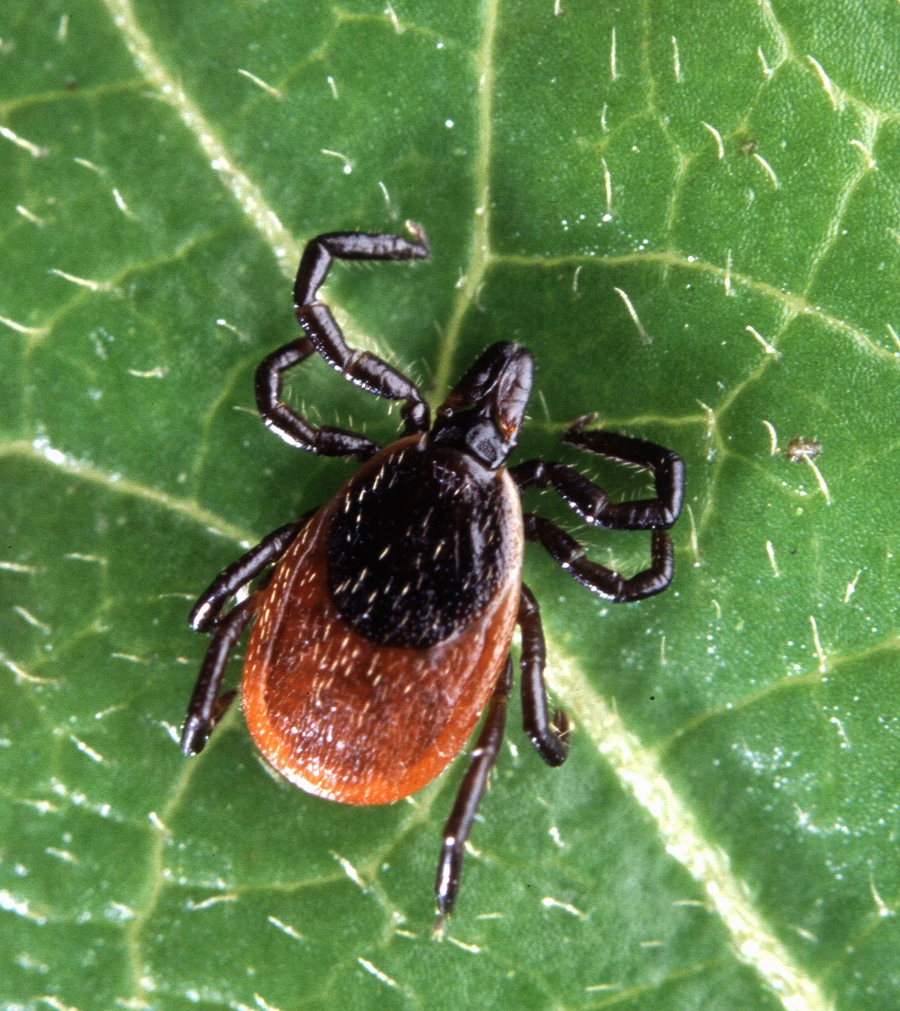
The blacklegged tick, also called the deer tick, is a tiny arachnid that attaches to hosts and feeds on blood, transmitting Lyme disease and other pathogens in eastern North America. Unfed nymphs are poppy-seed sized; adults are larger and most active in fall. Listed Not Evaluated by IUCN.
Top questions about the Blacklegged Tick
Blacklegged Tick facts at a glance
- Weight 0 g
- Length 0 cm
- Top speed 0 km/h
- Lifespan 2 years
| Scientific name | Ixodes scapularis |
|---|---|
| Diet | Blood — feeds on mammals, birds, and reptiles |
| Habitat | Deciduous forests, leaf litter, and grassy edges of eastern North America |
| Lifespan | 2–3 years across larva, nymph, and adult stages |
| Weight | 1–5 mg (0.000001–0.000005 kg) depending on stage |
| Top speed | Slow crawler; waits on vegetation with legs outstretched |
| Conservation status | Not Evaluated (IUCN) |
| Kingdom | Animalia |
|---|---|
| Phylum | Arthropoda |
| Class | Arachnida |
| Order | Ixodida |
| Family | Ixodidae |
| Genus | Ixodes |
Where it lives
The blacklegged tick (Ixodes scapularis) is native to Deciduous forest and grassy edges of eastern and midwestern United States and southeastern Canada — expanding northward with climate warming. — recorded across North America in this guide’s range summary.
For occurrence records, see GBIF species search and sources below.
How big is a blacklegged tick?
An adult blacklegged tick measures 0 cm long — a small fraction of the height of an average adult person (1.73 m) — and weighs around 0 g, a small fraction of an average adult’s body weight (70 kg).
Length vs an average adult’s height (to scale)
What is a group of blacklegged ticks called?
Group name (collective noun)
A group of Blacklegged Ticks is called a cluster.
Baby name
A baby Blacklegged Tick is called a larva.
Explore more animal collective nouns and baby animal names .
Three-host life cycle
Blacklegged ticks feed once at each life stage — larva, nymph, and adult — dropping off between hosts to moult. White-tailed deer are critical adult hosts that distribute ticks, while mice and birds infect nymphs with Lyme bacteria during larval and nymphal feeds.
Questing behaviour
Ticks climb vegetation and extend front legs to latch onto passing hosts — a behaviour called questing. They detect carbon dioxide, heat, and vibration. Permethrin-treated clothing and DEET repellents reduce attachment during hiking.
Lyme disease transmission
Ixodes scapularis is the primary vector of Borrelia burgdorferi, the bacterium causing Lyme disease in the United States. Nymphs — active in late spring and summer — cause most human infections because they are small and easily overlooked. Prompt tick removal within 24–36 hours reduces transmission risk.
Expanding range
Climate warming and reforestation expand tick range northward and into Canada. Not Evaluated by IUCN, blacklegged ticks are a major public health concern rather than a conservation species. Landscape management and deer control can reduce local abundance.
Dig deeper into the Blacklegged Tick
- Are Blacklegged Ticks Dangerous?
Are blacklegged ticks dangerous? Realistic risk, when incidents rise, and safety basics.
- How Long Do Blacklegged Ticks Live?
Blacklegged Tick lifespan is typically 2–3 years across larva, nymph, and adult stages. What shortens or extends life, life stages, and status (Not Evaluated).
- Blacklegged Tick: Key Facts
The blacklegged tick, also called the deer tick, is a tiny arachnid that attaches to hosts and feeds on blood, transmitting Lyme disease and other…
- What Do Blacklegged Ticks Eat?
What blacklegged ticks eat: Blood — feeds on mammals, birds, and reptiles, foraging style, and seasonal shifts in Deciduous forests, leaf litter, and grassy edges of eastern North America.
- Where Do Blacklegged Ticks Live?
Where blacklegged ticks live: Deciduous forests, leaf litter, and grassy edges of eastern North America, native range cues, and human overlap. Status Not Evaluated.
Explore the Blacklegged Tick
Related Invertebrates
Range & geography
Did you know? Blacklegged Tick facts
- The blacklegged tick, also called the deer tick, is a tiny arachnid that attaches to hosts and feeds on blood, transmitting Lyme disease and other pathogens in eastern North America.
- Another name for the blacklegged tick (Ixodes scapularis) — named because white-tailed deer are important hosts for adult ticks, though deer do not transmit Lyme bacteria.
- Use fine tweezers to grasp the tick close to the skin and pull steadily upward without twisting. Clean the bite area and monitor for rash or fever.
- No — only some blacklegged ticks are infected, and rates vary by region. Other tick species carry different diseases.
- Nymphs peak in May–July; adults in fall. Ticks can be active whenever temperatures exceed roughly 4°C (40°F).
- Conservation: Not Evaluated (IUCN).
Diet & feeding
Blacklegged Tick feeds primarily as a blood — feeds on mammals, birds, and reptiles. Blacklegged ticks feed once at each life stage — larva, nymph, and adult — dropping off between hosts to moult. White-tailed deer are critical adult hosts that distribute ticks, while mice and birds infect nymphs with Lyme bacteria dur
Adaptations
- Blacklegged ticks feed once at each life stage — larva, nymph, and adult — dropping off between hosts to moult. White-tailed deer are critical adult hosts that distribute ticks, while mice and birds infect nymphs with Lyme bacteria during larval and nymphal feeds.
- Ticks climb vegetation and extend front legs to latch onto passing hosts — a behaviour called questing. They detect carbon dioxide, heat, and vibration. Permethrin-treated clothing and DEET repellents reduce attachment during hiking.
Behaviour & ecology
- Blacklegged ticks feed once at each life stage — larva, nymph, and adult — dropping off between hosts to moult. White-tailed deer are critical adult hosts that distribute ticks, while mice and birds infect nymphs with Lyme bacteria during larval and nymphal feeds.
- Ticks climb vegetation and extend front legs to latch onto passing hosts — a behaviour called questing. They detect carbon dioxide, heat, and vibration. Permethrin-treated clothing and DEET repellents reduce attachment during hiking.
- Ixodes scapularis is the primary vector of Borrelia burgdorferi, the bacterium causing Lyme disease in the United States. Nymphs — active in late spring and summer — cause most human infections because they are small and easily overlooked. Prompt tick removal within 24–36 hours reduces transmission risk.
Communication
- Blacklegged Tick uses scent, posture, and vocal signals to mark territory and coordinate social behaviour.
- Communication intensity often peaks during breeding seasons and territorial disputes.
Habitat & range
Deciduous forests, leaf litter, and grassy edges of eastern North America
Ecological role
Blacklegged Tick plays a recognised ecological role in deciduous forests, leaf litter, and grassy edges of eastern north america.
Conservation status of the Blacklegged Tick
The blacklegged tick (Ixodes scapularis) is listed as Not Evaluated on the IUCN Red List. Not Evaluated (NE) means a species has not yet been assessed against the IUCN Red List criteria. A lack of evaluation does not imply a species is safe — only that no formal assessment has been completed.
The blacklegged tick (Ixodes scapularis) is assessed on the IUCN Red List. Look up on the IUCN Red List .
Frequently asked questions about the Blacklegged Tick
What is a deer tick?
Another name for the blacklegged tick (Ixodes scapularis) — named because white-tailed deer are important hosts for adult ticks, though deer do not transmit Lyme bacteria.
How do you remove a tick?
Use fine tweezers to grasp the tick close to the skin and pull steadily upward without twisting. Clean the bite area and monitor for rash or fever.
Do all ticks carry Lyme disease?
No — only some blacklegged ticks are infected, and rates vary by region. Other tick species carry different diseases.
When are ticks most active?
Nymphs peak in May–July; adults in fall. Ticks can be active whenever temperatures exceed roughly 4°C (40°F).
Where are blacklegged ticks found?
Eastern and midwestern United States and southeastern Canada — deciduous forest and edge habitat from Virginia to Minnesota and into New England.
What is a group of blacklegged ticks called?
A group of Blacklegged Ticks is called a cluster.
What is a baby blacklegged tick called?
A baby Blacklegged Tick is called a larva.
Sources & references
This guide is compiled and reviewed against established zoological and conservation references. Key sources for the Blacklegged Tick:
-
IUCN Red List of Threatened Species
Conservation status (Not Evaluated) reflects the IUCN Red List category for Ixodes scapularis.
-
iNaturalist — observations & photos
Search citizen-science observations and community IDs for Ixodes scapularis. Useful for range checks and recent sightings — not a substitute for formal Red List status.
-
GBIF — occurrence data
Global Biodiversity Information Facility species search for Ixodes scapularis. Explore published occurrence records used in range research.
- IUCN Red List — Ixodes scapularis.
Conservation status (Not Evaluated) and population trends.
- Animal Diversity Web — Ixodes scapularis. University of Michigan Museum of Zoology.
Life history, morphology, and range.
-
Global Animal Guide editorial standards
How we research, source, review, and update every guide for accuracy.