Animals That Glow in the Dark
Bioluminescent animals that produce their own light — fireflies, deep-sea fish, glowing plankton, and more — plus fluorescence vs bioluminescence.
Global Animal Guide · July 10, 2026
Quick answer
Animals that truly glow make light with chemistry (bioluminescence): fireflies, railroad worms, many deep-sea fishes and squids, some jellyfish and comb jellies, and bioluminescent plankton. Other species only fluoresce under UV — they re-emit light, they do not produce it. See our bioluminescence explainer for the chemistry.
Last updated: July 2026.
Glowing versus glowing back
Two completely different phenomena get filed under “glow in the dark”, and separating them explains most of the confusion online. Bioluminescence is light the animal manufactures itself, through a chemical reaction, in genuine darkness. Fluorescence is light the animal absorbs at one wavelength and re-emits at another — it requires an external light source, usually a blue or ultraviolet lamp, and stops the instant you switch that lamp off.
The test is simple: put the animal in a completely dark room. A firefly still lights up. A scorpion does not — it only appears an eerie cyan under a UV torch, because compounds in its cuticle fluoresce. Most viral “glowing animal” photographs are fluorescence shots taken under blue light with a filter, which is why the platypus, several frogs, and the hawksbill turtle have all had their turn as internet curiosities. The fluorescence is real and probably not accidental, but it is not the animal producing light.
A third category, phosphorescence, works like fluorescence but releases the stored energy slowly — this is what glow-in-the-dark toys do, and essentially no animal uses it.
The chemistry: luciferin, luciferase, and oxygen
Bioluminescence almost always runs on the same basic recipe. A small molecule called a luciferin is oxidised with the help of an enzyme called a luciferase, and the reaction releases energy as a photon rather than as heat. That last point is the remarkable part: this is nearly cold light, converting chemical energy to visible light at efficiencies that make a filament bulb look absurd.
“Luciferin” and “luciferase” are job titles, not specific chemicals. The firefly’s luciferin is unrelated to the coelenterazine used by many marine animals, which is unrelated again to the systems in glow-worms and railroad worms. Bioluminescence has evolved independently dozens of times across the tree of life — a textbook case of convergent evolution, where the same problem gets solved repeatedly with different parts.
Some animals do not make their own light at all. The anglerfish lure is populated by symbiotic bacteria housed in the bulb at the end of its fishing rod; the fish supplies nutrients and a home, the bacteria supply photons. Many squids run similar arrangements in dedicated light organs, and this outsourcing is common enough that a fair share of the ocean’s glow is technically bacterial.
Fireflies and the language of flashing
On land, bioluminescence is rare and mostly belongs to insects and fungi. Fireflies — actually beetles — are the famous exception, and their light is a signalling system rather than illumination. Each species flashes in a distinct pattern of pulse length and interval, effectively a species-specific code that lets males and females find the right partner in the dark. Females of many species answer from the ground with a timed reply.
That system has a dark exception. Females of some Photuris fireflies mimic the answering flash of other species, luring in hopeful males and eating them — earning the nickname femme fatale fireflies. The predator has cracked the code the signal depends on, which is a recurring theme: any honest signal invites forgery.
Firefly larvae and many glow-worms use light differently again, as a warning that they taste unpleasant, which is likely the original function from which adult courtship signalling evolved.
Why the deep sea glows
Most bioluminescent animals live in the ocean, and the majority of those live deep. Below the reach of sunlight, light is the only thing an animal can produce that carries information across distance, and the uses multiply accordingly.
Counter-illumination is the most elegant. Animals in the twilight zone are visible from below as silhouettes against the faint downwelling light. Many, including lanternfish and various squid, carry rows of photophores along their bellies that emit light matching the intensity and colour of the water above — erasing their own shadow. Some can adjust the brightness as ambient light changes. The cookiecutter shark may use a variant of this, with a dark collar left unlit so that from below it resembles a small fish, luring larger predators close enough to bite a plug out of.
Luring covers the anglerfish and the viperfish, which dangle or wave a light where a hungry animal will investigate it. Distraction goes the other way: the sea cucumber and several brittle star species can shed a glowing body part that keeps flashing while the animal itself crawls away in the dark. The vampire squid ejects a cloud of luminous mucus instead of ink, which serves the same purpose in water too deep for an ink cloud to work.
There is also the burglar alarm. Some plankton flash when attacked, and the flash attracts a larger predator that eats the attacker. The prey does not escape by being frightening; it escapes by calling in something bigger.
Blue light, and the animals that break the rule
Almost all marine bioluminescence is blue-green, for a straightforward physical reason: blue penetrates seawater further than any other wavelength, and most deep-sea eyes are tuned narrowly to it. Producing red light down there would be nearly pointless — it barely travels, and nothing can see it.
Which is exactly why a few dragonfishes produce red light and have evolved the ability to see it. They carry a private wavelength: a searchlight their prey are blind to. On land, the railroad worm does something comparable with red head lights alongside green body lights.
From jellyfish to laboratory
The glow of jellyfish has had consequences far beyond the ocean. The crystal jelly Aequorea victoria produces a protein that converts the blue light from its chemical reaction into green — green fluorescent protein, or GFP. Isolated and cloned, GFP became one of the most important tools in modern biology, letting researchers tag genes and watch proteins move inside living cells, and its discovery and development earned a Nobel Prize in Chemistry.
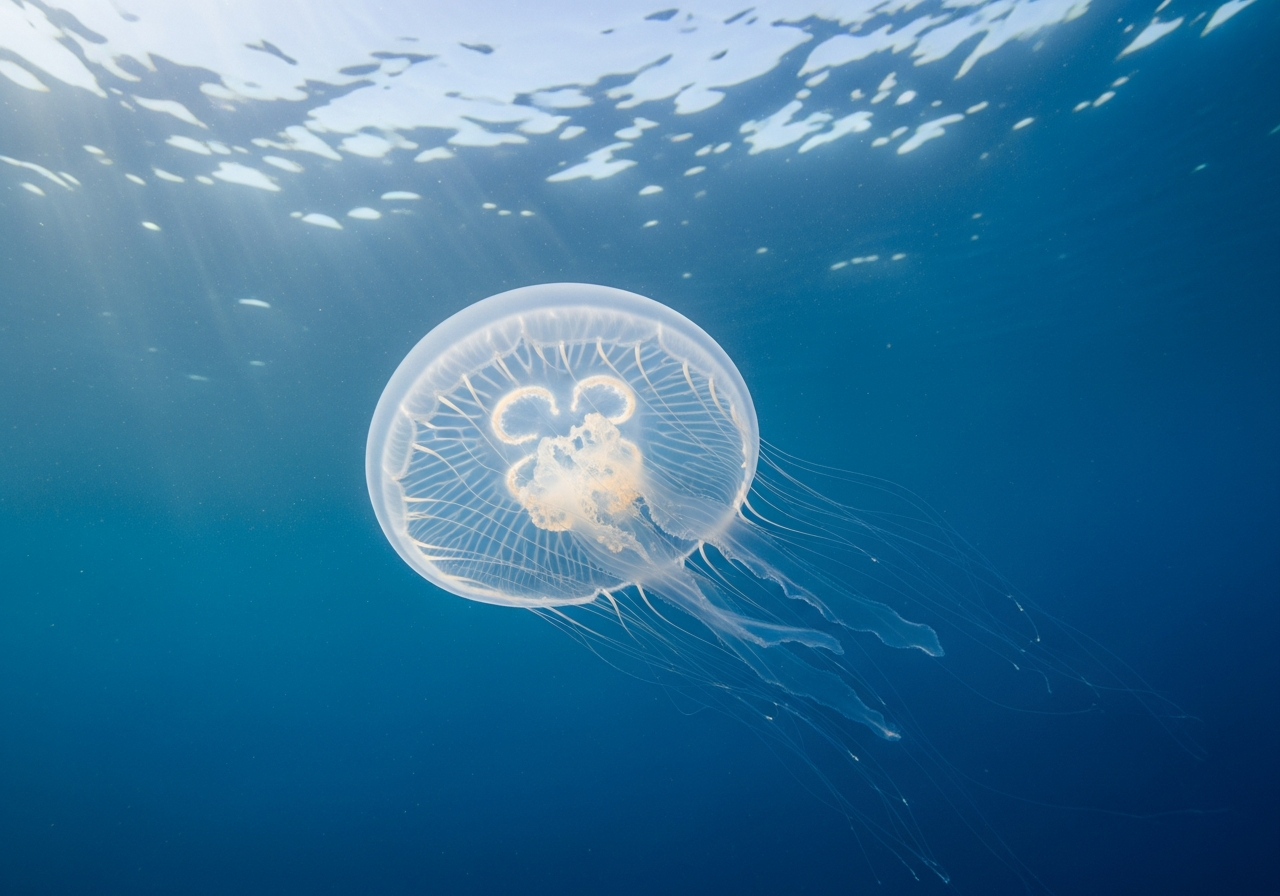
It is worth noting that jellyfish are inconsistent glowers: the common moon jellyfish does not put on the display people expect, while comb jellies frequently mistaken for jellyfish are shimmering because rows of beating cilia scatter light — a rainbow effect that is not bioluminescence at all. Meanwhile the “glowing” seas that draw crowds to certain bays are dinoflagellate plankton flashing when waves disturb them, and a good deal of what appears to glow on a night dive over coral is fluorescent pigment answering a dive torch rather than light the reef is making.
Related reading
Sources
Frequently asked questions
Do sharks glow?
Some deep-sea sharks are bioluminescent; many 'glowing shark' photos online show fluorescence under artificial light.
Why does the ocean glow at night?
Often dinoflagellate plankton disturbed by waves or boats — a bioluminescent display.