What Is the Fastest Bird in the World?
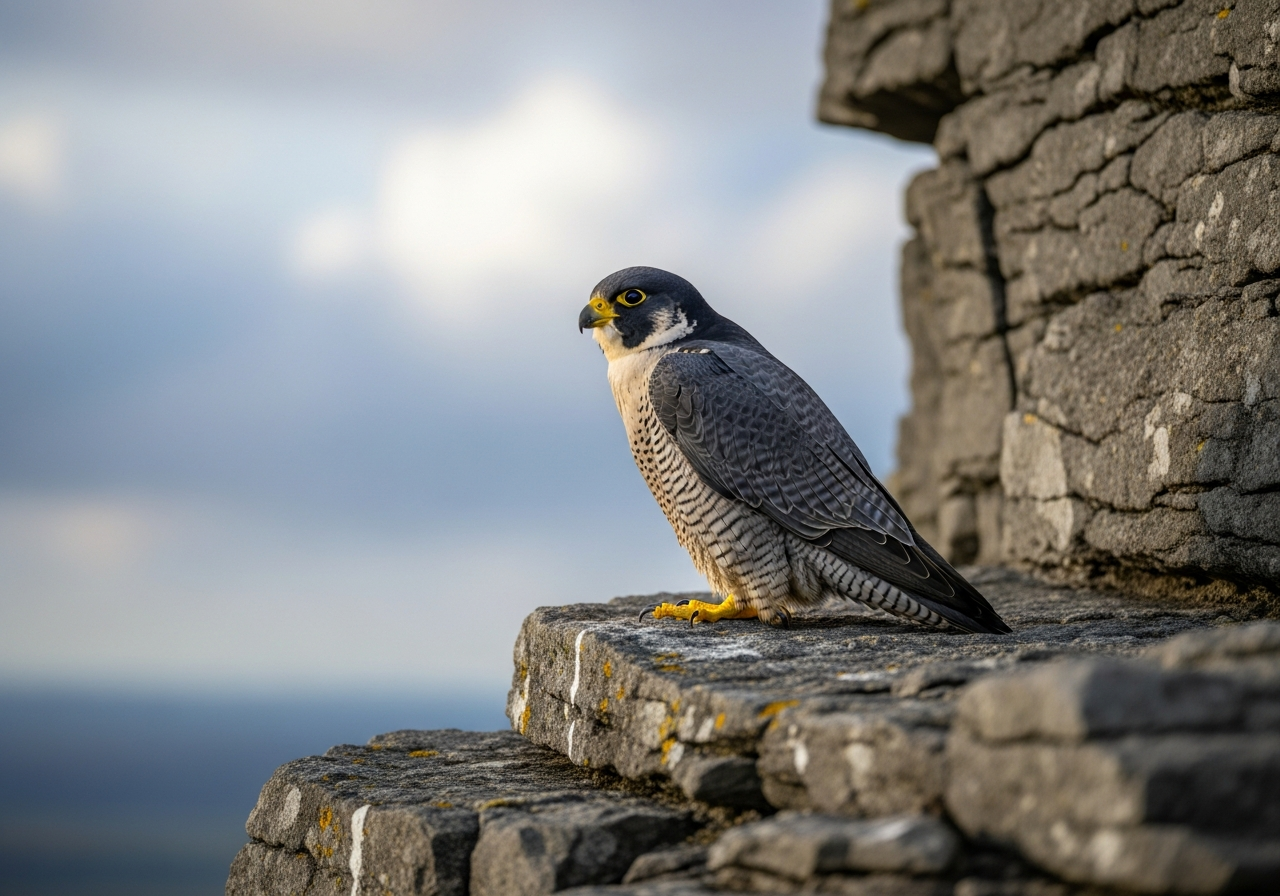
The peregrine falcon is the fastest bird overall, reaching over 380 km/h in a hunting dive. Level-flight champions include the common swift and spine-tailed swift.
Global Animal Guide · June 28, 2026
Quick answer
The peregrine falcon is the fastest bird, exceeding 380 km/h (240 mph) in a stoop. In level flight, swifts sustain remarkable speeds for migration.
Last updated: June 2026 — figures reflect widely cited scientific estimates.
The peregrine falcon is the fastest bird — and the fastest animal of any kind — reaching over 380 km/h in a stoop, the near-vertical hunting dive it uses to strike prey out of the air. But that record comes with a large asterisk, because the falcon is not really flying at that moment. It is falling, expertly. Ask instead which bird is fastest under its own power and the answer changes completely: the title passes to the swifts.
What actually happens in a stoop
A peregrine begins a stoop from height, sometimes a kilometre or more above its target. It folds its wings tight against its body, tucks its feet, and becomes a teardrop — a shape chosen to keep airflow attached to the body rather than tumbling into turbulent drag behind it. From there, physics takes over. The bird accelerates until air resistance balances its weight, and because it is small, dense and exceptionally streamlined, that balance point sits absurdly high.
Everything about the falcon is built to survive the consequences. Its skeleton is heavily reinforced compared with most birds of its size. A translucent nictitating membrane sweeps across the eye to keep the cornea clear at speeds that would dry and abrade it, without blinding the bird at the exact instant it needs to aim. Bony tubercles sit in the nostrils, and it is thought they slow and organise the incoming rush of air so that the falcon can still breathe against a hurricane pressing into its face — an idea frequently cited in aviation folklore as an inspiration for jet inlet cones, though that particular claim is far shakier than the anatomy itself.
The hardest part is not the dive but the exit. Pulling out of a stoop at the bottom subjects the bird to forces several times its own body weight, a load that would grey out a trained pilot, and it does so while adjusting its trajectory to intercept a moving target. Peregrines often do not seize prey in the dive at all; they strike with a clenched foot at speed, letting the impact do the killing, then turn and collect the falling body.
The level-flight champions
Strip out gravity and the ranking rearranges. In powered, horizontal flight the common swift is the best-documented fast bird, recorded in careful radar and tracking studies well past 100 km/h and holding it. The white-throated needletail, or spine-tailed swift, is widely quoted at higher figures still, but those numbers rest on old and poorly documented observations and should be treated as unverified rather than as a record.
Swifts are shaped for exactly this. Their wings are long, narrow and swept — a high aspect ratio, in aeronautical terms — which is the standard signature of an efficient high-speed aerofoil, at the cost of the slow-speed control that a woodland bird needs. The wing is dominated by the hand section rather than the arm, hinged so it can be scythed rather than flapped, and the body is small and smooth. The trade-off is total: a swift’s legs are so reduced that it struggles to launch from flat ground. It has surrendered the ability to walk in exchange for the ability to live in the air, feeding, mating and sleeping on the wing, and staying airborne for months on end.
Other contenders are fast in ways that are easy to misread. Ducks and geese — a mallard or a Canada goose — are genuinely quick and heavy-bodied fliers, and diving ducks have produced some of the highest credible level-flight claims. Albatrosses are quoted at very high speeds, but the albatross achieves them by dynamic soaring in a gale, harvesting energy from the wind gradient over the waves; that is brilliant, and it is not muscle power. The magnificent frigatebird does something similar with thermals, staying aloft for weeks by barely working at all.
Groundspeed, airspeed, and why records disagree
Most disagreements between “fastest bird” lists come down to a single distinction. Groundspeed is how fast the bird moves relative to the earth; airspeed is how fast it moves relative to the air it is flying through. A bird riding a strong tailwind can post a spectacular groundspeed while doing very little. Only airspeed measures the animal.
Method matters just as much. GPS loggers give groundspeed by default and need wind data to be corrected. Radar tracking can resolve airspeed but only over short arcs. The peregrine’s headline number comes from a trained bird stooping from altitude with a falconer measuring the descent — a controlled circumstance, not a routine hunt. So the honest framing is always conditional: fastest at what, measured how, with what assist. A kestrel hovering motionless over a verge in a headwind is flying hard at zero groundspeed, which makes the point neatly.
Fast birds that never leave the ground or the water
Two categories get excluded by the framing and deserve mention. The ostrich is the fastest bird on land and the fastest two-legged runner alive, having spent its flightlessness on a pair of enormous, two-toed sprinting legs; the emu runs the same strategy in Australia. Neither can fly, and both would leave any flying bird behind on the ground.
Underwater, the water’s density resets the scale entirely — the same physics that keeps fish slower than birds. The emperor penguin and the common murre fly with their wings through water rather than air, and their swimming speeds are a small fraction of any aerial record while representing a comparable athletic effort. The northern gannet bridges the two, folding into a plunge-dive that hits the sea hard enough to require air sacs in the face and neck to cushion the impact.
Speed for size
Absolute velocity flatters big birds. Measured in body lengths per second, a hummingbird beats them all: in its courtship dive it covers hundreds of its own body lengths every second, a relative speed exceeding that of a fighter jet, and it endures g-forces on the pull-out that comfortably exceed a peregrine’s. It weighs a few grams. The lesson runs through every record on this page — a superlative is a statement about a measurement, and choosing the measurement chooses the winner.
Conservation note
Record-holding species often face habitat loss and climate pressure. Protecting ecosystems preserves not only charismatic winners but the food webs they represent. The peregrine is the encouraging exception: it was driven from much of its range in the twentieth century by DDT, which thinned its eggshells until they broke under the incubating parent, and it recovered after the pesticide was banned to the point of nesting on office blocks and cathedral towers in the middle of cities, hunting pigeons between the buildings.
Sources
Related reading: Animal profiles · Fastest animals on Earth · Support wildlife protection
Frequently asked questions
What Is the Fastest Bird in the World
The peregrine falcon is the fastest bird, exceeding 380 km/h (240 mph) in a stoop. In level flight, swifts sustain remarkable speeds for migration.
How do scientists measure this record?
Records come from peer-reviewed studies, GPS tracking, high-speed video, toxicology assays, and acoustic meters — field conditions always add variation.
Can the record holder change?
Yes — new measurements, species reclassification, or better technology can update rankings. Always check whether speed, venom, or size is measured differently.