Keystone Species Explained: Animals That Hold Ecosystems Together
A keystone species has an outsized effect on its ecosystem. Sea otters, wolves, beavers, elephants, and prairie dogs — definitions and famous examples.
Global Animal Guide · July 10, 2026
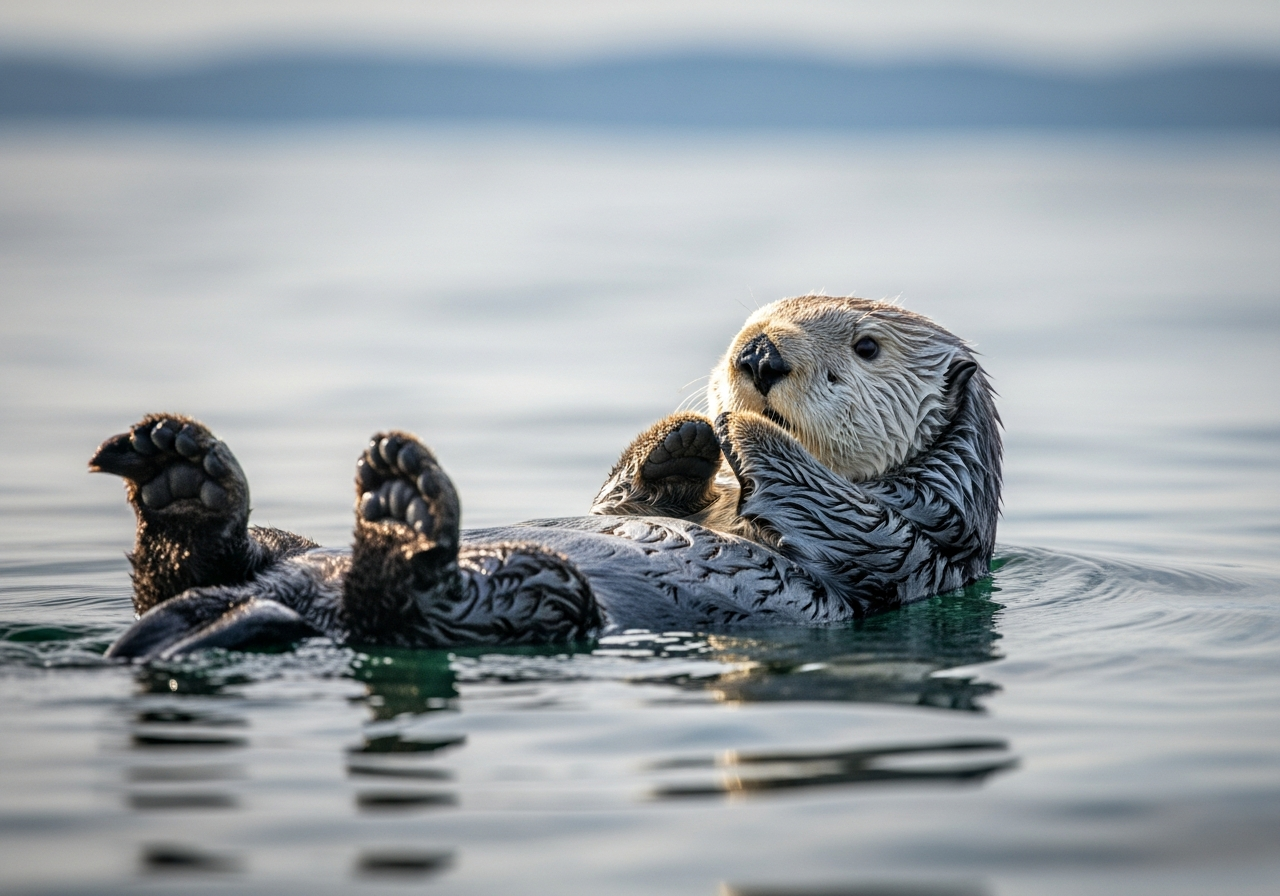
Image sourcing: see credits & licences
Quick answer
A keystone species has a disproportionately large effect on ecosystem structure relative to its abundance. Remove it, and the community can collapse or transform. Classic examples: sea otters protecting kelp by eating sea urchins; wolves reshaping rivers via trophic cascades; beavers creating wetlands.
Last updated: July 2026.
A keystone species is one whose influence on its ecosystem is far larger than its numbers would predict. The definition hinges on that mismatch. A species can be abundant and important — grass on a prairie, krill in the Southern Ocean — without being a keystone, because its importance scales with its biomass. A keystone is different: it is comparatively rare, and yet removing it triggers changes that ripple through dozens of other species. The name comes from architecture. The keystone is the wedge at the top of a stone arch; it carries little of the load, but pull it out and the arch collapses.
Where the idea came from
The concept was born on the rocky shores of Washington state in the 1960s, when ecologist Robert Paine ran an experiment that now appears in every introductory ecology course. Paine picked a stretch of intertidal rock and, for years, physically removed every Pisaster starfish he found, throwing them back into the sea. He left an adjacent stretch untouched as a control.
The result was dramatic. On the starfish-free rock, mussels — the starfish’s preferred prey — spread unchecked and paved the surface into a monoculture. Barnacles, limpets, anemones, algae and snail species that had coexisted there were crowded out. Species richness roughly halved. The control plot stayed diverse. The starfish had not been feeding the community or building it; it had simply been eating the one competitor capable of monopolising the space, and that single act of predation held the door open for everyone else.
How sea otters keep kelp forests standing
The best-documented keystone in the world is the sea otter. Otters eat sea urchins. Urchins eat kelp — specifically, they chew through the holdfast that anchors each kelp stipe to the rock, felling a plant many metres tall to get at a meal at its base.
Where otters are present, urchins are scarce and hide in crevices, grazing on drift kelp that falls to them. Kelp forests grow into dense three-dimensional canopies that shelter rockfish, invertebrates and juvenile salmon, and buffer coastlines from wave energy. Where otters were hunted out during the maritime fur trade, urchin populations exploded and mowed the kelp down to bare rock — a state ecologists call an urchin barren. Barrens are remarkably stable once established, because urchins can persist for years on almost nothing, keeping any kelp recruit cropped before it establishes.
That stability matters for the theory. Keystone effects are often not a smooth dial but a switch between two self-reinforcing states, which is why losing a keystone can be so much easier than getting the ecosystem back.
Trophic cascades: wolves, elk and what Yellowstone actually showed
The gray wolf’s return to Yellowstone in 1995 became the most famous keystone story ever told, and also the most oversimplified. The popular version says wolves reduced elk numbers and changed where elk browsed, willows and aspen recovered along streams, beaver returned to build dams, and riverbanks stabilised — wolves, in the memorable phrasing, changed the rivers.
The core mechanism is real. A predator that alters prey behaviour, not just prey numbers, is exerting what ecologists call a landscape of fear, and browsing pressure genuinely shifted. But the details are contested. Climate cycles, drought, bison grazing, human hunting outside the park and a recovering grizzly bear and coyote population all moved at the same time, and disentangling them is hard. Willow recovery has been patchy rather than uniform, and some researchers argue that hydrology, not herbivory, is the limiting factor in many reaches.
The honest summary is that Yellowstone demonstrates trophic cascades are possible and powerful, while also demonstrating that real ecosystems rarely have a single lever. Keystone effects are usually contingent — on soil, water, climate and which other species are still present.
Ecosystem engineers: a different route to the same power
Not every keystone works through predation. Some reshape habitat physically, and these are usually called ecosystem engineers. The categories overlap without being identical.
The beaver is the clearest case. By felling trees and damming streams, a beaver colony converts running water into ponds and wetlands, raises the water table, traps sediment, and creates habitat for amphibians, waterfowl, moose and fish. One rodent family manufactures a habitat type that would not otherwise exist there.
The African elephant does the reverse — it opens things up. Elephants push over trees, strip bark and break through thicket, maintaining savanna as a mosaic of grassland and woodland rather than letting it close into scrub. They also disperse large seeds that no other animal can swallow, and their dung supports a whole community including the dung beetle. Fence elephants out of an area for long enough and the vegetation structure changes, taking the grazers with it.
Prairie dogs work underground. Their burrow systems aerate soil, alter plant chemistry through clipping and grazing, and provide shelter used by burrowing owls, snakes, and the black-footed ferret, which is so dependent on prairie dogs that its near-extinction followed theirs directly. The bison preferentially grazes prairie dog towns, which means the two engineers reinforce each other.
Why most species are not keystones
The term gets diluted every time it is applied to any charismatic animal. It should not be. Most species, if removed, are replaced functionally by something else, and the community absorbs the loss with a modest reshuffle — this is ecological redundancy, and it is the norm rather than the exception.
Keystone status depends on context, too. A predator that is a keystone in one place may be unremarkable in another, where a competitor covers the same function or where the prey is limited by something other than predation. Pisaster is not a keystone everywhere along its range. And it is possible for a species to be a keystone at one density and irrelevant at another.
The practical test is the awkward one: you need evidence of what happens when the species goes. That evidence sometimes comes from deliberate experiments, sometimes from reintroductions like the wolf, and far too often from a local extinction that nobody planned.
Famous examples
- Sea otters — urchin control → kelp forests
- Wolves — trophic cascades in places like Yellowstone (debated in details, powerful as a concept)
- Beavers — dams create wetlands
- African elephants — open woodlands, disperse seeds
- Prairie dogs — burrow networks support many grassland species
- Starfish (Pisaster) — original keystone experiment
Conservation takeaway
Protecting keystones protects whole communities — often more efficiently than saving every species one by one. If conservation budgets are finite, and they always are, a species whose presence maintains the structure of an entire habitat buys more ecological return per pound than one that does not.
The corollary is a warning. Because keystone effects are non-linear, ecosystems can look fine right up until they are not. Otter populations declined for decades before the kelp went; the barren appeared suddenly. Managing for keystones means acting well before the arch starts to creak, and accepting that restoring a collapsed system is far slower and more expensive than holding a functioning one together.
Related reading
Sources
Frequently asked questions
Who coined keystone species?
Ecologist Robert Paine, from intertidal starfish experiments in the 1960s.
Is every predator a keystone?
No — only those whose removal causes major community change.
Are humans a keystone species?
Humans are a hyper-keystone or ecosystem engineer on a planetary scale — but the term is usually reserved for native wild species in ecological studies.
What is an ecosystem engineer?
A species that physically modifies habitat — beavers, elephants, prairie dogs — overlapping with but not identical to keystones.