Why Do Skunks Spray? Defense, Smell & Myths
Skunks spray a sulfur-rich musk from anal glands as a last-resort defense. Range, warning behaviour, what to do if sprayed, and why owls still hunt them.
Global Animal Guide · July 10, 2026
Quick answer
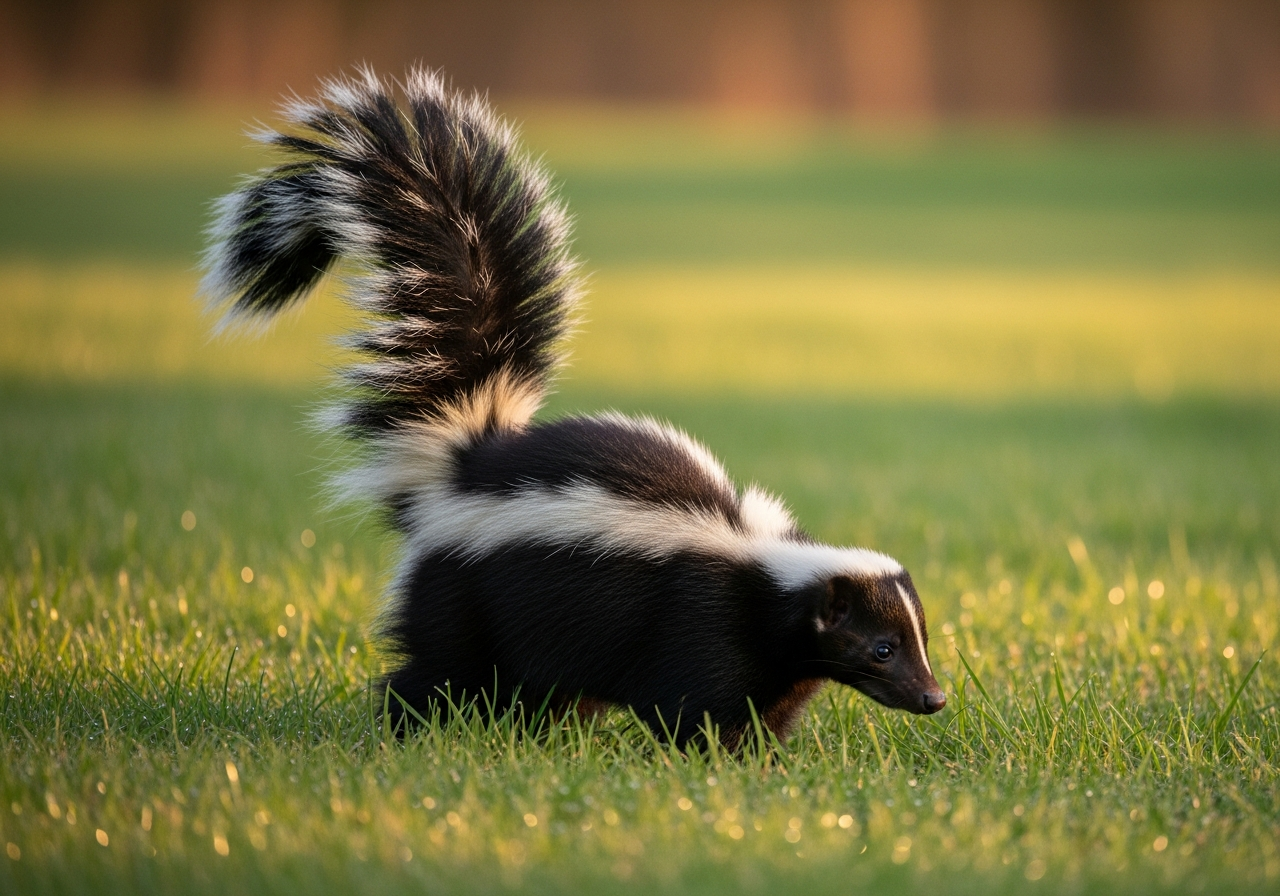
Skunks spray to defend themselves when stomping, hissing, and handstands fail to deter a threat. The oily musk contains thiols that smell extremely strong and can irritate eyes. Skunks prefer not to spray — reloading takes time and they become vulnerable afterward. Great horned owls are major predators partly because of a weak sense of smell.
Last updated: July 2026.
Spraying is the last resort, not the first
The single most useful thing to understand about a skunk is that it does not want to spray you. Everything about its behaviour is arranged to avoid having to.
A threatened skunk works through an escalating sequence of warnings. First it stops and stares. Then comes foot-stomping — a rapid drumming of the front paws that is startling out of all proportion to the animal’s size — along with a raised, bristling tail, hissing, and short bluff charges that stop dead a metre short. Spotted skunks add one of the more remarkable displays in mammals: a handstand, forefeet off the ground, hind legs in the air, walking towards the threat upside down. Only when all of that fails does the skunk turn, arch its back into a U so that both head and rear face the target, and fire.
That whole routine takes seconds and is easy to read. It also explains why so few people are actually sprayed: give the animal room and a clear escape route, back away rather than towards it, and the sequence simply stops. Skunks spray dogs far more often than people for the obvious reason — a dog charges through every warning at speed.
Why a skunk holds its fire
The reluctance is not politeness; it is economics. The glands hold only a small reserve — enough for roughly half a dozen full discharges — and refilling them takes on the order of a week to ten days. For that entire period the skunk is a slow, conspicuous, poorly armed animal in a landscape full of predators. Spraying is not a free action but the expenditure of a limited resource that leaves the animal genuinely vulnerable afterwards.
This is why the warning display matters so much to the skunk. The bold black-and-white coat is aposematic — warning coloration, the same strategy as the ladybug, the monarch butterfly, and the poison dart frog. The pattern is unmistakable, memorable, and works at dusk when skunks are active. A coyote or bobcat that has been sprayed once needs no second lesson: the sight of the stripes is enough. The colours, in other words, do the work so that the glands do not have to.
Chemistry
The musk is produced by a pair of glands flanking the anus, each opening through a small nipple the skunk can aim independently. The active ingredients are thiols — sulfur-containing compounds, the same chemical family that gives rotten eggs and rotting flesh their character. Human noses are extraordinarily sensitive to them, which is why the odour is detectable at absurd dilution and why it registers as alarming rather than merely unpleasant.
Two features make the spray so effective. First, the mixture is oily. It clings to fur, skin, and fabric instead of evaporating, which is why water alone accomplishes nothing and why degreasing chemistry works far better. Second, the blend contains thioacetates, which are relatively odourless until water breaks them down into fresh thiols. The result is a slow-release effect: a sprayed dog can seem improved, then reek again the next time it gets damp, for weeks. Beyond the smell, the spray is a genuine irritant — a direct hit to the face causes intense stinging and temporary blindness lasting minutes, which is the actual defensive point. The stench merely teaches the lesson.
Aim, range, and accuracy
Skunks aim, and they aim at the face. The muscles around each nipple let the animal direct the stream and even switch between a focused jet for a specific target and a broader mist for something moving. Accurate range is commonly cited at around three metres (about ten feet), though the mist and its odour drift very much further — anyone who has driven past a roadside skunk knows the smell reaches farther than the liquid ever could.
The U-shaped posture is the clever part. Most animals must choose between watching a threat and pointing a weapon at it. By curling so that head and rear both face forward, a skunk keeps its eyes on the target while the glands track it — which is why the spray so rarely misses.
The predator that ignores all of it
The defence has one famous hole: it only works on animals that can smell. Birds largely cannot, or at least not well, and the great horned owl is consequently the skunk’s most significant predator across much of its range. The great horned owl hunts silently at night, strikes from above, and has a poor sense of smell — so the stripes convey nothing, the stomping goes unseen, and the musk is irrelevant. Owls are routinely reported smelling strongly of skunk, apparently untroubled.
It is a neat illustration of a general principle: a defence is only as good as the sensory world of the animal it is aimed at. Mammalian predators — the red fox, the coyote, the badger — respect skunks. A predator hunting by sound and sight from above does not.
What to do if you or your dog gets sprayed
Forget tomato juice. It does not neutralise anything; it works only through olfactory fatigue — your nose gives up on the skunk smell after a few minutes and you notice the tomato instead. Bystanders arriving later smell only skunk.
What actually works is chemistry that breaks the thiols down: a mixture of hydrogen peroxide, baking soda (bicarbonate of soda), and a little dish soap. The peroxide oxidises the thiols into odourless compounds, the soap cuts the oil so the reaction can reach them. Mix it fresh in an open container and use it immediately — never store it in a sealed bottle, as it releases gas. Keep it well away from the eyes, work it into the coat, then rinse thoroughly. It may lighten dark fur.
Act quickly, before the oil dries in, and treat the animal outdoors — a sprayed dog let into the house transfers musk to every soft furnishing it touches. If the eyes took a direct hit, flush them with cool water and ring a vet.
Living alongside skunks
Skunks are, on balance, good neighbours: they eat enormous quantities of grubs, beetles, and rodents. Most conflict comes down to attractants — pet food left out, unsecured bins, or a gap under a deck that makes an appealing den. Remove those and the skunk generally moves on.
One serious caution. Skunks are a significant rabies reservoir in parts of North America. A skunk that is out in broad daylight, unsteady, unusually tame, or aggressive without provocation is not a photo opportunity. Never handle a wild skunk, keep pets away, keep rabies vaccinations current, and call animal control.
Related reading
Sources
Frequently asked questions
How far can a skunk spray?
Accurately several metres (often cited around 3 m / 10 ft), with mist travelling farther.
Do skunks spray for no reason?
Rarely — spraying is a last resort after warning displays.
What removes skunk smell from a dog?
A baking-soda, hydrogen-peroxide, and dish-soap mix is commonly recommended — not tomato juice. Keep peroxide away from eyes and rinse well; see a vet if eyes were hit.
Are skunks rabies risks?
Skunks can carry rabies in some regions — never handle a wild skunk; call wildlife control if one acts tame or disoriented.