How Do Honeybees Make Honey? From Nectar to Comb
Honey starts as flower nectar and ends as a golden store that feeds a colony through winter. Step by step: how bees collect, transform, and seal nature's oldest sweetener.
Global Animal Guide · June 24, 2026
Quick answer
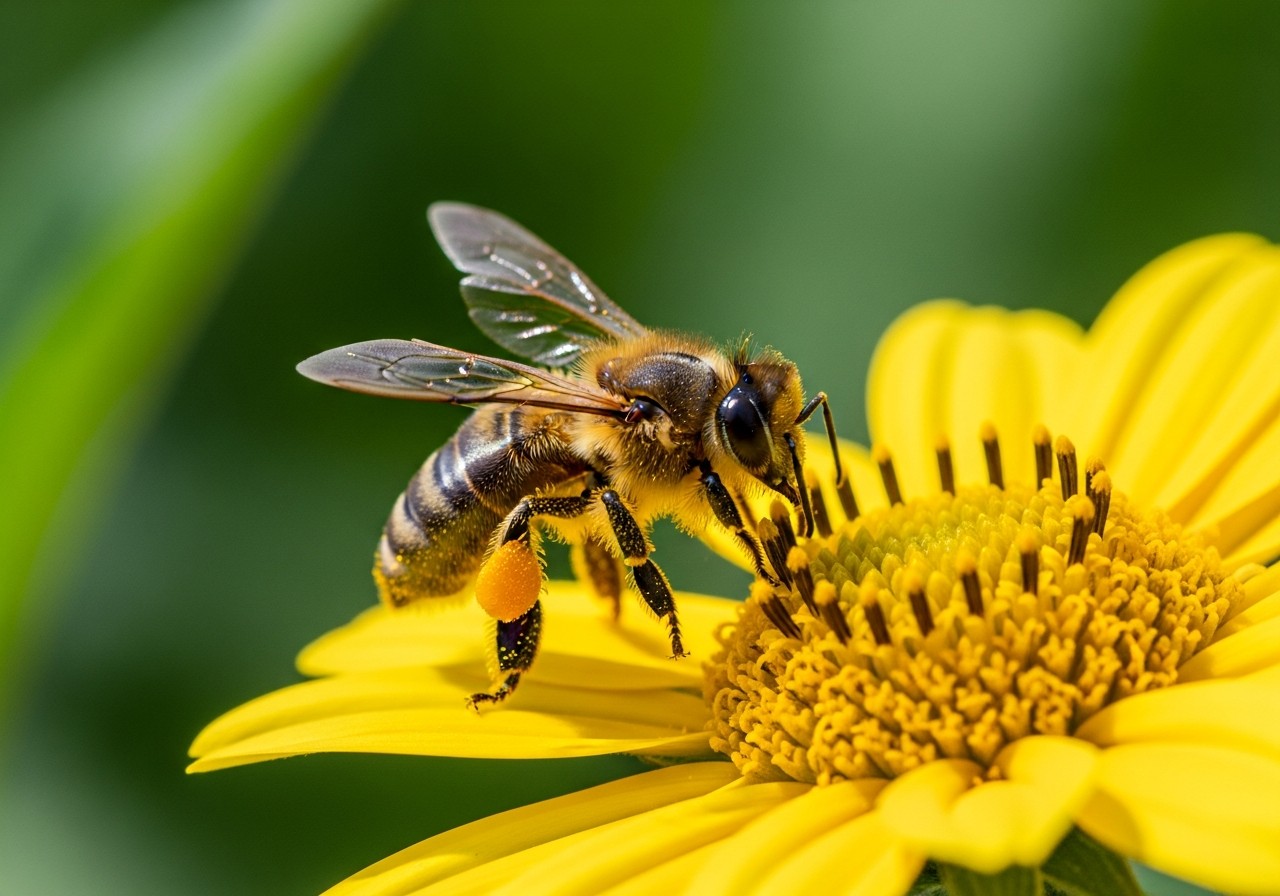
Honeybees make honey by collecting sugary nectar (and sometimes plant sap) in a special stomach, adding enzymes that break complex sugars into simpler ones, then passing it mouth-to-mouth among worker bees. Inside the hive they deposit it in wax cells and fan their wings to evaporate water until the syrup is thick enough to resist spoiling, then cap the cell with wax.
Why a colony bothers to make honey at all
Honey is a solution to a timing problem. Flowers do not bloom steadily; they bloom in pulses, and a temperate winter offers nothing at all. A honey bee colony does not hibernate — it clusters and shivers through the cold, burning fuel for months. So the colony converts a glut of watery, perishable nectar into a dense, chemically hostile syrup that will not ferment, and lives off it until the next bloom.
That framing explains every step that follows. Nectar is roughly 70–80% water: it is dilute, heavy to carry, and spoils within days. Honey is around 17–20% water, and it keeps for years. Everything the bees do between flower and capped cell serves those two changes — concentrate the sugar, and make it inhospitable to microbes.
It also explains why so few bees make honey. A colony only needs a stockpile if it survives as a group through a dearth. Most of the world’s twenty-thousand-plus bee species — including nearly every solitary species — do not. A female carpenter bee provisions each of her tunnelled cells with a lump of pollen and nectar, seals it, and dies before her offspring emerge; she has no colony to feed and no winter to plan for. The bumblebee sits in between: its colonies store small amounts of nectar in wax pots, but the colony dies each autumn and only new queens overwinter, so there is no point building a pantry. Surplus honey, the kind worth harvesting, is essentially a western honeybee speciality.
Step 1: Foraging, and the enzyme added in flight
A forager lands, extends her proboscis, and draws nectar up into her crop — the “honey stomach”, a distinct storage chamber ahead of the true digestive gut. A valve controls what passes through for her own use; the rest is cargo, not food. This is why calling honey “bee vomit” misses the point: the nectar is never digested, and its regurgitation is a deliberate transfer, not the expulsion of waste.
The chemistry starts before she gets home. Glands add invertase, which splits sucrose into its component simple sugars, glucose and fructose. This matters for more than taste. Two small molecules exert roughly twice the osmotic pressure of one large one, so inverting the sugar helps make the finished honey osmotically lethal to microbes — it draws water straight out of any bacterial cell that lands in it.
Foragers recruit others to good flowers through the waggle dance, encoding direction and distance in the angle and duration of a figure-of-eight run. A colony can therefore concentrate its whole workforce on whichever patch is currently richest. Some colonies collect honeydew instead — sugary excretions from sap-feeding aphids, gathered from leaf surfaces — which yields darker, more mineral-rich honey.
Step 2: Trophallaxis, and why the relay matters
Back at the hive, the forager does not usually deposit her load herself. She passes it to house bees through trophallaxis, mouth to mouth, and they may pass it on again. It looks like a waste of effort; it is not.
Each transfer spreads the droplet across a bee’s mouthparts, exposing a large surface area to the warm hive air and evaporating water. Each transfer also adds more enzyme. Alongside invertase, bees contribute glucose oxidase, which converts a little of the glucose into gluconic acid and hydrogen peroxide. The acid drops honey’s pH to around 3.5–4.5 — acidic enough on its own to deter most spoilage organisms — and the peroxide adds a mild antiseptic effect. The relay is a processing line disguised as a greeting.
Step 3: Ripening in the comb
House bees deposit the part-processed syrup into hexagonal wax cells, secreted as flakes from glands on the underside of the worker’s abdomen. Often they hang the droplet at the top of the cell rather than filling it, maximising the exposed surface.
Then the colony fans. Ranks of workers beat their wings to drive a directed airflow through the hive, and because the cluster is already held near 35 °C for brood-rearing, that air is warm and thirsty. Water evaporates until moisture falls to roughly 17–20%. Below that threshold there is simply not enough free water for yeasts and bacteria to grow — the sugar has locked it up. Fanning does double duty as the hive’s climate control, which is why a colony sounds loudest on a humid summer evening.
Step 4: Capping, and why honey does not spoil
When a cell tests ripe, bees seal it with a wax capping. Three defences now overlap: extreme osmotic pressure, low pH, and trace hydrogen peroxide, all inside an airtight lid. Sealed honey keeps for years; archaeologists have recovered edible honey from ancient tombs.
The main exception is honey harvested before it is capped. Uncapped honey is still too wet, and it ferments — which, historically, is exactly how mead was discovered.
Pollen, propolis, and the rest of the pantry
Honey is only carbohydrate. It fuels flight muscle and winter shivering, but it builds nothing. For protein, fats, and micronutrients the colony collects pollen, packing it into cells and letting it ferment slightly into “bee bread” that nurse bees convert into brood food. A colony with abundant honey and no pollen will starve its larvae.
The third material is propolis — plant resins mixed with wax, used to seal draughts, varnish surfaces, and entomb intruders too large to carry out — a mouse that dies inside a hive may be sealed in resin rather than left to rot. It is also strongly antimicrobial, which matters when tens of thousands of closely related animals live at 35 °C in a confined space. That crowding is exactly what attracts raiders: a yellowjacket will pick off foragers at the entrance, and the Asian giant hornet can destroy a colony outright, which is why guard bees mass at the doorway. Honey, pollen, and propolis together form the colony’s real larder and pharmacy.
Humans, hives, and the wider pollinator picture
People have raided wild nests for thousands of years, and modern beekeeping mainly refines the harvest: movable frames let a keeper take surplus without destroying the colony. Commercial hives are also trucked to crops at bloom, from almonds to apples, making the honeybee an agricultural instrument as much as a honey producer.
That success has a shadow. Managed honeybees are livestock, not wildlife, and concentrating them can crowd out native pollinators — solitary bees, hoverflies, and beetles that many wild plants depend on. Helping pollinators generally means the same things that help hives specifically: plant varied native flowers that bloom across the whole season, leave bare ground and dead stems for nesting, and never spray insecticide on anything in flower. The monarch butterfly, the bumblebee, and the honeybee all benefit from the same untidy garden.
Sources
Related reading: What if bees disappeared? · Honey bee guide · Symbiotic relationships in nature
Frequently asked questions
Is honey bee vomit?
Not exactly — nectar is stored in a separate crop (honey stomach) and processed through repeated regurgitation and enzymatic mixing before being placed in cells. It is a deliberate transformation, not digestive waste.
Why do bees make honey?
Honey is long-term food storage. A colony needs reserves when flowers are scarce — especially through winter in temperate climates.
How much honey can one hive produce?
A strong hive in a good season may store tens of kilograms, though much is consumed by the colony itself.
Do all bees make honey?
No — only a few species, including the western honeybee (Apis mellifera), produce surplus honey harvested by beekeepers. Most of the world's 20,000+ bee species are solitary and do not store honey at scale.