Penguins of the World: Species, Habitats & Facts
Penguins are flightless seabirds of the Southern Hemisphere (plus the Galápagos). How many species, where they live, what they eat, and conservation threats.
Global Animal Guide · July 10, 2026
Quick answer
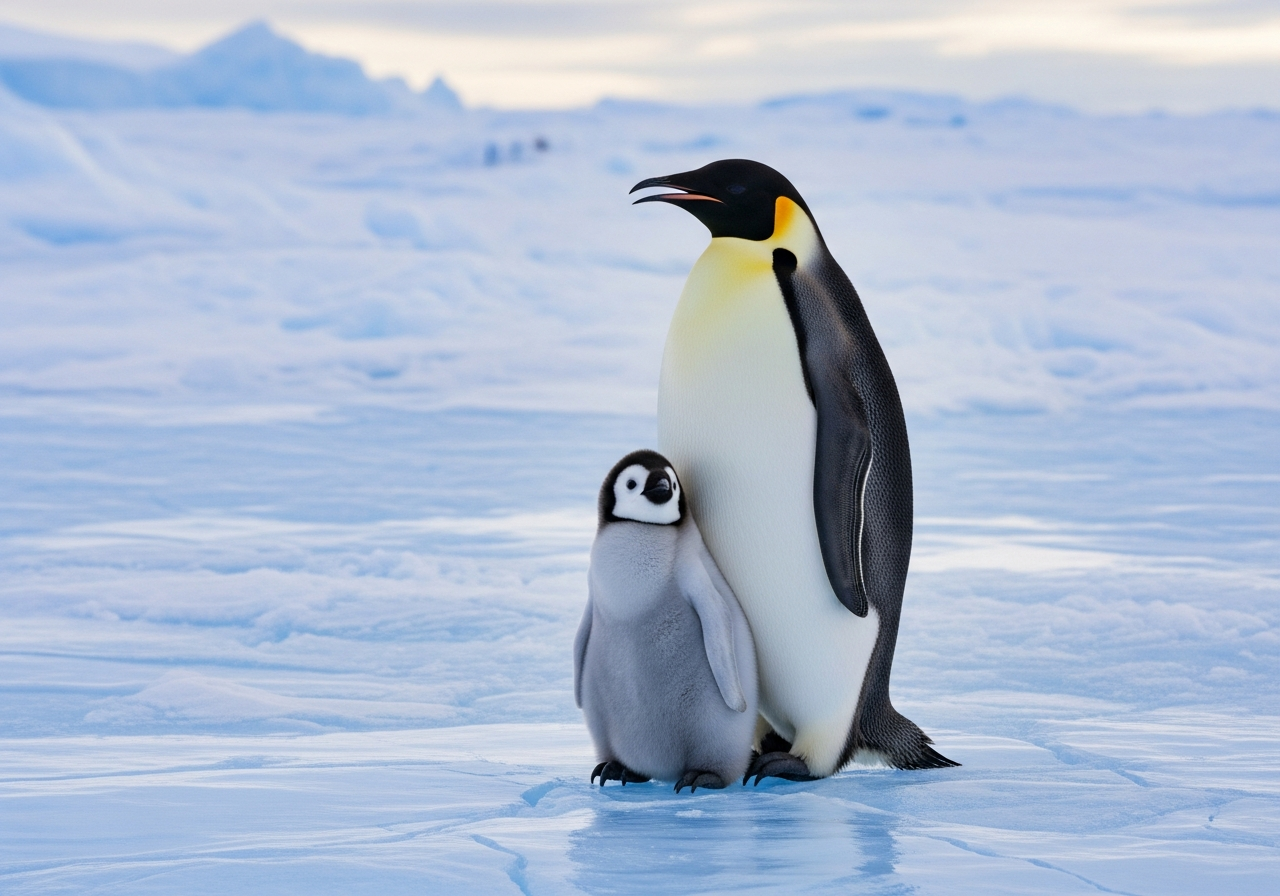
Penguins (family Spheniscidae) are flightless seabirds with flipper-like wings for underwater 'flight.' About 18 species live mostly in the Southern Hemisphere; the Galápagos penguin is the only species near the equator. They eat fish, squid, and krill. Many species are threatened by climate change, overfishing, and pollution.
Last updated: July 2026.
Birds that traded the sky for the sea
Penguins are not birds that failed to learn flight. They are birds whose ancestors could fly and whose descendants gave it up, because you cannot be excellent at both. Flight demands the lightest possible body: hollow bones, minimal mass, a wing broad enough to generate lift in thin air. Swimming demands close to the opposite — enough density to stop fighting your own buoyancy, and a small, stiff, high-speed blade that will not snap under the load of a fluid roughly 800 times denser than air.
Every wing-propelled diver sits somewhere on that trade-off, and the ones pushing hardest towards water eventually lose the sky. Penguins went all the way. Their bones are dense rather than pneumatic — ballast, not dead weight. The wing has fused into a rigid flipper driven from the shoulder, its wrist and elbow barely moving. On land the result is famously undignified. Underwater it is superb: a penguin genuinely flies, generating thrust on both upstroke and downstroke, which most swimming animals cannot do.
The plumage is a second piece of engineering. Penguin feathers are short, stiff, and packed far more densely than a flying bird’s, overlapping into a barrier that holds an insulating layer of air against the skin. The bird preens oil through it constantly. This is also why oil spills are lethal to penguins out of proportion to the toxic dose — contaminating the coat destroys the insulation, and the bird chills in water it was previously perfectly comfortable in.
The diving toolkit
The emperor penguin is the extreme case: dives beyond 500 metres and breath-holds exceeding twenty minutes are documented. Getting there requires more than good swimming.
Oxygen storage is the foundation. Penguins carry unusually high concentrations of myoglobin in their muscle, which lets the tissue hold its own oxygen supply rather than depending on continuous delivery from blood. On a dive the body then rations that store: heart rate falls dramatically, and circulation is shunted away from non-essential tissue towards the heart and brain. The same dive response appears in seals and in whales such as the sperm whale — convergent solutions to an identical constraint.
Pressure is handled by yielding to it. A rigid air-filled chest would be crushed at depth, so the ribcage and air sacs compress. Countershading handles concealment: dark above, white below, so a predator looking down sees a bird against dark water and one looking up sees it against bright sky. The same pattern appears on orcas, great white sharks, and most open-water hunters, because the problem is the same and there are not many answers to it.
Not every penguin is an athlete of this order. Little penguins forage in shallow inshore water on short dives. The family spans a wide range of strategies; emperors simply occupy the far end.
Species snapshot
Roughly 18 species are recognised, and the vagueness is real — taxonomists disagree over whether some crested penguins are separate species or regional populations, so the count moves as evidence accumulates. The groups:
- Great penguins — emperor and king, the largest, both incubating a single egg on their feet rather than in a nest
- Brush-tailed — Adélie, chinstrap, gentoo; pebble-nesting Antarctic and sub-Antarctic breeders
- Crested — macaroni, rockhopper, fiordland and relatives, with yellow head plumes
- Banded — African, Humboldt, Magellanic, Galápagos; warm-water species with dark chest stripes
- Little penguin — the smallest, around 30 cm, nesting in burrows on Australian and New Zealand coasts
- Yellow-eyed penguin — a New Zealand endemic, unusual in nesting solitarily rather than colonially
Why no penguins in the Arctic
The absence is not about cold — emperors breed through the Antarctic winter, so the Arctic would hardly trouble them. It is about history and geography. Penguins evolved in the Southern Hemisphere and the equatorial tropics form a barrier of warm water that a cold-adapted diving bird cannot cross.
The Galápagos penguin is the sole species reaching the equator, and it manages it by cheating: the cold Humboldt Current carries a tongue of nutrient-rich water north along South America, giving the bird a corridor of familiar conditions. Cross into genuinely warm ocean and the food disappears.
The Arctic’s equivalent niche belongs to the auks — the Atlantic puffin and the common murre — which resemble penguins closely without being related to them. They are, again, wing-propelled divers wearing black and white, and the great auk, hunted to extinction in the nineteenth century, was flightless too. Two lineages arrived at the same design from opposite ends of the planet.
Life on the colony
Most penguins breed colonially, in dense aggregations that can run to hundreds of thousands. The logic is safety in numbers and shortage of suitable ground — the fringe of a colony absorbs predation from leopard seals at the water’s edge and skuas from above, so the centre is the valuable real estate, and fights over it are constant.
Emperors solve an unusual problem. They breed on sea ice through the Antarctic winter, when nothing else is there. The female lays a single egg and departs to feed; the male balances it on his feet under a fold of skin and fasts for around two months in the dark, huddling with thousands of other males and rotating slowly through the pack so that each bird takes turns in the freezing outer ring. He loses a substantial share of his body mass before the female returns to relieve him. The pay-off is timing: the chick fledges as summer food peaks.
Finding one bird among thousands is its own difficulty, solved acoustically. Penguins have a two-voice syrinx and produce calls distinctive enough that mates and chicks identify each other by voice alone in an overwhelming crowd.
Conservation
Penguins are among the more threatened seabird families, and the pressures stack.
Warming seas are the largest. Antarctic species depend on krill, which depends on sea ice; less ice means less krill and longer foraging trips for the same food. Emperors depend on stable fast ice lasting long enough for chicks to fledge — ice that breaks up early drowns them before they are waterproof. Adélie colonies are declining in warming regions and growing in others, which is the signature of range shift, not resilience.
Fisheries compete directly for the same anchovies and sardines. African penguins have declined severely alongside their prey. Historic guano mining stripped the substrate Humboldt and African penguins burrow into, leaving them exposed on bare rock. Oil spills hit hard for the reason described above; gillnets drown divers; introduced rats, cats, and stoats devastate island colonies that evolved without ground predators.
The encouraging part is that several of these are solvable with policy rather than technology — fishing exclusion zones around colonies, artificial nest boxes replacing lost guano, predator eradication on islands. The warming is the hard one.
Related reading
Sources
Frequently asked questions
How many penguin species are there?
About 18, depending on whether some crested penguins are split or lumped.
Do any penguins live in the Arctic?
No — penguins are Southern Hemisphere birds (Galápagos excepted near the equator). Arctic 'penguins' in cartoons are usually auks or puffins.
What is the largest penguin?
The emperor penguin — up to about 120 cm tall.
Can penguins fly?
Not in air — their wings are flippers specialised for swimming.