Ocean Pollution and Marine Life: Plastics, Chemicals, and Noise
Pollution reaches every ocean — from surface plastics to deep-sea toxins. How marine pollution harms wildlife, food webs, and human health, and what can reduce the damage.
Global Animal Guide · June 24, 2026
Quick answer
Ocean pollution harms marine life through plastic ingestion and entanglement, chemical toxins that accumulate in food chains, nutrient runoff causing dead zones, oil spills coating feathers and gills, and underwater noise disrupting whale communication. Microplastics have been found in fish, seabirds, and deep-sea organisms. Reducing single-use plastics, improving wastewater treatment, cutting shipping emissions, and enforcing fishing gear recovery are key responses.
No ocean is untouched
Ocean pollution is not one problem. It is a set of very different insults — plastic, industrial chemicals, agricultural nutrients, oil, and noise — that arrive by different routes, harm animals by different mechanisms, and demand different fixes. Lumping them together as “pollution” obscures the fact that a solution to one does nothing for the others.
What unites them is reach. The ocean is downhill from everything. Rivers, storm drains, sewage outfalls, and the atmosphere all terminate in salt water, and once material is there, currents distribute it globally. Contaminants have been recovered from Arctic ice and from animals living in the deepest trenches — places no factory has ever operated. There is no longer a control group.
Plastic: entanglement and mistaken meals
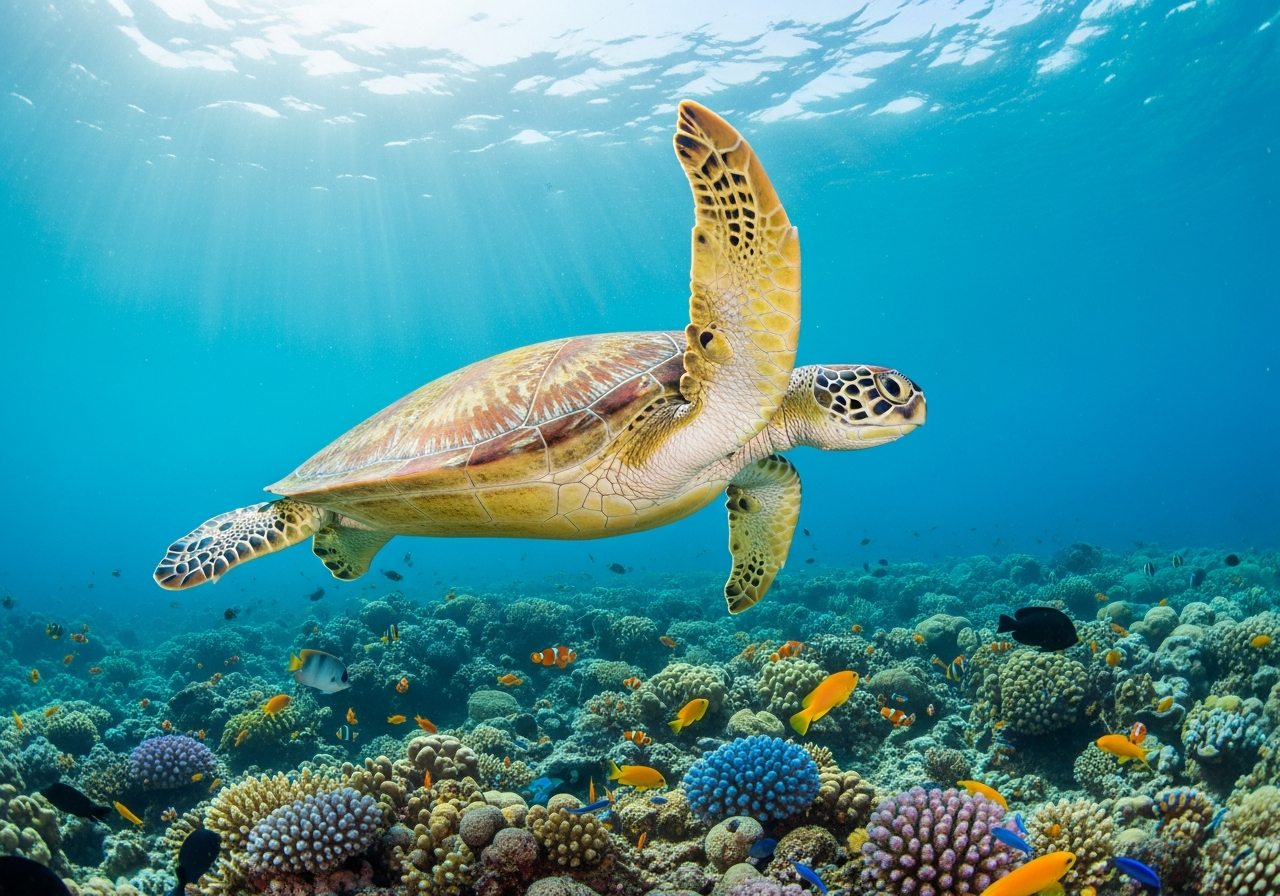
Plastic harms marine animals two ways, and they are worth separating. Entanglement is mechanical. Ghost fishing gear — nets and lines lost or abandoned at sea — keeps catching for years after anyone stops tending it, because a drifting net does not know it has been discarded. It snares grey seals, green sea turtles, sharks, and diving seabirds, which then drown or starve while still attached.
Ingestion is a sensory failure. A floating carrier bag has roughly the silhouette and drift of a jellyfish — the staple food of the leatherback turtle, which is built to eat exactly that and has backward-pointing throat spines making rejection nearly impossible. Seabirds like the albatross face a worse trap: floating plastic accumulates a biofilm of algae that emits dimethyl sulphide, the same chemical cue that signals a krill swarm. The bird is not being stupid. The plastic smells like food, and adults carry it back and feed it to chicks.
Consequences follow from bulk and chemistry:
- Starvation when a stomach fills with indigestible material that still registers as “full”
- Internal injury and perforation from sharp fragments
- Toxic exposure, because plastics both leach their own additives and adsorb oily pollutants from surrounding water, concentrating them into an edible pellet
Microplastics — fragments under 5 mm — are the fraction that cannot be cleaned up. Larger items embrittle under sunlight and mechanical stress and shed particles indefinitely; synthetic textiles release fibres in every wash. They now turn up in plankton, in filter-feeders from mussels to the giant clam, and in commercial fish. What that does to wildlife and to people eating seafood is an active research frontier rather than a settled matter.
Chemical pollution and bioaccumulation
Industrial chemicals — PCBs, mercury, PFAS (“forever chemicals”) — reach the sea through rivers, runoff, and air. The dangerous ones share two properties: they resist breakdown, and they dissolve in fat rather than water.
That combination drives biomagnification, and the arithmetic is unforgiving. A contaminant that an animal cannot excrete stays in its fat for life. A predator eating a thousand contaminated prey over a lifetime inherits the burden of all thousand. Concentration multiplies at every step: plankton to fish to seal to whale. This is why the animals at the top of marine food chains carry the heaviest loads despite living in open water far from any source. Some orca populations carry PCB burdens high enough to impair immune function and reproduction — a legacy of chemicals largely banned decades ago, which is precisely the point about persistence. Sperm whales and polar bears, both apex feeders, sit in the same position.
Oil acts faster and more physically. Seabird feathers and the fur of a sea otter work by trapping an insulating layer of air, held in place by fine structure and precise geometry. Oil collapses that structure. The animal is not poisoned so much as stripped of its coat: it loses buoyancy and body heat, then poisons itself further while frantically preening. Otters are especially exposed because they have no blubber and rely entirely on fur. Chronic small leaks from shipping and drilling add a steadier, less visible version of the same stress.
Nutrient runoff and dead zones
Agricultural fertiliser is designed to make plants grow, and it does not stop working when it washes off a field. In coastal water, nitrogen and phosphorus fuel enormous algal blooms. The blooms themselves are not the problem — the aftermath is. When the algae die, bacteria decompose them, and decomposition consumes dissolved oxygen faster than mixing can replace it.
The result is a hypoxic dead zone: water that is chemically ordinary but biologically uninhabitable. Mobile animals flee. Everything anchored — shellfish beds, seagrass, bottom-dwelling invertebrates — suffocates in place. The Gulf of Mexico and the Baltic Sea host large recurring examples, and they are seasonal, expanding after spring fertiliser application and the rains that follow. This is a land-use problem wearing an ocean costume.
Noise as pollution
Sound travels far and fast in water, which is exactly why marine mammals built their lives around it. Humpback whales sing across ocean basins; bottlenose dolphins hunt by echolocation. Shipping, seismic surveys, and military sonar inject noise into the same low frequencies whales use.
The damage is mostly masking rather than deafening. A whale calling to a distant mate in a shipping lane is like a person shouting across a crowded room: the signal is not destroyed, its usable range is. Chronic noise also elevates stress hormones, and acute sonar events have been linked to mass strandings in deep-diving species such as beaked whales. Noise has one redeeming feature the others lack — it stops the instant the source does. Slower vessels and quieter propeller design deliver immediate results.
Climate-linked ocean stress
CO₂ is not classic pollution, but the ocean absorbs a large share of it and the chemistry is direct: dissolved CO₂ forms carbonic acid, lowering pH and reducing the carbonate ions that animals need to build shells. That pressures corals, oysters, and the pteropods underpinning many polar food webs. Warming compounds it — warmer water holds less oxygen, enlarging dead zones, and heat stress bleaches reefs already weakened by runoff. The stressors are not additive so much as multiplicative.
What helps
- Reduce single-use plastics and improve recycling where systems actually work
- Ban destructive gear, mark gear for traceability, and fund ghost-net recovery
- Treat wastewater and buffer agricultural runoff with restored wetlands
- Regulate shipping lanes and speeds in sensitive habitats
- Support marine protected areas, where ecosystems recover measurably
The pattern across all of these: the ocean is where the consequences land, not where the decisions are made. Almost every input is generated on land, which is inconvenient for anyone hoping to fix this at sea — and encouraging, because it means the leverage sits somewhere reachable.
Sources
Related reading: Why coral reefs matter · Why do whales sing? · Green sea turtle guide
Frequently asked questions
How much plastic is in the ocean?
Estimates suggest millions of metric tonnes enter annually, accumulating in gyres, coastlines, and sediments — with much breaking into microplastics over time.
Do fish eat plastic?
Yes — many species mistake plastic for prey or ingest it indirectly. Effects include gut blockage, reduced feeding, and chemical exposure.
What is a marine dead zone?
Areas where excess fertiliser runoff triggers algal blooms; decomposition uses up oxygen, suffocating fish and bottom-dwelling life.
Can ocean pollution affect human health?
Yes — through contaminated seafood, pathogens in coastal waters, and economic losses in fisheries and tourism.