Why Do Whales Sing? The Science of Whale Song
Humpbacks, bowheads, and other whales produce haunting songs that travel for kilometres. What we know about why they sing, how songs spread, and what changed in the ocean soundscape.
Global Animal Guide · June 24, 2026
Quick answer
Whales sing mainly for mating and social communication. Male humpbacks produce long, structured songs during breeding season — likely to attract females and signal size or fitness to rivals. Songs evolve like cultural trends within populations and can spread across ocean basins. Other species use clicks, pulses, and calls for navigation, feeding coordination, and mother-calf contact. Human shipping and sonar add noise that can drown out these vital signals.
Whales sing because sound is the only signal that works reliably in their world, and because — for male humpback whales at least — a long, difficult, precisely structured song appears to be a way of advertising who you are to everyone within earshot. Breeding is the leading explanation, but it is not the only one, and “song” in the strict sense is only one part of a much larger vocal repertoire that whales use to navigate, hunt, and keep families together.
Why sound, and not sight or smell
The ocean is a sound world. Sunlight is effectively gone below a couple of hundred metres, and even in clear tropical water a whale can see only tens of metres. Scent disperses slowly and unpredictably in currents. Sound, by contrast, travels roughly four to five times faster in seawater than in air and loses energy far more gradually.
Better still, the ocean has structure that helps. At intermediate depths, temperature and pressure combine to create a layer where sound speed reaches a minimum — the deep sound channel. Low-frequency sound entering this layer is repeatedly refracted back into it rather than escaping to the surface or the seabed, so it can propagate for hundreds and in some conditions thousands of kilometres. A blue whale calling into that channel is using a natural waveguide.
This is why baleen whales evolved towards very low frequencies, often near or below the bottom of human hearing. Low frequencies bend around obstacles and resist absorption; high frequencies fade fast. The trade-off is resolution: low sound carries far but conveys little fine detail. Toothed whales made the opposite bargain, which is why the sperm whale and the bottlenose dolphin use high-frequency clicks for echolocation — enormous detail, but only over short ranges.
Humpback song: structure and mystery
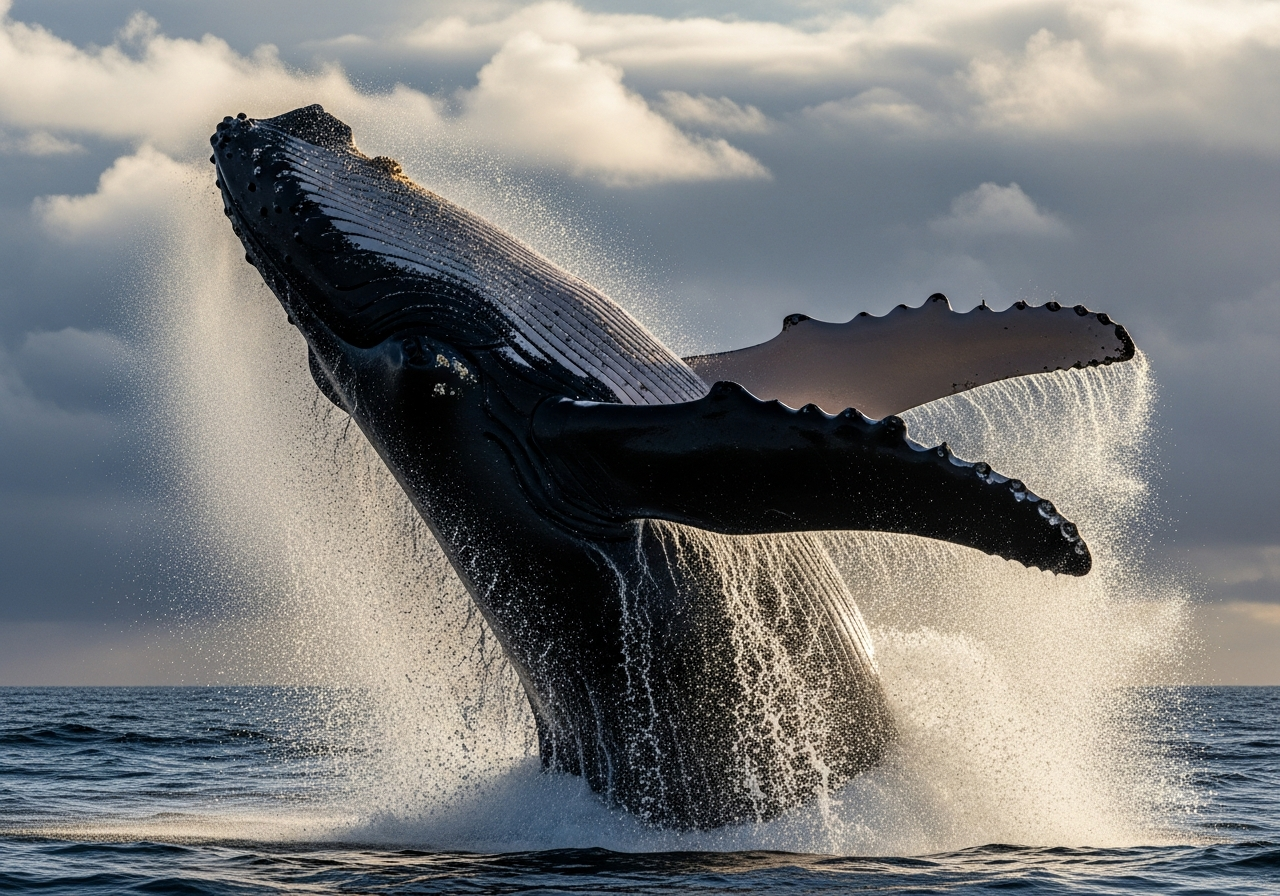
Male humpback whales sing predominantly on breeding grounds. A song is not random noise — it has hierarchical structure:
- Units — Single cries or moans
- Phrases — Groups of units in pattern
- Themes — Repeated phrase sequences
- Song — Themes arranged in predictable order
All males in a population sing the same version at a given time, but the song evolves month to month — themes drop out and new ones appear, sometimes borrowed from distant populations. Scientists compare it to cultural transmission in humans.
What makes this remarkable is that nobody conducts it. There is no leader whose version becomes canon. The shared song emerges from many individuals copying each other closely but imperfectly, with small errors and innovations accumulating in a shared direction. It is the same process that makes regional accents in human speech drift over decades — only compressed into months.
Why sing? Leading theories
Mate attraction — Females may prefer longer, more complex, or novel songs. Males may advertise stamina — singing is energetically costly. A singing humpback is typically on a breeding ground where it is barely feeding, holding position for hours, and spending breath on sound rather than diving for food. That cost is the point: a signal is only honest if a weak animal cannot fake it.
Male-male signalling — Songs may warn rivals without physical fights. Spacing on breeding grounds supports this idea, and singers sometimes fall silent or join other males when approached, which fits a signal aimed partly at competitors rather than only at females.
Navigation or coordination — Less likely for full song displays, but shorter calls help groups stay together during migration and feeding. Humpbacks on feeding grounds use quite different sounds — including the rising trumpet calls associated with bubble-net feeding — and these are not songs at all.
No theory fully explains every species or context; functions probably overlap. A display that attracts a mate and simultaneously spaces out rivals is doing two jobs with one signal, and evolution rarely tidies such things into single-purpose traits.
Beyond humpbacks
Blue whales produce low moans that carry thousands of kilometres — possibly for long-range contact across sparse populations. When a population is thin and an ocean is wide, the ability to be heard across a basin may be the difference between finding a mate and not.
Sperm whales use patterned click codas — social dialects differ between clans. Females in a clan share a coda repertoire that functions rather like a badge of membership, and clans with different dialects can share the same waters while largely keeping to their own.
Belugas are nicknamed “canaries of the sea” for varied whistles and chirps. The beluga whale has an unusually flexible sound repertoire and, unlike most whales, a mobile neck and expressive melon.
Bowhead whales in the Arctic sing through dark winters — one of the longest-known seasonal song cycles. Unlike humpbacks, bowheads sing many song types at once rather than converging on a single shared version.
Other cetaceans fill out the picture. The fin whale produces regular low pulses in long sequences; the minke whale makes mechanical-sounding pulse trains; the orca uses pod-specific call dialects that persist across generations; and the narwhal combines clicks, whistles, and knocks under Arctic ice.
Learning and culture
Whales are cultural learners. Calves pick up call types from mothers and peers. Humpback song revolutions — when an entire population adopts a new song in one season — suggest rapid social learning across ocean regions.
The mechanism appears to be contact between populations. Whales from neighbouring breeding grounds overlap on migration routes and feeding areas, hear each other’s songs, and carry fragments home. Novelty seems to spread preferentially, which is why revolutions run in a consistent direction across an ocean rather than sloshing back and forth.
This matters beyond curiosity. If song is learned rather than innate, then a population reduced to very low numbers can lose repertoire that no individual can reinvent — the same fragility that threatens language when its last fluent speakers die.
The noise we add
Industrial oceans are louder than a century ago. Chronic shipping noise overlaps whale frequencies, causing communication masking. Acute events like military sonar have been linked to strandings in beaked whales. Slowing ships, routing traffic away from breeding grounds, and quieting seismic surveys are active conservation tools.
Masking is the insidious part. It does not kill; it shrinks. As background noise rises, the distance at which a call remains detectable contracts — so a whale that could once reach a mate across a basin may now reach only across a bay. Whales respond by calling louder, shifting frequency, or repeating themselves, but each of those costs energy and none fully restores the lost range.
The encouraging detail is that noise, unlike a chemical spill, stops the moment the source stops. Quieter hull designs, reduced speeds, and rerouted lanes work immediately. Few conservation levers are that responsive.
Listening to whales teaches us about intelligence, culture, and connectivity — and about how much our noise costs the deep.
Sources
Related reading: Biggest animals that ever lived · Ocean pollution and marine life · Blue whale guide
Frequently asked questions
Which whales sing the most famous songs?
Male humpback whales are best known — their songs can last 10–20 minutes and repeat for hours, with themes that change across seasons and years.
Can whale songs be heard by humans?
Yes — many whale vocalisations are low-frequency and loud enough for divers or hydrophone recordings to capture kilometres from the source.
Do female whales sing?
Females vocalise but rarely produce the long, structured songs males perform. Research focuses on male breeding displays.
How does ocean noise pollution affect whales?
Shipping, drilling, and military sonar raise background noise, forcing whales to call louder, change behaviour, or abandon habitat — sometimes with fatal strandings linked to sonar.