The Biggest Animals That Ever Lived
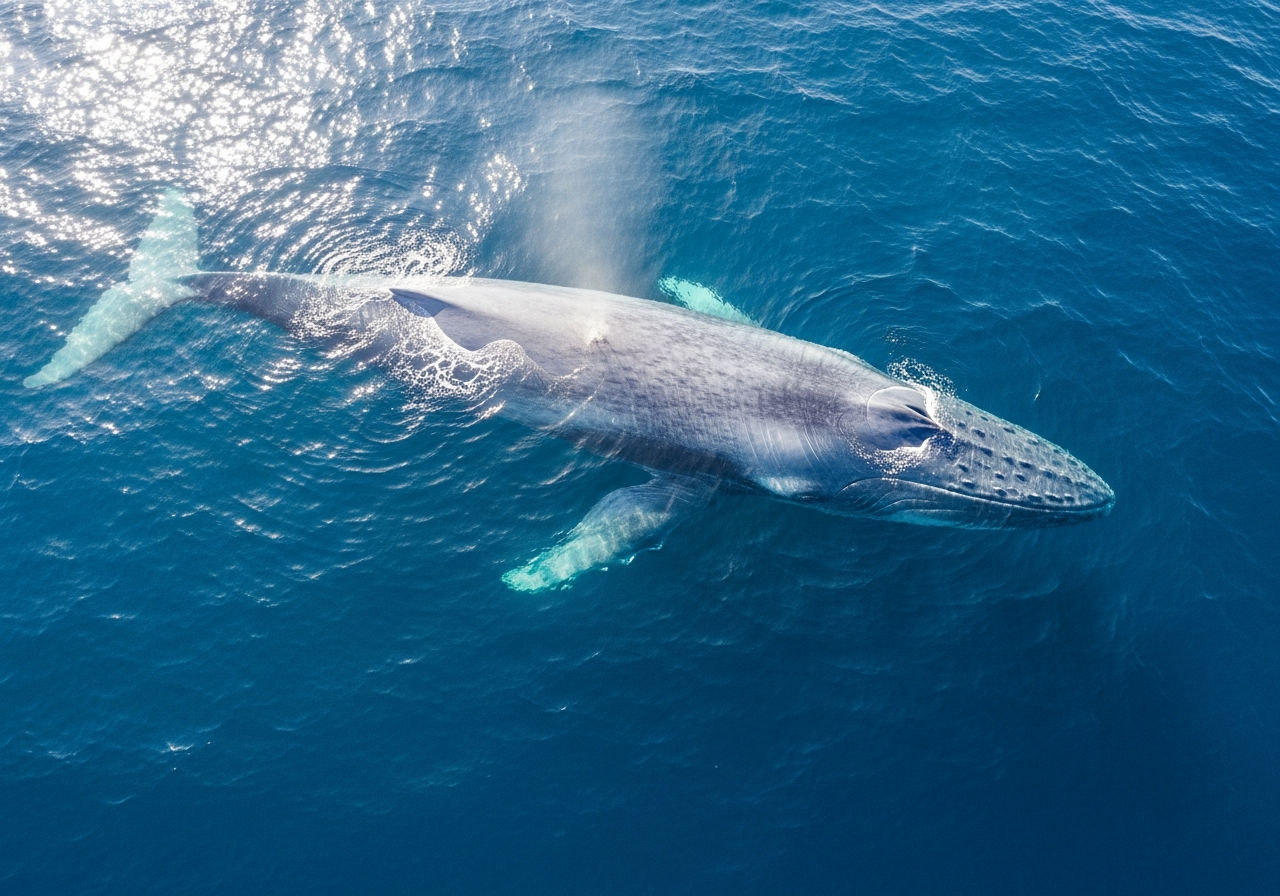
The blue whale is the largest animal that has ever lived — bigger than any dinosaur, at up to 30 m long and 200 tonnes. Here are the biggest animals ever, on land and in the sea.
Global Animal Guide · June 9, 2026
Quick answer
The blue whale is the largest animal that has ever lived — larger than any dinosaur — growing up to about 30 m (98 ft) long and weighing as much as 200 tonnes. The African bush elephant is the largest living land animal, the whale shark is the largest fish, and the giraffe is the tallest animal. Many giant prehistoric animals were huge, but none matched the blue whale.
Last updated: June 2026 — sizes are well-cited maximums; the very largest individuals are exceptional.
The largest animal that has ever lived is alive right now. The blue whale reaches about 30 m and up to roughly 200 tonnes, and nothing in the fossil record — no dinosaur, no ancient marine reptile, no prehistoric shark — is known to have matched that mass. This is counterintuitive, because the deep past is popularly imagined as the age of giants. It was not. The age of giants is the present, and it is happening in the ocean.
The biggest animals ever, by category
- Largest animal ever: the blue whale. At up to 30 m (98 ft) and 200 tonnes, it is the heaviest animal known to have existed — its heart alone is the size of a small car. The ocean’s buoyancy lets it grow far beyond what any land animal could support.
- Largest land animal today: the African bush elephant. Up to about 6 tonnes and 4 m tall at the shoulder, it dwarfs every other living land animal.
- Largest fish: the whale shark. Reaching about 18 m, this gentle giant filters tiny plankton from the water rather than hunting large prey.
- Tallest animal: the giraffe. Standing up to 5.5 m, its towering neck lets it browse leaves no other animal can reach.
- Largest predatory fish: the great white shark. At up to about 6 m, it is the biggest hunting fish in today’s oceans.
- Largest marine predator: the orca. The biggest member of the dolphin family and an apex predator in every ocean.
- Largest dinosaurs: sauropods such as Argentinosaurus may have reached 30-35 m long, rivalling the blue whale in length — but not in weight.
Why the ocean grows the biggest giants
The single biggest reason the largest animal ever is a whale, not a dinosaur, is water. Seawater is close to the density of animal tissue, so a marine body is very nearly weightless. It does not need pillar-like limbs, a load-bearing spine, or a skeleton engineered against gravity — the sea does that work for free. A stranded whale dies partly because its own mass, unsupported, crushes the tissues underneath it. That is the clearest possible demonstration of what buoyancy was doing.
On land, the arithmetic turns hostile fast. Double an animal’s length and its mass rises eightfold, while the cross-sectional area of the bones and muscles carrying that mass rises only fourfold. Every increment of size therefore demands disproportionately thicker legs, and eventually the legs would need to be thicker than the body has room for. Sauropod dinosaurs pushed against this ceiling with hollow, air-filled vertebrae and column-straight limbs, and they got remarkably far. They still did not get near a blue whale.
Buoyancy is necessary but not sufficient — the whale shark and the orca enjoy the same free support and stop far short. What separates the blue whale is the second condition: a food supply dense enough to fuel the body it is allowed to have.
Filter feeding is the other half of the answer
Almost every truly enormous animal in the ocean eats very small things. Blue whales and humpback whales lunge into krill swarms and strain them through baleen; the whale shark, the basking shark, and the manta ray filter plankton on the move. Hunting individual large prey means spending energy on each capture, and no predator can catch enough big animals per day to run a 200-tonne body. Filtering flips the economics: one enormous mouthful can return a meal’s worth of energy for a single expenditure.
This explains why the biggest predatory fish, the great white shark, is only around 6 m, while the biggest filter feeder is three times that. It also explains the sperm whale as a genuine exception — the largest toothed predator alive, sustained by dives to squid-rich depths where prey is abundant enough to make active hunting pay.
Why the biggest land animals are smaller than you expect
At about 6 tonnes, the elephant is the heaviest land animal today, and it shows exactly what that costs: columnar legs, a shortened stride, no ability to jump or gallop properly, and a constant thermal problem. Large bodies produce heat in proportion to volume but shed it in proportion to surface area, so an elephant’s ears function as radiators laced with blood vessels. Overheating, not strength, is often the practical ceiling on terrestrial size.
The giraffe illustrates the other tax. Standing up to 5.5 m tall, it needs an extraordinarily powerful heart and thickened arterial walls to push blood to a brain held metres above it, plus valves and pressure-buffering vessels to avoid blacking out every time it lowers its head to drink. Height is not free.
Extinct land mammals such as Paraceratherium, a hornless rhino relative, exceeded the elephant — but only modestly. Land life plateaus in the tens of tonnes. The sea does not.
Reading the size records sceptically
Superlatives invite exaggeration, and prehistoric ones especially. Many famous giant dinosaurs are known from a handful of bones, and their masses are estimated by scaling from partial skeletons — which is why published figures for the same animal can differ by a factor of two. Argentinosaurus may have reached 30–35 m long, rivalling the blue whale in length while falling well short in weight, because a long neck and tail add metres cheaply. Length and mass are not the same record.
Living animals are measured more honestly, and even then the very largest individuals are exceptional rather than typical. A 30 m blue whale is a record, not an average. The reliable claim is narrower and more interesting than the headline: no animal known to science, living or fossil, has convincingly exceeded the blue whale’s mass.
Giants need the most protection
Being huge is a strategy that works right up until humans arrive. The biggest animals reproduce slowly, mature late, raise few young, and need vast territories — the exact profile that recovers worst from losses. They are also worth the most per animal to hunt, which is why whaling targeted the largest species first and reduced blue whale numbers to a small fraction of their original population before protection arrived. Recovery is under way but measured in generations, not decades.
The pattern repeats on land. Elephants, rhinoceroses, and other megafauna are the first to go when habitat fragments or hunting intensifies, and their loss reshapes whole ecosystems, because giants are usually keystone species — dispersing seeds, felling trees, and cycling nutrients at a scale nothing else replaces. Whale faeces fertilise surface waters with iron and nitrogen, feeding the very plankton the whales eat. Protecting the planet’s largest species is not nostalgia for spectacle; it is maintenance of the systems they run.
Sources
Related reading: Blue whale · Whale shark · Elephant · Giraffe · Great white shark · Support wildlife protection
Frequently asked questions
What is the largest animal that ever lived?
The blue whale is the largest animal known to have ever existed, bigger than any dinosaur, reaching up to 30 m long and around 200 tonnes.
Was any dinosaur bigger than a blue whale?
No. The longest dinosaurs may have rivalled the blue whale in length, but none came close to its mass.
What is the largest land animal alive today?
The African bush elephant is the largest living land animal, weighing up to about 6 tonnes.