Why Are Flamingos Pink? Diet, Feathers & Facts
Flamingos are pink because of carotenoid pigments in their food — brine shrimp and algae. Chicks hatch grey-white; colour builds with diet.
Global Animal Guide · July 10, 2026
Quick answer
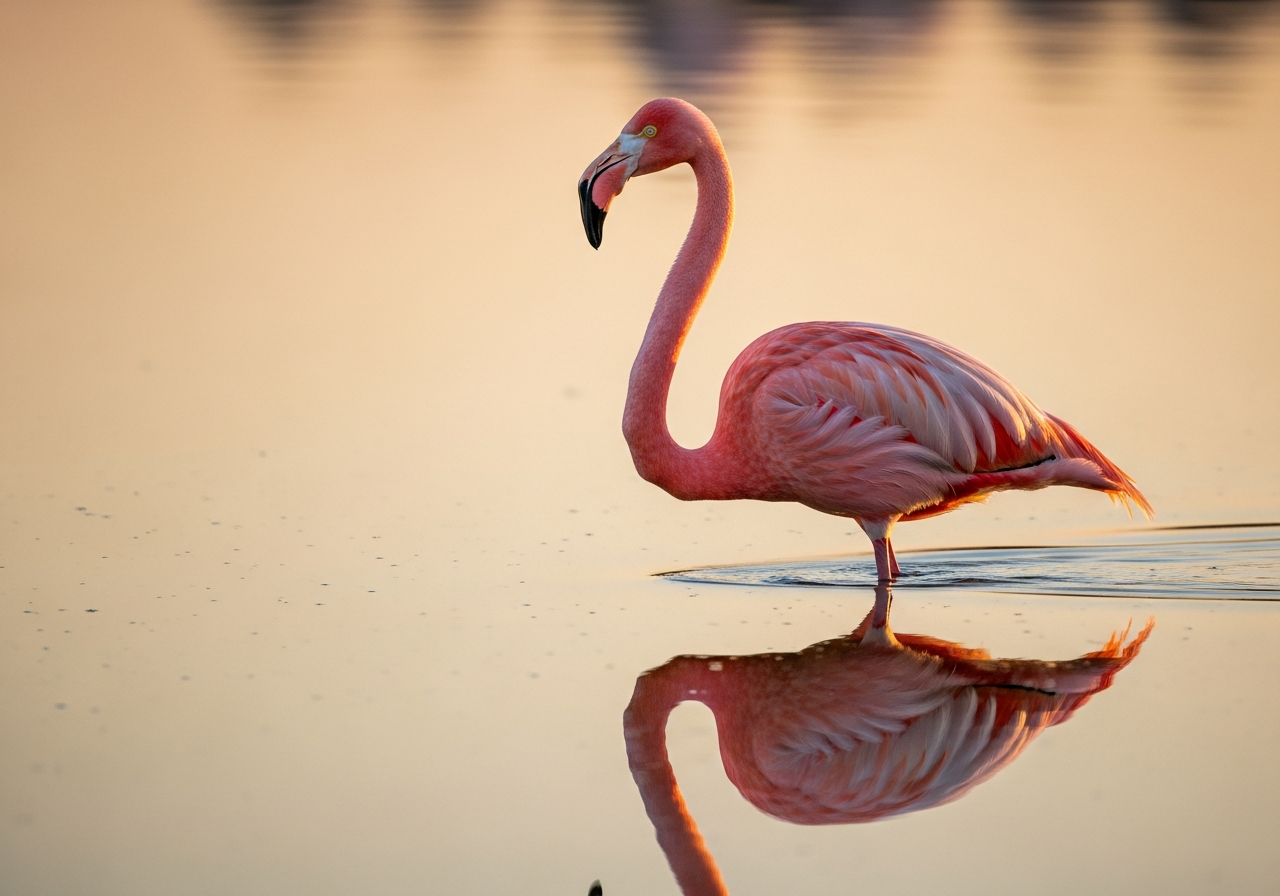
Flamingos get their pink and orange colour from carotenoid pigments in algae and the small crustaceans that eat those algae. Without those pigments in the diet, feathers fade toward white or pale. Chicks are greyish-white and gain colour as they feed.
Last updated: July 2026.
Pigment pathway
Algae produce carotenoids → shrimp and other prey concentrate them → flamingo liver metabolises pigments → feathers, skin, and egg yolks take on pink/orange hues.
The important thing about that chain is where it starts. No animal can build a carotenoid from scratch — the biochemical machinery exists only in plants, algae, and some bacteria and fungi. Every gram of pink in a flamingo was manufactured by something photosynthetic and eaten. A flamingo is, quite literally, the colour of its dinner.
The particular pigments involved are beta-carotene, astaxanthin, and canthaxanthin — the same family that makes carrots orange and cooked prawns red. Flamingos do not simply store them unchanged. Enzymes in the liver convert dietary carotenoids into the specific forms deposited in growing feathers, in the bare skin of the legs and face, and in egg yolk. Two flamingos eating slightly different prey in different lakes can end up genuinely different shades.
Why a pigment has to be eaten to be worn
Compare this with the other ways animals make colour and the flamingo’s dependence stands out. Melanin — the black of a common raven — is synthesised internally from an amino acid, so a bird can produce it on almost any diet. Structural colour is not pigment at all: the blue of a blue jay and the shifting greens of a peacock train come from microscopic feather architecture scattering light, which is why a crushed blue feather turns brown while a crushed red one stays red. Parrots hold a third card entirely, manufacturing their own red and yellow pigments called psittacofulvins, which is why a scarlet macaw stays scarlet on a diet with no carotenoids to speak of.
Flamingos have none of those workarounds. Their colour is imported, and it is spent. Carotenoids diverted into a feather are carotenoids not used elsewhere in the body, which is the foundation of everything interesting about flamingo colour.
How a filter-feeding bill harvests pigment
The bird’s whole feeding apparatus exists to strain pigment-bearing food out of water. A flamingo feeds with its head upside down, the bill inverted so the large lower mandible does the moving while the upper acts as a lid. Rows of comb-like plates called lamellae line the bill’s edges, and a thick, spiny tongue pumps back and forth like a piston, drawing water in and forcing it out through the filter while retaining what is caught.
The size of the mesh determines the diet, and the diet determines the shade. Greater flamingos have a relatively coarse filter and take brine shrimp, molluscs, insect larvae, and other invertebrates that have already concentrated carotenoids from the algae they grazed. Lesser flamingos have a much finer, deep-keeled bill and skim cyanobacteria and diatoms directly from the surface film of alkaline soda lakes — cutting out the middleman and feeding one trophic level lower.
That difference explains a pattern often noticed in zoos and in the wild: lesser flamingos tend to be the deeper, more saturated pink, because they are eating the pigment source itself rather than an animal that ate it. The harsh soda lakes they favour are so caustic that few other birds can exploit them, which is precisely why the food is available.
Grey chick to pink adult
Chicks hatch a fluffy grey-white and stay that way for months. Colour arrives gradually as pigment accumulates and, crucially, as new feathers grow — a feather takes up carotenoid only while it is developing and still connected to a blood supply. Once grown, it is dead tissue and cannot be topped up from within. Full adult colour typically takes a couple of years.
There is a wrinkle here that makes flamingos genuinely unusual among birds. Both parents feed their chick on crop milk, a secretion from the upper digestive tract that is unusually rich in carotenoids — and producing it visibly drains the adults. Breeding flamingos grow noticeably paler while raising a chick, then regain colour once the chick is independent. The parent’s pink is being poured into the offspring.
Colour as an honest signal
Because pigment must be found, filtered, processed, and then given away, colour cannot be faked. A vividly pink flamingo is advertising that it is feeding well, foraging in a productive lake, healthy enough to spare carotenoids for display rather than routing them into immune function, and not currently drained by a chick. Biologists call this an honest signal — the cost is what makes it trustworthy.
Flamingos act on that information. Deeper-coloured birds tend to display more, claim better positions in the dense courtship groups where the flock performs its synchronised head-flagging and wing salutes, and pair earlier in the season — and early pairs get the better nest sites. Colour, in other words, is not decoration; it is a résumé.
Greater flamingos go further and apply pigment cosmetically. They spread carotenoid-rich oil from the preen gland at the base of the tail onto their neck and breast feathers, brightening plumage that would otherwise fade in the sun, and they do this most intensively during courtship. It is one of the few well-documented cases of a bird using make-up. The same logic drives carotenoid colour across birds generally: the red of a northern cardinal, the yellow of an american goldfinch, the blue-tinted feet of a blue-footed booby that dull within days on a poor diet, and the pink of a roseate spoonbill — another wetland filter-feeder converging on the same solution. Even the flesh of salmon is astaxanthin from crustaceans, the identical pigment in a different animal.
Species note
Greater, lesser, Chilean, Andean, James’s, and American flamingos vary in intensity, but the dietary mechanism is shared.
American flamingos are typically the most vividly red-orange, Chilean flamingos paler with grey legs and red joints, Andean and James’s flamingos duskier — differences that track the prey and productivity of the lakes each species exploits at least as much as anything genetic.
What happens when the pigment stops
Remove carotenoids and a flamingo fades. Early zoo collections learned this the hard way: birds fed on a plain diet moulted in progressively paler, and eventually near-white, plumage. Nothing was wrong with the birds — they had simply run out of paint. Modern collections supplement feed with carotenoid sources, which is why zoo flamingos look like wild ones.
The fade is not instant, and the reason is that dead-feather rule. A bird deprived of pigment keeps the plumage it already grew; the loss only shows as it moults and replaces feathers with unpigmented ones. Restore the diet and colour returns on the same schedule — one moult at a time. The bare skin of the face and legs, being living tissue, responds much faster in both directions, which is why an unhealthy flamingo often shows it in the legs first.
Related reading
Sources
Frequently asked questions
Are flamingos born pink?
No — chicks are grey-white and turn pink over months to years with diet.
What do flamingos eat?
Filter-fed algae, diatoms, and small invertebrates such as brine shrimp.
Can zoo flamingos lose their colour?
Yes — if diets lack carotenoids; zoos supplement to keep plumage vivid.
Why do flamingos stand on one leg?
Likely to conserve heat and reduce muscle fatigue — still studied, but energy-saving is the leading explanation.