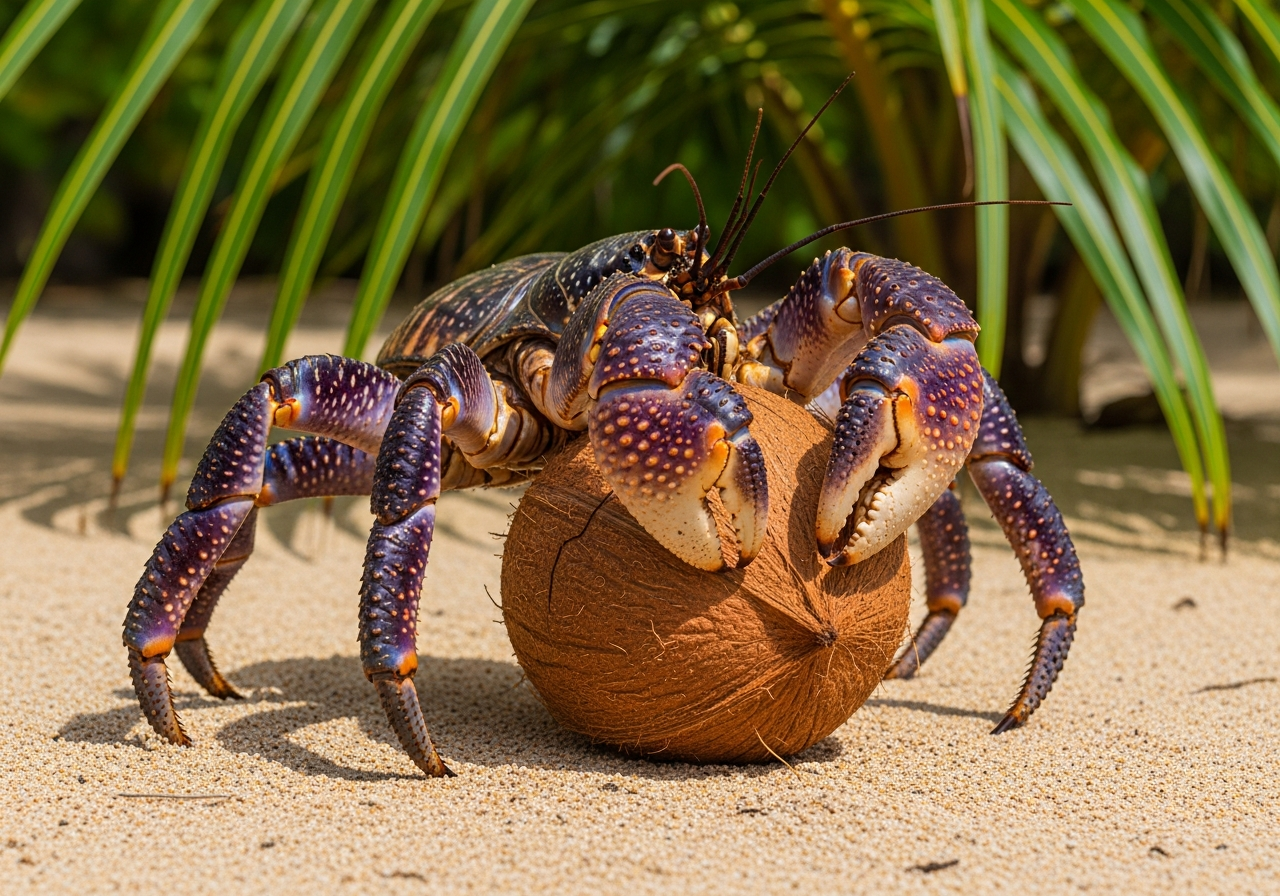
The coconut crab (Birgus latro) is a crustacean of the family Coenobitidae, in the order Decapoda.
Quick answer
The coconut crab (Birgus latro) is the world's largest land-living arthropod, a giant terrestrial hermit crab found on tropical islands across the Indo-Pacific. Adults reach a leg span of about 1 m (3 ft) and weigh up to roughly 4 kg (9 lb). Famous for climbing trees and cracking open coconuts with powerful claws, it is a long-lived omnivore that may survive 40 to 60 years. The IUCN lists it as Vulnerable.
Top questions about the Coconut Crab
Coconut Crab facts at a glance
- Weight 4 kg
- Length 40 cm
- Top speed 4 km/h
- Lifespan 40 years
| Scientific name | Birgus latro |
|---|---|
| Diet | Omnivore (coconuts, fruit, seeds, carrion) |
| Habitat | Tropical islands across the Indo-Pacific |
| Lifespan | Possibly 40–60 years |
| Weight | Up to about 4 kg (9 lb) |
| Leg span | Up to about 1 m (3 ft) |
| Conservation status | Vulnerable (IUCN) |
| Kingdom | Animalia |
|---|---|
| Phylum | Arthropoda |
| Class | Malacostraca |
| Order | Decapoda |
| Family | Coenobitidae |
| Genus | Birgus |
Where it lives
The coconut crab (Birgus latro) is native to Tropical islands across the Indian Ocean and Pacific Ocean, from the Andaman Islands east to the Cook Islands. — recorded across Asia, Oceans in this guide’s range summary.
For occurrence records, see GBIF species search and sources below.
How big is a coconut crab?
An adult coconut crab measures 40 cm long — about 23% of the height of an average adult person (1.73 m) — and weighs around 4.0 kg, about 6% of an average adult’s body weight (70 kg).
Length vs an average adult’s height (to scale)
What is a group of coconut crabs called?
Group name (collective noun)
A group of Coconut Crabs is called a cast.
Baby name
A baby Coconut Crab is called a zoea.
Explore more animal collective nouns and baby animal names .
Size and body
The coconut crab is the heaviest land arthropod on Earth, with a leg span reaching about 1 m (3 ft) and a body mass of up to roughly 4 kg (9 lb). Unlike its smaller hermit-crab relatives, an adult no longer carries a borrowed shell, instead hardening its own abdomen for protection. Its front claws are extraordinarily strong, capable of a pinch measured among the most powerful of any animal for its size. The body is armoured in a thick exoskeleton that ranges from bluish to reddish-orange depending on the island population.
Climbing and coconuts
Coconut crabs are accomplished climbers that scale palm trunks and other trees, sometimes several metres up, to reach fruit or to escape the heat. They are named for their habit of husking and cracking coconuts, using their claws to strip the fibrous outer layer and hammer through to the flesh inside, a task that can take days. On the ground they are slow, moving at only around 4 km/h, so climbing gives them access to food that faster animals cannot reach. Their grip is strong enough to carry objects heavier than their own body.
Diet and feeding
Despite the name, the coconut crab is a broad omnivore rather than a coconut specialist. It eats fallen fruit, seeds, nuts, the pith of toppled trees, and carrion, and will scavenge almost anything organic it encounters at night. It also feeds on other crabs and has been recorded taking small live animals when the chance arises. A keen sense of smell, unusual among crustaceans and more like that of insects, guides it to food across the forest floor.
Life cycle and breeding
Coconut crabs are terrestrial as adults but remain tied to the sea for reproduction. After mating on land, a female carries her eggs on the underside of her abdomen and then releases the hatching larvae into the ocean, usually at high tide. The tiny larvae drift and develop in the water for several weeks before settling and, like young hermit crabs, occupying small shells while they mature on land. Once large enough, they abandon the shell for good and never return to the water, growing slowly over decades.
Distribution and habitat
The species is found on tropical islands and coastlines throughout the Indo-Pacific, from the western Indian Ocean to islands scattered across the central Pacific. It favours forested coastal areas with plenty of cover, sheltering by day in rock crevices or burrows lined with fibre and emerging to forage after dark. Because populations are isolated island by island, numbers vary widely from place to place. It has vanished from some islands where humans are numerous and survives best on remote, undisturbed land.
Conservation status
The coconut crab is listed as Vulnerable by the IUCN, with populations declining across much of its range. Its slow growth, late maturity, and long lifespan of possibly 40 to 60 years make it slow to recover from losses. Hunting for food, habitat loss, and predation of larvae and juveniles by introduced animals all put pressure on island populations. Several countries now regulate harvesting, setting size limits and protecting breeding females to keep local populations from collapsing.
Dig deeper into the Coconut Crab
- Are Coconut Crabs Endangered?
Are coconut crabs endangered? Status Vulnerable, main threats, and what protection means.
- Coconut Crab: Key Facts
Coconut Crabs (Birgus latro) are invertebrates found across Asia. The world's largest land arthropod and tree-climbing island giant.
- How Long Do Coconut Crabs Live?
Coconut Crab lifespan is typically Possibly 40–60 years. What shortens or extends life, life stages, and status (Vulnerable).
- What Do Coconut Crabs Eat?
What coconut crabs eat: Omnivore (coconuts, fruit, seeds, carrion), foraging style, and seasonal shifts in Tropical islands across the Indo-Pacific.
- Where Do Coconut Crabs Live?
Where coconut crabs live: Tropical islands across the Indo-Pacific, native range cues, and human overlap. Status Vulnerable.
Explore the Coconut Crab
Close relatives
- Pistol Shrimp Same order
- Japanese Spider Crab Same order
- Blue Crab Same order
- American Lobster Same order
Collections
Range & geography
Did you know? Coconut Crab facts
- The coconut crab (Birgus latro) is the largest land-living arthropod on Earth, weighing up to about 4 kg (9 lb) with a leg span approaching 1 m (3 ft).
- Yes. Coconut crabs can crack open a coconut by working their claw through the husk over multiple strikes, or by targeting the soft eye. Their measured grip force is among the highest of any animal.
- Adults cannot swim and will drown if submerged for extended periods. They breathe through a modified lung organ that requires air. Only larval coconut crabs are aquatic.
- Their grip is genuinely powerful and can cause a painful injury, but they are not aggressive toward people. Wild coconut crabs are shy and mostly nocturnal, and will retreat rather than attack when given the chance.
- Coconut crabs grow very slowly and are believed to live for several decades, possibly 40 to 60 years. Their longevity makes them especially vulnerable to hunting, as overharvested populations take a very long time to recover.
- Conservation: Vulnerable (IUCN).
Diet & feeding
Coconut Crab feeds primarily as a omnivore (coconuts, fruit, seeds, carrion). Despite descending from marine ancestors, adult coconut crabs have become fully terrestrial. They breathe air through a branchiostegal lung — a modified gill cavity lined with tissue that absorbs oxygen from air. Paradoxically, an adult cocon
Adaptations
- The coconut crab is the largest terrestrial arthropod alive today. Large adults can weigh around 4 kg and stretch nearly a metre from claw to claw. Their chelae (claws) generate one of the most powerful gripping forces measured in any animal — up to around 3,300 N, comparable in force to the bite of a lion. This grip is strong enough to husk and crack open a coconut, the food that gives the animal its name.
- Despite descending from marine ancestors, adult coconut crabs have become fully terrestrial. They breathe air through a branchiostegal lung — a modified gill cavity lined with tissue that absorbs oxygen from air. Paradoxically, an adult coconut crab will drown if submerged in water for too long. Only females return briefly to the shoreline to release their eggs, which hatch into aquatic larvae that later settle on land and lose their dependence on the sea.
Behaviour & ecology
- The coconut crab is the largest terrestrial arthropod alive today. Large adults can weigh around 4 kg and stretch nearly a metre from claw to claw. Their chelae (claws) generate one of the most powerful gripping forces measured in any animal — up to around 3,300 N, comparable in force to the bite of a lion. This grip is strong enough to husk and crack open a coconut, the food that gives the animal its name.
- Despite descending from marine ancestors, adult coconut crabs have become fully terrestrial. They breathe air through a branchiostegal lung — a modified gill cavity lined with tissue that absorbs oxygen from air. Paradoxically, an adult coconut crab will drown if submerged in water for too long. Only females return briefly to the shoreline to release their eggs, which hatch into aquatic larvae that later settle on land and lose their dependence on the sea.
- Coconut crabs are opportunistic omnivores. They eat fruit, seeds, coconuts, and carrion, and will cache food for later. They crack coconuts by working a claw through the soft eye or repeatedly hammering the shell. They climb palms and other trees several metres high to reach fruit. Their scavenging role helps recycle nutrients across the tropical island ecosystems they inhabit.
Communication
- Coconut Crab uses scent, posture, and vocal signals to mark territory and coordinate social behaviour.
- Communication intensity often peaks during breeding seasons and territorial disputes.
Habitat & range
Tropical islands across the Indo-Pacific
Ecological role
Coconut Crab plays a recognised ecological role in tropical islands across the indo-pacific.
Conservation status of the Coconut Crab
The coconut crab (Birgus latro) is listed as Vulnerable on the IUCN Red List. Vulnerable (VU) means a species faces a high risk of extinction in the medium-term future. It is the lowest-risk of the three 'threatened' IUCN categories — one step below Endangered, which is itself below Critically Endangered — and is often an early warning that a population is in trouble.
The coconut crab (Birgus latro) is assessed on the IUCN Red List. Look up on the IUCN Red List .
Frequently asked questions about the Coconut Crab
How big can a coconut crab get?
Coconut crabs are the largest land arthropods in the world. A full-grown adult can span about 1 m (3 ft) from leg tip to leg tip and weigh up to roughly 4 kg (9 lb).
Can coconut crabs actually open coconuts?
Yes. They use their powerful front claws to strip the fibrous husk and then hammer and pry at the shell until it cracks, reaching the flesh inside. The process can take several days for a single coconut.
Do coconut crabs climb trees?
They do. Coconut crabs regularly climb palms and other trees, sometimes several metres up, to reach fruit or escape the heat of the ground. Climbing is important because they move slowly on land, at only about 4 km/h.
How long do coconut crabs live?
They are remarkably long-lived for an invertebrate, possibly reaching 40 to 60 years. They grow slowly and mature late, which is one reason their populations recover slowly from over-harvesting.
Are coconut crabs dangerous to humans?
Their claws are among the strongest of any animal for their size and can deliver a painful, even injurious pinch, so they should be handled with care. They are not aggressive predators of people, but a grip from a large adult is difficult to break.
Where do coconut crabs live?
They live on tropical islands and coasts across the Indo-Pacific, from the western Indian Ocean to the central Pacific. As adults they are fully land-dwelling, returning to the sea only to release their larvae.
What is a group of coconut crabs called?
A group of Coconut Crabs is called a cast.
What is a baby coconut crab called?
A baby Coconut Crab is called a zoea.
Sources & references
This guide is compiled and reviewed against established zoological and conservation references. Key sources for the Coconut Crab:
-
IUCN Red List of Threatened Species
Conservation status (Vulnerable) reflects the IUCN Red List category for Birgus latro.
-
iNaturalist — observations & photos
Search citizen-science observations and community IDs for Birgus latro. Useful for range checks and recent sightings — not a substitute for formal Red List status.
-
GBIF — occurrence data
Global Biodiversity Information Facility species search for Birgus latro. Explore published occurrence records used in range research.
- IUCN Red List — Birgus latro.
Conservation status (Vulnerable) and population trends.
- Animal Diversity Web — Birgus latro. University of Michigan Museum of Zoology.
Life history, morphology, and range.
- Wikipedia — Coconut Crab.
General taxonomy and overview (cross-check primary sources).
-
Global Animal Guide editorial standards
How we research, source, review, and update every guide for accuracy.