How Fast Do Hummingbirds Fly? Speed, Wings & Heart Rate
Hummingbirds hover at wingbeats of dozens per second and fly roughly 30–50 km/h in normal flight — with higher speeds in courtship dives for some species.
Global Animal Guide · July 10, 2026
Quick answer
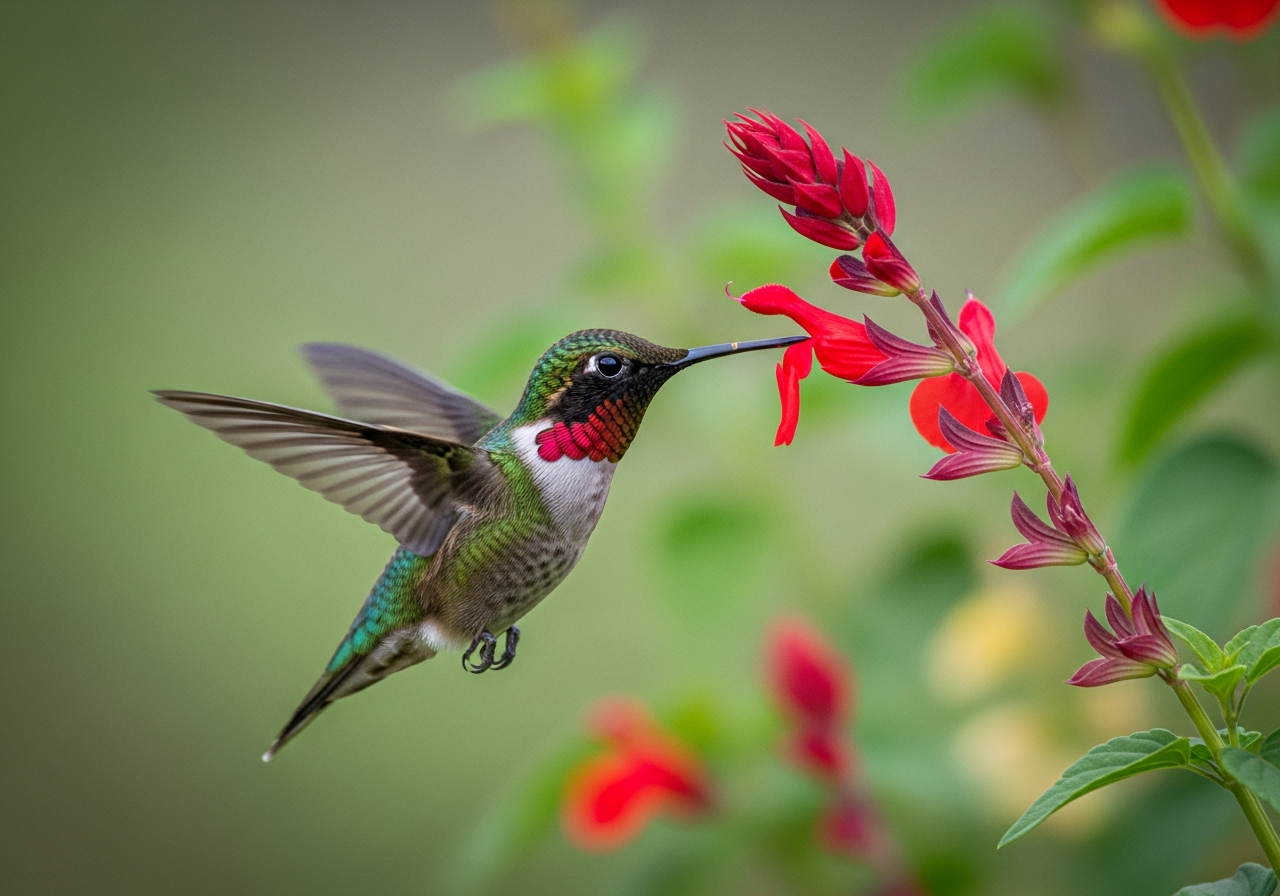
Typical forward flight for many hummingbirds is about 30–45 km/h (19–28 mph). Wingbeat rates often fall between 50 and 80 beats per second in small species (slower in larger ones). Some males reach much higher speeds in brief courtship dives. Hovering uses enormous energy — which is why they visit nectar constantly and may enter torpor at night.
Last updated: July 2026.
What “fast” means for a hummingbird
In ordinary forward flight, most hummingbird species cruise at roughly 30–45 km/h (19–28 mph). That is unremarkable by bird standards — a common swift beats it comfortably in level flapping flight, and a stooping peregrine falcon is in another category entirely. Judged on raw kilometres per hour, hummingbirds are middling.
Judged on almost any other measure, they are extraordinary. Scale speed to body length and a diving hummingbird outperforms a peregrine and a fighter jet. Scale it to wingbeat frequency, manoeuvrability, or metabolic cost, and nothing else with feathers comes close. The interesting question is not how fast they fly but how a bird weighing less than a two-pound coin sustains any of it.
The shoulder joint that makes hovering possible
Most birds generate nearly all their lift on the downstroke and recover on the upstroke, which is why they cannot hold a fixed point in still air. A kestrel appears to hover, but it is really flying into a headwind at exactly the wind’s speed — take the wind away and the illusion fails.
Hummingbirds do it properly, in dead calm. Their trick is anatomical. The wing is short and effectively rigid, with the elbow and wrist joints greatly reduced, so almost the entire motion comes from an unusually mobile shoulder joint that lets the wing rotate through nearly 180°. The wing sweeps a horizontal figure-of-eight, flipping over between strokes so the leading edge always meets the air front-on. The upstroke is therefore inverted and productive rather than wasted.
The trade-off shows in the muscles. In most birds the downstroke muscle dwarfs the upstroke muscle. In hummingbirds the upstroke muscle is proportionally huge, and the flight muscles together make up something like a quarter to a third of body mass. The upstroke still contributes less lift than the downstroke — hummingbirds are not quite insects — but enough to hold station, reverse, and fly sideways. It also costs them on the ground: their legs are tiny and they cannot walk. A hummingbird that wants to move a centimetre along a twig flies.
Why wingbeat rate depends on size
Quoted wingbeat rates of 50–80 per second apply to small species; they are not a fixed hummingbird property but a consequence of size. Small wings have less inertia and must beat faster to move enough air, so frequency rises sharply as species get smaller. The tiniest hummingbirds sit at the upper end of that range, while the giant hummingbird of the Andes — a comparative heavyweight — flaps at a rate the eye can almost follow.
The same scaling runs right across flying animals. A bumblebee beats its wings faster than any hummingbird; a monarch butterfly, with vast wings for its mass, flaps only a few times a second; an albatross can cross open ocean barely flapping at all. Hummingbirds sit at the small, high-frequency end of the vertebrate range, which is precisely why they hum: the wingbeat frequency falls inside human hearing.
The courtship dive: the fastest thing they do
Cruising speeds understate the peak. Males of several species perform steep courtship dives, climbing high and plunging past a perched female before pulling up hard. Speeds during these dives can roughly double or triple normal cruising flight, and the pull-out subjects the bird to accelerations that would grey out a human pilot.
Relative to body length, these dives are the fastest self-powered movements measured in any vertebrate — a hummingbird covers a far greater number of its own body lengths per second than a diving peregrine does. Absolute speed is modest; the achievement is packing that performance into a few grams. The dive is not just a chase, either: air rushing through the tail feathers produces a species-specific chirp, so the manoeuvre is partly an acoustic display.
The engine behind the speed
Hovering is the most expensive form of flight there is, and hummingbirds do it as their default. Sustaining it means an active heart rate that can exceed 1,000 beats per minute in small species and a breathing rate of several hundred breaths per minute, supplied by the exceptionally efficient one-way airflow of the avian lung.
Their fuel handling is equally unusual. Rather than converting nectar sugar to fat and burning that, a foraging hummingbird oxidises the glucose and fructose it just drank almost directly in its flight muscle — some of the sugar reaching the wings within minutes. That is why they feed constantly: they are running the engine close to empty, hand-to-mouth, all day.
Feeding itself is not passive capillary action, as older accounts claimed. The forked tongue tip springs open inside the flower and traps nectar as it is pulled out, working as an elastic micropump — a mechanism that lets them refill in a fraction of a second, dozens of times an hour.
Torpor: switching the engine off
An animal burning fuel that fast cannot survive a cold night without a strategy, because it cannot forage in the dark. The solution is torpor: body temperature falls, heart rate and metabolism drop steeply, and the bird hangs on its perch functionally comatose, sometimes upside down and unresponsive. Rewarming at dawn takes time and costs energy, so hummingbirds use torpor selectively — mainly when cold, when fat reserves are low, or at high altitude in the Andes.
This is the same physiological toolkit that a bat or a shrew draws on, and it sits on the same continuum as hibernation. It also explains a common sight: a hummingbird that seems dead on a cold morning is often simply not switched on yet.
Migration on a few grams of fat
Fast-twitch, sugar-burning flight does not obviously suit long distance, yet many hummingbirds migrate. Ruby-throated hummingbirds cross the Gulf of Mexico non-stop, roughly 800 kilometres of open water, and the rufous hummingbird runs one of the longest migrations of any bird relative to its size.
They manage it by changing mode. Before departure they gorge and lay down fat, in some cases approaching a doubling of body mass, then fly steady forward flight rather than hovering — which is far cheaper per kilometre, since forward motion supplies airflow over the wings for free. Ironically, the bird famous for hovering can only migrate by not doing it.
Related reading
- Hummingbird profile
- Fastest bird
- Hibernation explained (torpor section)
Sources
Frequently asked questions
How fast do hummingbird wings beat?
Often 50–80 times per second in small species; exact rates vary by species and activity.
Can hummingbirds fly backwards?
Yes — their wing anatomy allows backward and sideways hovering flight unique among birds.
What is a hummingbird heart rate?
Resting rates are already high; active rates can exceed 1,000 beats per minute in small species.
Do hummingbirds migrate?
Many species do — ruby-throated hummingbirds cross the Gulf of Mexico on migration.