Rainforest Layers Explained: From Forest Floor to Emergent Trees
Tropical rainforests stack life in distinct vertical layers — each with its own light, humidity, and species. Explore the forest floor, understory, canopy, and emergent layer.
Global Animal Guide · June 24, 2026
Quick answer
Rainforests divide into four main layers: the dark forest floor where decomposers recycle nutrients; the understory of shade-tolerant shrubs and young trees; the canopy where most photosynthesis happens and most species live; and the emergent layer of the tallest trees rising above the main roof. Each layer has different light, temperature, and humidity — so animals and plants specialise by height.
A vertical world
Tropical rainforests stack their life in horizontal bands because one resource is scarce and it comes from directly overhead. Water is abundant, warmth is constant, nutrients cycle fast — but light is intercepted by whatever grows tallest first. Everything below gets the remainder.
That single constraint generates the structure. Plants race upward, the winners form a roof, and the roof creates environments beneath it that differ as sharply as separate habitats. Move from canopy to forest floor and light falls by around two orders of magnitude, humidity climbs, temperature steadies, and wind dies almost completely. Thirty vertical metres separates conditions that would elsewhere lie hundreds of horizontal kilometres apart.
Animals then specialise by height, and the specialisation runs deep — into limb proportions, eye placement, colouration, and diet. A sloth is not a ground animal that happens to be up a tree. It is built for hanging, and it is nearly helpless on soil.
Forest floor: dark and recycling
Only about 1–2% of sunlight reaches the ground. Too little for most plants, which is why a mature rainforest floor is surprisingly open and walkable — the impenetrable green wall of the popular imagination is what grows along riverbanks and clearings, where light gets in from the side.
The floor’s real work is decomposition, and it happens astonishingly fast. Warmth and permanent moisture keep fungi and bacteria running at full speed, so a fallen leaf can be gone in weeks rather than the years it would take in a temperate wood. That speed produces a counterintuitive result: rainforest soils are typically poor. Nutrients do not accumulate in the ground because nothing pauses there long enough. The forest’s fertility is locked up in living wood and leaves, cycled continuously, with tree roots and their fungal partners intercepting nutrients almost at the moment of release. This is precisely why clearing rainforest for farmland disappoints so quickly — the nutrients left with the trees.
The residents reflect the dimness. Leafcutter ants run highways through the litter, carrying fragments to underground gardens where they farm fungus. The tapir browses trails as a major seed disperser. Giant anteaters work termite mounds by smell, their eyesight almost incidental. And the jaguar hunts here, in a forest where sightlines are short and ambush beats pursuit.
Understory: waiting in the shade
The understory is defined by patience. Saplings, shrubs, and shade-tolerant palms hold position in deep shade, growing at a crawl, biding time.
What they are waiting for is a treefall gap. When a canopy giant comes down it tears a hole in the roof, and a column of full sunlight strikes ground that has not seen it in decades. The plants already in place sprint upward in a race that is usually decided in a few seasons. The forest is not a stable cathedral, then, but a slow mosaic of gaps at different stages of healing — and much of its diversity depends on that churn, because permanent shade would favour a much narrower set of species.
The light here is dim, green, and dappled, which shapes the animals. The red-eyed tree frog rests camouflaged against leaves by day and reveals its colours only when disturbed. The emerald tree boa drapes over branches in coils that read as foliage. And the poison dart frog inverts the strategy entirely, advertising in scarlet and blue — a signal that works because in this stratum a predator sees a frog from close range or not at all.
Canopy: the main stage
The canopy — the near-continuous roof of interlocking crowns, typically 20 to 40 metres up — is where the forest actually lives. Most photosynthesis, most flowering, most fruiting, and by most estimates more than half of all forest species occur here. Trees often spread sideways rather than climb further, and many show crown shyness, leaving visible gaps between neighbouring crowns rather than touching.
The canopy is a habitat that grows on other plants. Epiphytes — orchids, ferns, bromeliads — root on branches and never touch soil, harvesting water and nutrients from rain and air. Bromeliads pool water in their leaf rosettes, creating small aerial ponds where frogs breed and insect larvae develop, tens of metres above the nearest puddle. Lianas take the opposite approach, rooting in the ground and using the trees as scaffolding to reach light without paying to build a trunk.
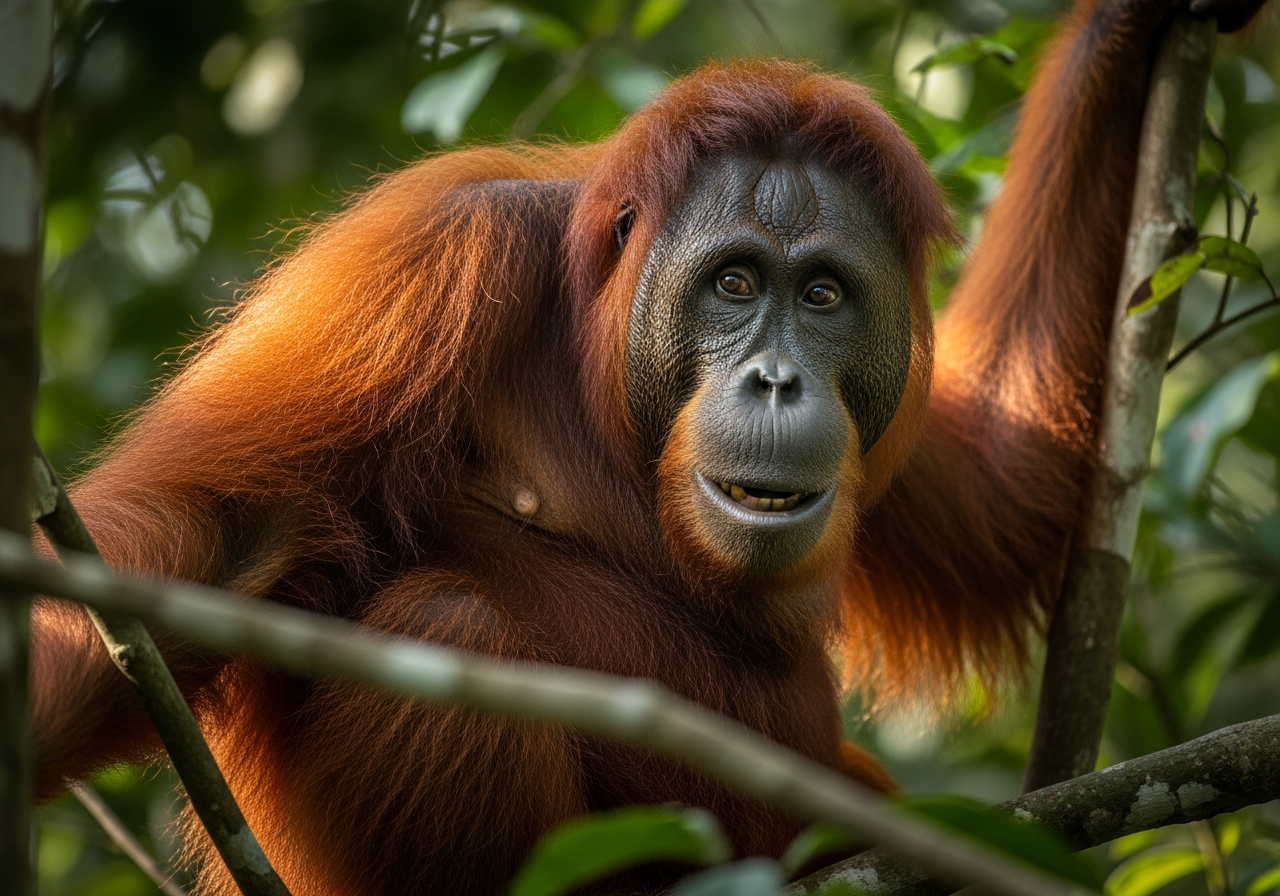
The animal life is correspondingly rich, and much of it is arboreal to the point of never descending. Howler monkeys use prehensile tails as a fifth limb. Toucans and hornbills take fruit from thin outer branches with long bills that let them reach without committing weight. Scarlet macaws crack hard seeds. Orangutans move by clambering rather than leaping, distributing their weight across multiple supports — an approach forced on them by size. Some species have converged on gliding: the flying frogs, lizards, and colugos of Southeast Asia all independently evolved membranes to cross gaps without going down and back up, because descending to the floor is dangerous and expensive.
Canopy fogging studies revealed beetle communities so specialised by tree species that entomologists sharply revised their estimates of global insect diversity upward.
Emergent layer: giants above the roof
Emergents are the individual trees that punch clear of the canopy, sometimes exceeding 60 metres. They are a genuinely different environment: full unfiltered sun, real wind, wide temperature swings, and drying air. Kapok and Brazil nut trees are characteristic.
Height costs a great deal. Water must be lifted the full distance against gravity, and the trunk must resist wind loads the canopy never feels — which is why emergents so often have enormous buttress roots, flaring plates of wood that brace against toppling in shallow soil that offers no deep anchorage.
The pay-off is monopoly on light, plus access to wind. Many emergents are wind-pollinated or wind-dispersed, which only works above the still air below. And large raptors — the harpy eagle in the Neotropics — use emergents as lookouts, watching for monkeys and sloths in the canopy below and dropping onto them.
Why layers matter for conservation
The layering explains why forest damage is worse than it looks from a satellite. Selective logging takes the largest emergents and canopy trees first, because they are worth the most. Canopy cover may still read as forest, but the structure has been decapitated — and the epiphytes, the aerial water bodies, the raptor perches, and the continuous branch network that arboreal animals walk on all go with it. A forest can lose its function while keeping its outline.
Fragmentation attacks from the side. An edge is not neutral: sun and wind penetrate, drying the interior, and the deep-shade microclimate the understory needs retreats inward. Small fragments become edge all the way through.
Both point the same way. Protecting rainforest means protecting three-dimensional structure, not tree count — old growth with a full vertical profile is not interchangeable with young regrowth of the same canopy area. Corridors reconnecting fragments and Indigenous-managed forests, which tend to retain structure, both outperform bare replanting here. A rainforest is less a collection of trees than a stack of habitats, and each one can be lost separately.
Sources
Related reading: What is biodiversity? · Why habitats disappear · Orangutan guide
Frequently asked questions
Which rainforest layer has the most biodiversity?
The canopy — often holding more than half of forest species, including epiphytes, insects, birds, and mammals rarely seen from the ground.
What animals live on the forest floor?
Tapirs, anteaters, leafcutter ants, frogs, and decomposers like fungi and termites — adapted to low light and heavy leaf litter.
What is an epiphyte?
A plant that grows on another plant without being a parasite — orchids and bromeliads in the canopy collect water and nutrients from air and rain.
Why are rainforests called the lungs of the Earth?
They absorb large amounts of CO₂ and produce oxygen through photosynthesis — though oceans and phytoplankton contribute heavily too. Their bigger role may be storing carbon and regulating climate.